Picking the best payment gateway for e-commerce websites in India is a significant process because it directly impacts cart abandonment rates, checkout speeds and profit margins.
As digital transactions surge across metropolitan cities, smaller urban centres and rural regions in India, payment systems must support secure transactions across multiple payment channels, including UPI, credit/debit cards, net banking and Buy Now, Pay Later (BNPL) services.
In India, Razorpay, Cashfree Payments, PayU, CCAvenue and PhonePe Payment Gateway are among the providers that offer payment processing solutions for online businesses. Each offers different features, payment options and pricing structures.
Ahead, the guide discusses the top 10 payment gateways for e-commerce websites in India, comparing their features, charges and payment capabilities to help businesses improve transaction success rates and manage payment processing costs.
Quick Answer:
The best payment gateway for an e-commerce website in India depends on transaction charges, supported payment methods, security, website integration and settlement terms. Popular options include Razorpay, Cashfree Payments, PayU, CCAvenue and PhonePe Payment Gateway. Businesses should compare pricing, UPI and card support, international payments and settlement timelines before choosing a provider.
Key Takeaways
- The top 10 best payment gateways for e-commerce websites in India include Razorpay, Cashfree Payments, PayU, CCAvenue, Paytm, PhonePe, Easebuzz, Instamojo, BillDesk and Stripe India.
- Payment methods, transaction charges, website compatibility, security measures and settlement terms help businesses in comparing different providers.
- Integrating a payment gateway for a business involves merchant verification, API credentials or plugins, checkout testing and activation of live payments.
What Is a Payment Gateway for an E-commerce Website?
A payment gateway for an e-commerce website is a digital service that securely captures, encrypts and transmits a customer’s payment information, such as credit/debit cards, UPI or wallets, to financial institutions for authorisation and funds collection. It acts as a secure digital bridge between your online store and the banking network.
Top 10 Payment Gateways for E-commerce Websites in India
The top 10 picks from the best payment gateways for e-commerce websites in India, based on current industry standards, feature sets, integration options and relevance to online businesses, are discussed below:
1. Razorpay
Razorpay provides online payment processing for websites and mobile applications, while supporting UPI, cards, net banking and EMI options. Its services include payment links, recurring payments, e-commerce integrations and APIs. Through RazorpayX, businesses can also automate vendor payouts and payroll. Razorpay further holds RBI authorisation as a Payment Aggregator–Cross Border (PA-CB), allowing businesses to accept payments in over 130+ global currencies.
2. Cashfree Payments
Cashfree Payments supports UPI, cards, net banking and other domestic payment methods, while holding official licenses from the Reserve Bank of India (RBI) as a Payment Aggregator (PA) and cross-border payment aggregator (PA-CB). Its e-commerce solutions include 1-click checkout, international payment acceptance, automated subscriptions, refund management and fraud monitoring. The merchants can also access instant settlements, subject to approval and applicable terms.
3. PayU
PayU supports over 150 payment methods, which include UPI, cards, net banking, wallets, EMI and Buy Now, Pay Later options. PayU has officially received integrated authorisation from the RBI to operate as a Payment Aggregator. Its services include checkout integrations, risk management capabilities and international payment acceptance in multiple currencies. It also offers payment solutions tailored to direct-to-consumer brands and online retailers.
4. CCAvenue
CCAvenue provides 200+ payment modes, including 6 credit cards, 97+ debit cards, 58+ net banking options, 15 bank EMI options, UPI and 13 prepaid wallets. It supports 27 global currencies, such as USD, GBP, EUR, AED, SAR and SGD, enabling merchants to accept international payments with settlements in Indian rupees. Its features include customised checkout pages, shopping cart integrations, dynamic transaction routing, payment retries, fraud monitoring and transaction reporting.
5. Paytm Payment Gateway
Paytm Payment Gateway service supports more than 100 payment methods, which include UPI, cards, net banking and EMI, alongside various flexible settlement options. Its features include e-commerce integrations, recurring payments, transaction reporting and flexible settlements. Importantly, Paytm Payments Services Limited is a separate entity from Paytm Payments Bank Limited, whose banking licence was formally cancelled by the RBI on 24 April 2026.
6. PhonePe Payment Gateway
PhonePe Payment Gateway supports online payments through UPI, credit and debit cards and net banking. Its solutions include standard checkout, developer APIs, software development kits, e-commerce platform plugins, dynamic QR codes and recurring payments through UPI AutoPay. The merchants can also have access to transaction reports and payment management tools through its centralised dashboard.
7. Easebuzz
Easebuzz provides payment gateway services with 150+ payment options, which include UPI, credit and debit cards, net banking, wallets, EMI and BNPL. Its platform includes API-based integrations, over 100 API plugins, payment links, payment forms, recurring payment collection and automated reconciliation. It also provides solutions for vendor payouts and payment splitting that support businesses with varied online collection and financial operations requirements.
8. Instamojo
Instamojo helps D2C businesses in selling physical and digital products through online stores, Smart Pages and payment links. The customers can pay using UPI, credit and debit cards, net banking and wallets. After the RBI returned its payment aggregator application in September 2023, Instamojo shifted towards store-building and commerce tools, with payment processing handled through licensed payment aggregators. Its other features include inventory management, shipping support, discount tools and sales tracking.
9. BillDesk
BillDesk builds its infrastructure to cater directly to corporations or businesses, financial institutions (banks) and government organisations. Its payment aggregator platform supports more than 150 payment methods, including cards, UPI, net banking, wallets, affordability options and pay-with-points services. The platform offers APIs, integration capabilities, transaction dashboards and infrastructure designed to handle payment processing at scale.
10. Stripe India
Stripe offers payment processing tools, hosted checkout and developer APIs to help businesses accept online payments. Stripe accounts in India are invite-only. Its features include access to over 125 payment methods, one-click checkout and international payments in more than 135 foreign currencies across supported markets. Stripe also uses AI-powered tools, including Radar and Authorisation Boost, to help detect fraud and improve payment authorisation rates.
How to Choose the Best Payment Gateway for Your E-commerce Website?
For a business, selection of a suitable payment gateway should involve comparing the following factors:
Identify Preferred Payment Methods: The business should consider the payment methods customers commonly use, for example, UPI, cards, net banking and wallets. Further, the businesses that operate internationally should check support for foreign cards and currencies, while EMI and Buy Now, Pay Later options may suit higher-value purchases.
Compare Fees and Charges: The fees and charges involved in payment gateways include transaction fees, setup charges, annual maintenance fees and GST on applicable charges. There might also be additional costs for international payments, currency conversion, refunds and chargebacks, which a business should estimate to determine the total cost of processing payments.
Check Website Compatibility: Integration options vary by e-commerce platform. The gateway should integrate with the e-commerce platform of the business through supported plugins, APIs or software development kits (SDKs). Businesses should also compare hosted checkout and API-based integration based on their technical resources and customisation needs.
Review Security and Compliance: Businesses must verify the applicable regulatory authorisations of the provider and review its fraud prevention, authentication and data protection measures. In India, providers must also hold a valid Payment Aggregator (PA) license or authorisation from the RBI. PCI DSS requirements also apply to entities that store, process or transmit payment card data or can affect its security.
Compare Settlements and Support: An e-commerce business should compare settlement schedules, payout conditions, transaction reports and refund handling. They should also check customer support channels and response availability to resolve failed payments, settlement discrepancies, and technical issues without unnecessary delays.
Explore our article on the RBI’s Digital Payments Intelligence Platform to learn more about India’s efforts to strengthen digital payment security and address cyber fraud.
How to Integrate a Payment Gateway Into an E-commerce Website
After selecting the best payment gateway for e-commerce websites in India, a business can connect it to its website through a plugin or a custom integration, using the following steps:
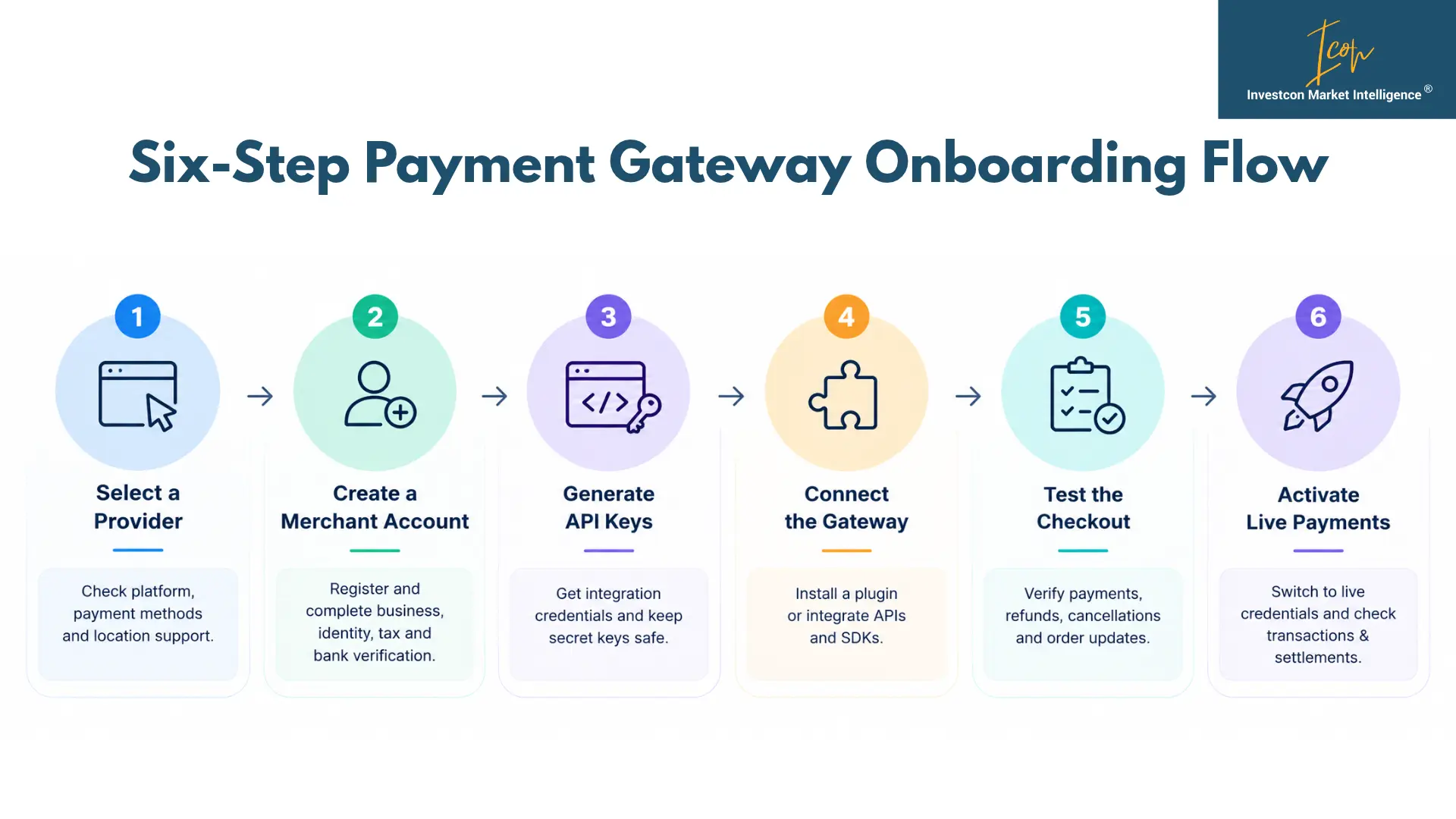
| Step–1 | Select a Provider | Confirm that the provider supports the website platform, required payment methods and business location. |
| Step–2 | Create a Merchant Account | Register the business and submit the required business, identity, tax and bank details for verification. |
| Ste–3 | Generate API Keys | Obtain the required integration credentials from the provider’s dashboard. Keep secret keys confidential. |
| Step–4 | Connect the Gateway | Install an official plugin for platforms or integrate APIs and SDKs for a custom website. |
| Step–5 | Test the Checkout | Test successful and failed payments, cancellations, refunds and order status updates in the provider’s test environment. |
| Step–6 | Activate Live Payments | Switch to live credentials after testing and account approval. Check transactions and settlement records after launch. |
Payment Gateway Charges in India
Payment gateway fees vary by payment method and provider. The following table shows the published domestic pricing of selected providers as of 27 October 2026:
| Payment gateway | Published transaction charges | Setup or maintenance fees |
| Razorpay | 2% per transaction, plus 18% GST on the fee. | No setup fee or annual maintenance charge listed. |
| Cashfree Payments | 1.95% for eligible domestic payments. | Zero setup fee. GST and offer exclusions apply. |
| PayU | 2% for domestic cards, net banking, wallets and BNPL; 3% for EMI, American Express, Diners Club and international transactions. UPI pricing varies by business type and volume. | No setup or annual maintenance fee under the standard plan. |
| CCAvenue | Standard 2% platform fee for online payments plus 18% GST. | Confirm applicable fees directly with CCAvenue. |
| Paytm Payment Gateway | 0% to 3.50% based on the payment method and merchant size | No setup fee or annual maintenance charge. |
| PhonePe Payment Gateway | 1.99%, with a limited-period free offer subject to terms. | Zero setup fee and annual maintenance fee under the listed plan. |
| Easebuzz | 1.5% to 2% across major payment modes. | Confirm the applicable setup and service fees in the commercial proposal. |
| Instamojo | Varies across plans, including Lite, Starter and Growth. | Check the current agreement for any other applicable charges. |
| BillDesk | Standard merchant transaction rates are not clearly published on its official website. | Request a quote based on business and payment requirements. |
| Stripe India | 2% for cards issued in India and 3% for cards issued outside India. | No setup fee or monthly fee under standard pricing. Indian accounts are invite-only. |
Explore our White Papers vs Case Studies article to learn how fintech brands can explain complex processes, including payment reconciliation, to business clients.
Conclusion
Many gateways have hidden costs like PCI compliance fees, chargeback fees, cross-border fees or statement fees that businesses overlook. Finding the best payment gateway for e-commerce websites in India therefore depends entirely on an enterprise’s transaction volume and local customer preferences, such as heavy reliance on UPI.
At Investcon Market Intelligence, we recommend that before committing, businesses must carefully compare full fee structures and payout speeds. Testing the checkout in a trial mode further helps in catching any glitches before the customers do.
FAQs
Q: Can a business accept online payments without a website?
Ans: Yes. Payment links and payment forms allow businesses to collect payments through WhatsApp, email or social media without building a website.
Q: How long does an online payment refund take in India?
Ans: The refund timeline in India can take from an hour to 7 business days to appear, although the timeline varies significantly by the specific payment method used.
Q: What happens if money is deducted but an online order fails?
Ans: Under Reserve Bank of India (RBI) Turnaround Time (TAT) Guidelines, failed UPI merchant payments (person-to-merchant) where your account is debited but confirmation is not received have a mandatory auto-reversal timeline of T+5 days (where T is the transaction date).
Q: Is GST registration compulsory to use a payment gateway?
Ans: No, GST registration is not universally mandatory to use a payment gateway in India. It depends on your business model, turnover and the specific payment gateway’s policy.
Q: Can an e-commerce website offer cash on delivery alongside online payments?
Ans: Yes. Stores offer cash on delivery separately through their checkout and delivery arrangements while using a payment gateway for electronic transactions.

Lakshmi Sundari is a finance content writer and editor with over four years of experience across financial content and content strategy. She holds an MBA in Finance and writes on investing, personal finance and fixed-income markets. Her work spans long-form articles, PR, thought leadership, newsletters and social media, along with editorial planning and content strategy. She focuses on explaining financial developments and investment concepts through research-backed, practical writing.