Summary
- Passive investment involves mimicking the market index performance, while active investment involves surpassing it through skilled stock picking.
- Passive funds usually carry a low expense ratio since there is less portfolio management and fewer transactions involved. However, most people invest using both passive and active funds.
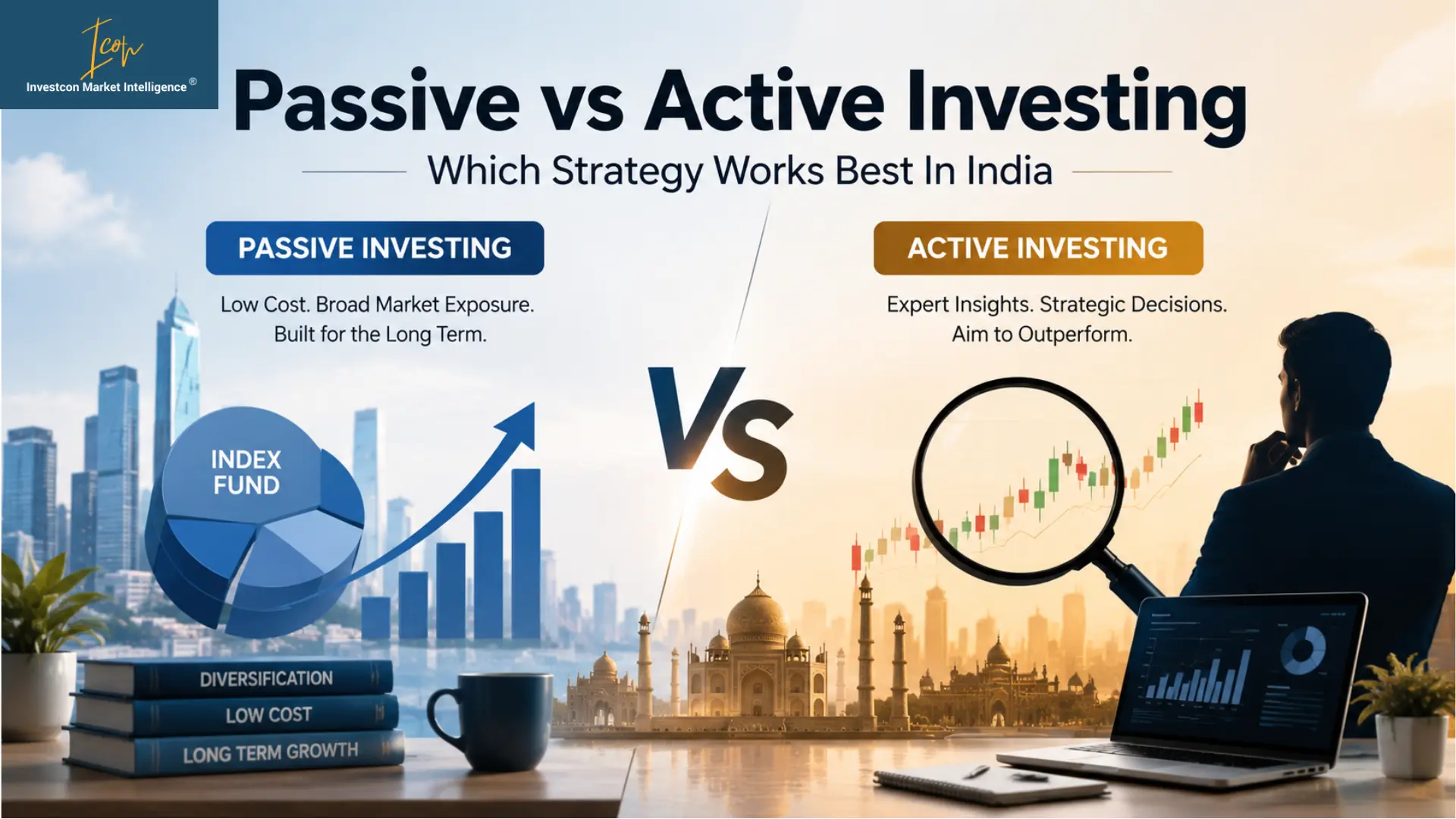
Not every Indian investor needs to use the same strategy. The choice of active or passive approach of investing can depend on various aspects, including their goals, degree of risk they can tolerate, and how much management they would like to incur. In passive investing, they need to match market performance at lower cost, whereas in active investing, it aims to beat the market by actively selecting stocks. Understanding the difference between them will provide insight into which of t he two or a combination of both suits your financial goal.
What is Passive investing?
Passive investing is a form of investing that seeks to duplicate the returns on a market index. The investor does not trade actively but holds investments such as mutual funds or ETFs that are designed to mirror an index. The indices can be the Nifty 50 or the Sensex. There is little trading and minimal management by fund managers, resulting in low expense ratios for passive funds. It is suitable for investors who seek to build wealth in a simple, inexpensive way through market growth.
What is Active investing?
Active investing is an approach where a portfolio manager or an individual investor makes active choices of securities to achieve superior returns compared to a benchmark index. The decisions made are guided by research by the fund managers on company fundamentals, market trends, economic environment, and valuation. The active investment portfolio is periodically evaluated and rebalanced to take advantage of possible opportunities and minimise any risk. This type of investment is more costly because of the involvement of professionals in management and frequent transactions.
Passive vs Active investing
The key differences between passive and active investing are listed below.
| Basis | Passive Investing | Active Investing |
| Objectives | Seeks to replicate the returns of a market index | Aims to outperform the market through investment decisions |
| Portfolio management | Tracks a predefined index with minimal changes | Continuously managed based on market conditions and research |
| Decision making | Follows the index methodology | Depends on the expertise and decisions of the fund manager |
| Risk | Primarily reflects overall market risk | Involves market risk along with the risk of poor investment decisions |
| Return potential | Delivers returns close to the benchmark after expenses | May outperform or underperform the index, depending on the manager’s strategy |
| Tax efficiency | Generally more tax-efficient because of lower portfolio turnover | May generate higher taxable gains due to frequent transactions |
Advantages and Disadvantages of Passive Investing
The advantages and disadvantages of passive investing.
| Advantages | Disadvantages |
| The expense ratio is low because of minimal fund management | Cannot outperform the benchmark index |
| Broad diversification through index-based investment | Fully vulnerable to any market losses in the event of downturns |
| The investment process is simple and does not require much oversight | Not very flexible when it comes to reacting to market changes |
| Ideal tool for creating wealth over the long term | Includes poor-performing stocks if they are part of the index |
| Minimising emotional decision-making | Less opportunity to generate excess returns |
Advantages and Disadvantages of Active Investing
The advantages and disadvantages of active investing are listed below.
| Advantages | Disadvantages |
| Possibility of beating the market through stock selection skills | Higher expense ratios and management fees |
| Flexibility in managing the portfolio according to market conditions | Dependence of performance on the skill of the fund manager |
| Ability to avoid over-valued and weak-performing stocks | There is no assurance of outperforming the benchmark |
| Opportunities to invest in small-cap and mid-cap stock categories | Portfolio turnover could lead to tax liability |
| Professional research and periodic portfolio management | Chances of a higher cost due to trading |
Which Strategy Works Best in Different Market Conditions?
Since the market is said to be dynamic, it changes quite often. And different market conditions do not align with a single strategy. Therefore, fund managers and individuals need to adjust their strategies according to the market conditions.
1. Bull Market: In a bull market, passive investing works well because passive investors can reap the rising markets without engaging in constant transactions. Since all companies are experiencing growth, index mutual funds will still be able to perform and keep the costs low.
2. Bear Market: In a bear market, active investing can provide an edge where managers of such funds minimise their exposure to weak sectors. Even when losses are approaching, active management can help limit the extent of loss.
3. Volatile Market: When the market experiences sudden price movements, active management of mutual funds can involve portfolio management and adjustment in accordance with the changed situation. Passive funds will continue to track the index, disregarding volatility, resulting in higher short-term price movements.
4. Flat market: When the market shows flat or stable behaviour, active investing can take advantage of the situation, as there are undervalued stocks with growth potential. Passive investment is likely to mimic the benchmark’s flat behaviour, resulting in low returns.
5. Mid-cap and Small-cap Markets: Active investing can prove beneficial in mid-cap and small-cap markets, since smaller companies get less analyst attention, thus offering scope for identifying undervalued firms.
6. Wealth building for the future: For long-term investments, a passive investment strategy is a good choice for investors, since it offers a lower cost of investment and continuous exposure to market returns.
7. A Balanced Approach: Rather than opting for one approach over another, investors can consider both active and passive strategies simultaneously. As a result, investors may benefit from lower costs and higher return potential.
Common Mistakes Investors Make While Choosing Between Active and Passive Investing
There are certain mistakes investors make while choosing a strategy and deciding which strategy will efficiently align with their funds and market conditions.
1. Pursuing short-term returns: Investors put money into the same fund only because of its recent performance. However, good performance cannot predict future outcomes, and there is a great likelihood that the leader will change with it.
2. Overlooking the importance of expense ratio: high expense due to high management fees can greatly diminish long-term returns on investment. Therefore, the expense ratio must be taken into account along with performance measures.
3. Selecting a strategy without financial targets: Sometimes, investors choose whether the fund is active or passive based on market trends instead of their own preferences. The strategy must fit the personal characteristics of each investor.
4. Frequently switching between strategies: Switching from one strategy to another due to short-term market changes may decrease profitability. A disciplined long-term approach is more efficient.
5. Assuming that active funds will always be superior: Though active funds tend to perform better than the market, they do not guarantee to always perform above the benchmark. Before investing, investors must consider performance over time, management, and risk-adjusted performance.
6. Assuming passive investing carries no risk: As passive funds track the market, they fall when the entire market declines. Hence, they reduce stock-selection risk, but not market risk.
Should Indian Investors Choose Active or Passive Investing in 2026?
Understand how to decide whether you should invest passively or actively in terms of cost, return, and your risk tolerance level.
1. Choose passive funds for lower costs: For investors seeking exposure to the broader market at low costs, passive investing could be the ideal choice. Passive investing comes in the form of index funds or ETFs, which help diversify investments with a lower expense ratio.
2. Choosing active investing for higher profits: Active investing is suitable for investors willing to take more risk for higher profits. Professional fund managers can recognise potential investments which can be measured using market indices.
3. Evaluate the risk appetite: Conservative investors will opt for passive investing since this strategy tracks the market without changing the portfolio. More aggressive investors could allocate some of their capital to actively managed funds.
4. Consider market segments: Passively-managed funds tend to work well for large-cap investments, while actively-managed funds might have more room for value-added efforts in mid-cap and small-cap segments, based on their stock-selecting efforts.
5. A combination strategy is also an option: Most investors invest passively to gain stable market exposure and also actively to achieve positive alpha returns.
Final Thoughts
There are certain strengths and weaknesses to both active and passive investing. Passive investing is a simple, diversified, and inexpensive strategy for participating in market growth, while active investing offers the potential to outperform the market, using research. However, active investing does not guarantee exceptional returns and generally has higher expenses and dependence on the fund manager.
Instead of looking at passive and active investments as opposite approaches, they can be utilised complementarily. This means that a diversified portfolio consisting of passive and selective active funds can enable the investor to gain benefits from both strategies.
FAQs
1. What is the difference between passive and active investing?
Passive investing aims to match the performance of a market index by investing in index funds or ETFs. Active investing involves fund managers selecting securities to outperform a benchmark index.
2. Which strategy is cheaper?
Passive investing is generally more affordable because it requires limited portfolio management and lower trading activity, resulting in lower expense ratios than actively managed funds.
3. Do active or passive funds perform better in India?
There is no definitive winner. Passive funds often perform well in large-cap segments, while active funds may have greater opportunities to outperform in mid-cap and small-cap categories. Performance also depends on market conditions and fund management.
4. Which strategy carries more risk?
Active investing typically carries higher risk because returns depend on the investment decisions of the fund manager. Passive investing mainly reflects overall market risk but cannot protect investors during broad market declines.
5. Should I choose one over the other?
The choice depends on your investment goals, risk tolerance, and investment horizon. Many investors benefit from combining both strategies, using passive funds for long-term market exposure and active funds to pursue higher return opportunities in specific market segments.