
Since insurance policies need precise communication of exclusions, waiting periods, deductibles, riders, claim conditions, and coverage limitations, they are information-heavy by nature. Content that is full of jargon, exaggerated claims, and more pushes the readers away. Quality insurance article writing services can present insurance information in a reader-friendly manner that builds trust and enables complete comprehension. Insurance content for policyholders must strike a balance between correctness, simplicity, and completeness.
Why Insurance Policy Content Writing Fails
Complex information alone does not make insurance content difficult to read, but a few specific and avoidable mistakes do. Explained here are some of them that good insurance content for policyholders must avoid:
- Industry Jargon Overload: Terms like sum insured, co-payment, grace period, free-look period, etc. are common for insurance professionals, but the common person who is expected to buy the policy might find them difficult to comprehend. If the content contains too much jargon that is not explained, readers will misunderstand their insurance policies or stop reading.
- Information Is Given Without Context: Saying that “this insurance policy contains a 30-day waiting period” may be technically correct. Still, it does not explain the reason for the waiting period or its impact on the claim. While a brochure or policy document can only provide that explanation, blog or video content must explain further.
- Important Information Is Hidden: The information about exclusions, sub-limits, and conditions of claims is usually provided at the end of a long paragraph or buried in FAQ pages. As a result, people who scan the content do not see it and face unexpected difficulties during the claim process.
- Content Is Too Promotional: The problem here is not just the promotional tone of the content. In the attempt to sell an insurance policy, the content turns into empty phrases like “comprehensive coverage for complete peace of mind.” Such phrases lack factual information and fail to gain customer trust.
What Makes Insurance Content Reader-Friendly
There are a few key traits of effective, reader-friendly insurance policy content.
• Clarity Over Complexity: Clarity does not necessarily equal simplicity. The idea is to use words that are easy to understand to explain difficult concepts, provided that the meaning remains appropriate. Writers should organise sentences in a way that enables readers to understand the message in one read-through. The phrase “the policy has a sub-limit on room rent” can be transformed into “the policy sets a maximum daily amount payable for the hospital room.”
• Explain the Consequences: Each element of the insurance policy should be linked to its consequence or result that the reader will see. Instead of a deductible being defined as just a numerical value, it needs to be presented as the amount the customer must pay before the insurance company begins to cover the costs.
• Make Data Scannable: Before beginning a thorough read, the majority of readers just scan to judge its fruitfulness before investing time. Insurance content teams can use trackable headings, bullet points, summary sections, and bold essential phrases.
• Be Specific About Your Restrictions: Restrictions must be explained clearly and truthfully. For example, a phrase like “pre-existing conditions are covered after a 24-month waiting period” is more reliable than the vague assurance of “most conditions are covered.” Content is credible when it is precise, even when it presents unfavourable news.
How to Explain an Insurance Policy Step-by-Step
Insurance policy content writing is consistent, comprehensive, and easy to understand when they follow a repeatable format.
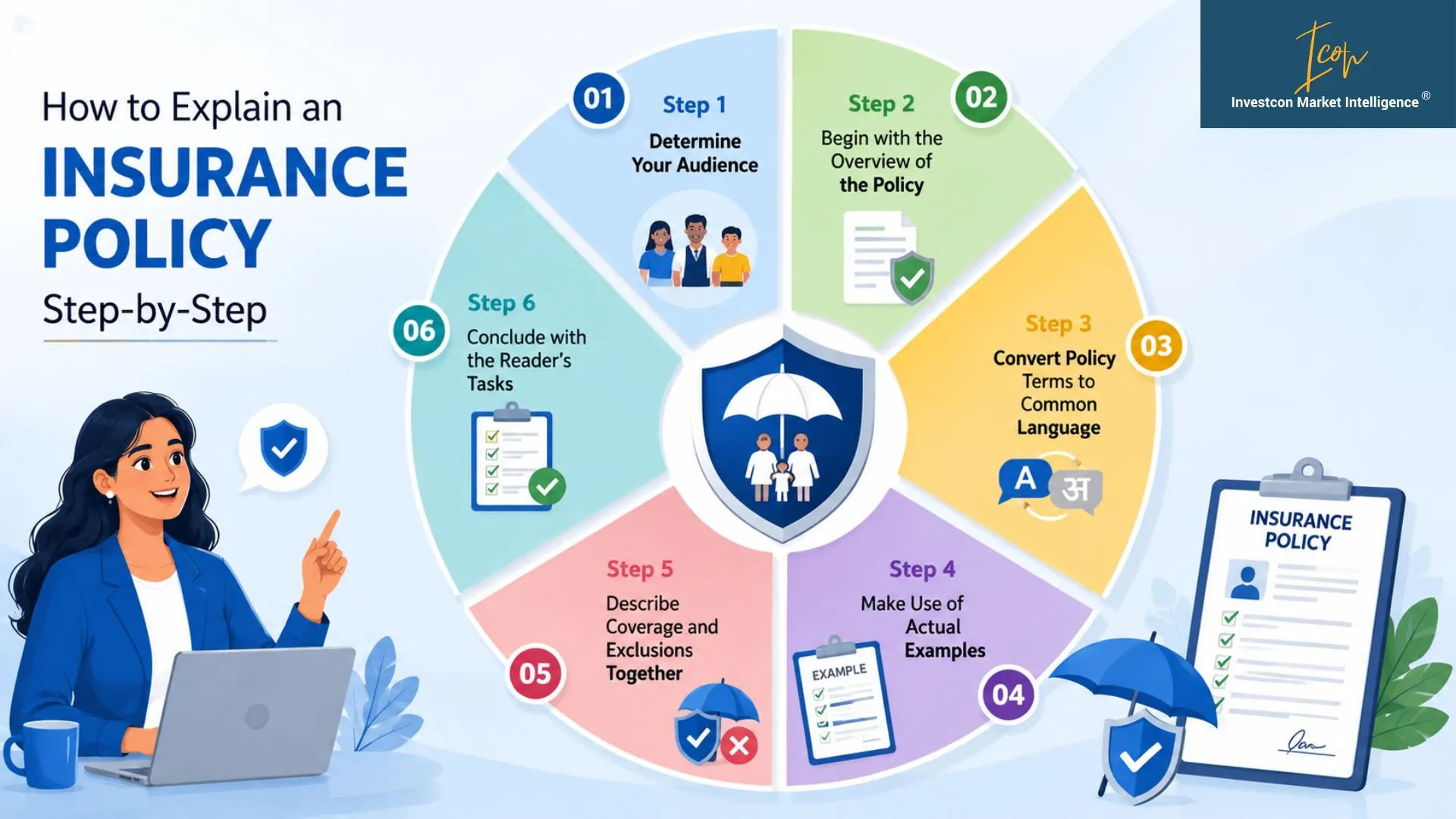
Step 1: Determine Your Audience
Information for an existing policyholder reviewing claim circumstances requires a different level of detail than information for a first-time prospective holder investigating insurance terms. Determine the reader’s level of knowledge and the decision they are attempting to make before you begin writing. It helps curate content that helps readers.
Step 2: Begin with the Overview of the Policy
Inform the reader as to what the policy is fundamentally about, who the policy targets, and what its overall scope covers before you get into the nitty-gritty details. This might put things into context for you.
Step 3: Convert Policy Terms to Common Language
All technical terms must be rendered in plain English without loss of meaning. For instance, ex gratia payment may be defined as “payment made by an insurer as a gesture of goodwill without being bound by the requirements of the policy.”
Step 4: Make Use of Actual Examples
Illustrations help make abstract ideas practical. Instead of saying “co-pay applies to senior citizens,” show this: when a senior citizen is insured under a policy and is hospitalised for treatment worth ₹1,00,000 with 20% co-payment, he would have to pay ₹20,000, while the insurance company pays the rest ₹80,000.
Step 5: Describe Coverage and Exclusions Together
A distorted impression results from presenting what is covered without promptly pointing out what isn’t. Readers are better able to construct an accurate picture as they proceed when coverage and its pertinent exclusion are paired in the same section rather than being pushed into a separate list.
Step 6: Conclude with the Reader’s Tasks
Optimal insurance content ends with action that a reader must take to secure a policy, such as how to submit a claim, which paperwork to have on hand, or what circumstances call for a renewal review. This transforms a Call-to-Action (CTA) into factual and quality information.
Content Framework for Explaining Complex Insurance Terms
In case one phrase or term requires an in-depth understanding, a uniform four-step process helps to organise the information provided into a coherent and complete content:
| Definition | Explain the meaning of the term |
| Explanation | Give any further detail or explanation crucial for complete comprehension |
| Example | Give real-life situations to illustrate it better |
| Implication | Discuss the relevance of the term for the policy owner |
Aligning Content With Different User Needs
All insurance articles are not meant to perform the same function. A reader-friendly insurance policy content for existing and future clients corresponds to the stage of the consumer’s decision-making process.
|
Content Type |
Goal |
| Educational | Educate and build an initial knowledge base. It gives a reader information about insurance products in general without any direct connection to any particular product. This is the starting point for a potential client. |
| Comparative | Helps the reader compare various alternatives using specific criteria like premium, coverage limit, claim settlement ratio, etc., to help informed decision-making. |
| Policy Explainer | Unlike a comparative piece, it explains a particular policy in greater detail via its terms, features, exclusions and more. |
| Decision-oriented | This type of content is the closest to conversion. It answers the remaining questions of the consumer about the application process, charges, etc. |
Bottomline
When insurance policy content writing does the interpretative labour that the reader would otherwise have to accomplish on their own, it can be successful in converting readers into policyholders. Effective insurance content for policyholders organises, translates, and contextualises information rather than eliminating it. Consistently investing in this, whether through a professional insurance article writing agency, helps brands develop the type of trust that results in fewer claim disputes and increased policyholder retention. Investcon houses expert finance content writers who can translate complex policy points into easy-to-comprehend content pieces. Visit Investcon today.
Key Highlights
- Insurance policy content can be difficult to comprehend due to its information-dense nature.
- Insurance content writing must avoid jargon, explain complicated concepts, and avoid exaggerated claims.
FAQs
1. How long should an insurance policy explainer article be?
There is no set word count. It will depend on the length of the policy itself. The more complex the policy, the more words there may be in the explanation. One policy term explanation may be 300 to 500 words, and a full policy explanation could be 2,000 or more words long.
2. Should insurance content be reviewed by legal or compliance teams before publishing?
Yes, because simplification of policy language alters the meaning. It is possible to change the meaning of a claim condition or exclusion simply by altering the wording a little. A compliance check is done to confirm that the simplified wording still reflects the policy wording.
3. How is writing for insurance different from other financial content?
The subject matter of insurance involves conditional occurrences. Policies are based on certain conditions, time frames, and exclusions, not fixed figures such as rates or fees. Thus, accuracy in terms of “applicability” becomes very important in insurance writing compared to other types of finance writing.

- 2 Bar Reversal Indicator - August 31, 2026
- Insurance Content Writing: How to Explain Policies Without Losing Readers - August 17, 2026
- Why Every Wealth Management Firm Needs an Industry Report (Not Just a Blog) - August 12, 2026