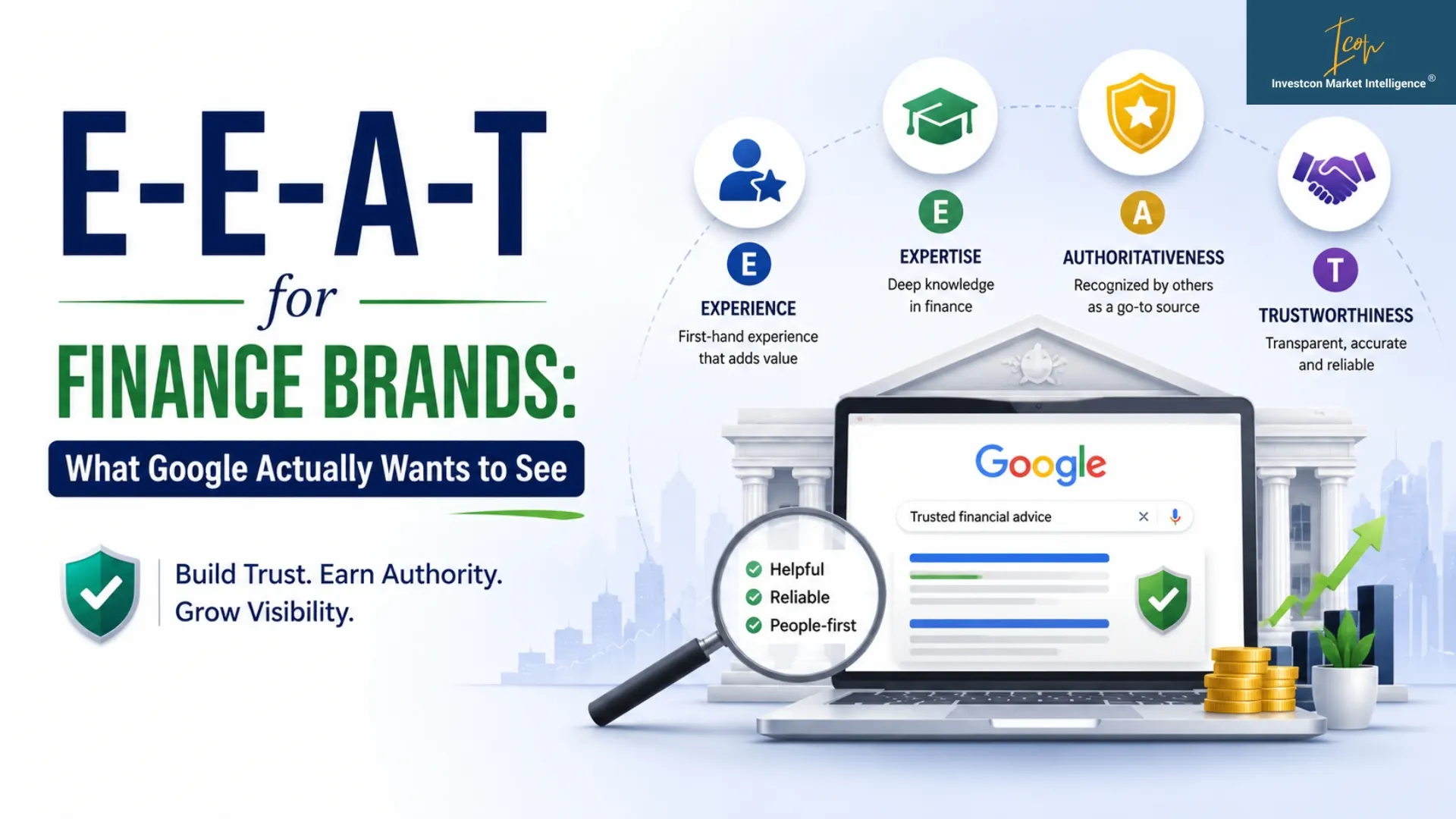
What is E-E-A-T
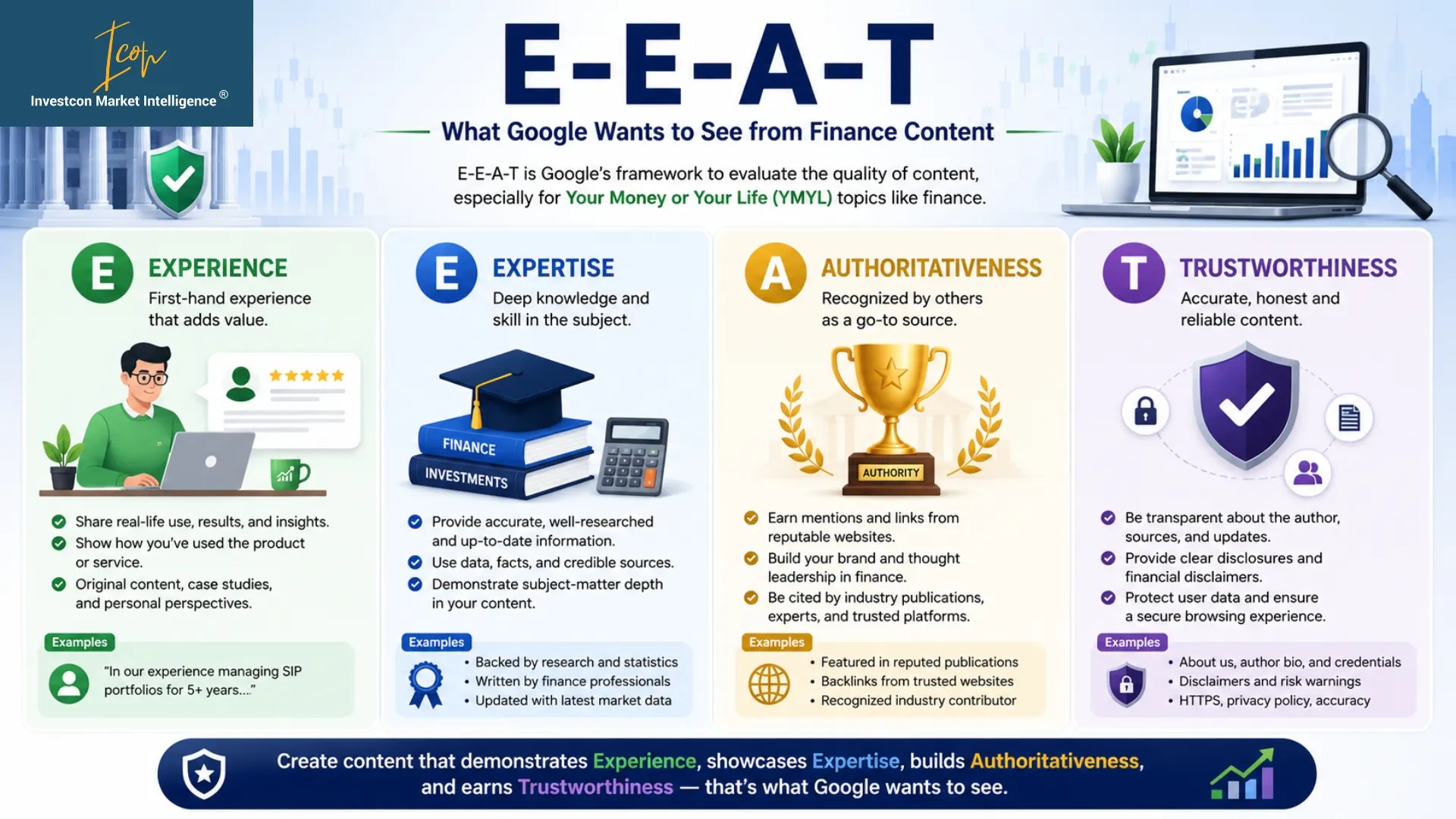
The acronym E-E-A-T represents Experience, Expertise, Authoritativeness, and Trustworthiness. It is one of the principles in Google’s quality evaluation guidelines, used to determine the credibility and accuracy of content, particularly in YMYL sectors such as finance. It is important to apply the Google E-E-A-T guidelines correctly and understand that all four factors are separate entities.
- Experience
The writer of the blog must demonstrate their experience of the subject matter. An experienced take, backed by data, is preferred over recycled content.
- Expertise
The information presented on the site or in the blog post should demonstrate genuine financial expertise. The writer’s knowledge, skills, and credentials demonstrate their expertise in this domain.
- Authority
The wider industry reputation of the author or website plays a crucial role. Established backlinks from reliable websites help build this authoritativeness.
- Trustworthiness
It gauges a website’s authenticity, transparency, and accuracy. The use of correct vocabulary, accurate calculations, up-to-date tax laws, etc., demonstrates the blog’s trustworthiness.
Why E-E-A-T Matters More in Finance Than Other Industries
Finance blogs are part of YMYL, as misinformation of any kind can result in real losses, such as financial losses, fines, lost opportunities, or becoming a target for scams. Therefore, Google expects finance content to have a higher level of credibility than entertainment content.
This is true for almost all finance categories, like:
- Mutual Funds
- Stock investments
- Taxes
- Loans
- Credit Cards
- Insurance
- Retirement
In the case of blogs in these categories, finance brand authority and credibility become as important as keyword optimisation.
What Google Looks for in Finance Brands
Below are the parameters Google uses to judge finance content.
1. Demonstrate real financial experience:
General tips such as diversifying an investment portfolio and setting aside emergency funds have become oversaturated on the internet. Therefore, finance brands require specificity, as explained below:
- Practical examples based on actual situations
- Walkthroughs, like how to open a demat account, how to file ITR, etc.
- Investment comparisons using actual numbers
- Actual screenshots of the platform or statement
- Calculations rather than estimations
- Case studies based on actual results
- Personal observations, when appropriate
Personal experience implies that the content was not just compiled from other articles, but the author actually dealt with the product, operation, or process described.
2. Showcase qualified authors
Readers would like to know the author behind the content before believing it. Information about the content team builds trust. The following content additions about the author can help this case:
- Author bios for every article
- Accreditation/qualifications (CFA, CA, CFP, SEBI registered investment advisor)
- Background knowledge in finance
- LinkedIn profile links
- Editorial contributors and reviewers named
Professional expertise isn’t necessarily limited to those with accreditation. A founder or practitioner with extensive experience could also be considered.
3. Build authority beyond the website
Authority is built via backlinks, meaning when another website or blog quotes your content. It shows that other credible finance sites trust your content:
- Links from trusted and relevant websites
- Mentions in trusted financial publications
- Guest posts on industry websites
- Interviews with experts and expert quotes
- Lectures and speaking engagements
- Research reports
- Mentions from other trusted sources
Authority cannot be created through SEO; authority is built via citations from credible finance sites.
4. Make every claim verifiable
Each statistical data point, ratio, or regulation should have its origin in a primary source from credible organisations, such as the RBI, SEBI, the Income Tax Department, the Ministry of Finance, company annual reports, or audited financial statements. Direct linking to primary sources, frequent refreshing of statistical data points, and deleting claims without any verifiable source is crucial for finance content strategy.
5. Keep financial content updated
Finance is a dynamic subject that keeps changing. Blog content should be updated based on changes to tax slabs after the budget, the RBI’s repo rate declaration, new laws or regulations, etc. Old information disrupts search rankings and affects the brand’s credibility.
6. Have strong editorial standards
Every credible finance site should have an editorial review process, not just content writing. High-ranking sites usually have a process that includes both creation and review. The following are must-haves to help your content showcase expertise and authority.
- Editorial review process
- Fact-checking before publication
- Compliance review for regulatory issues
- A stated corrections policy
- A stated conflict-of-interest policy
- Correctly labelled sponsored content
An editorial process gives readers confidence that the article was thoroughly vetted and not simply rushed to publication for rankings.
Common E-E-A-T Mistakes
Here are some common mistakes that your financial content must avoid:
- Anonymously publishing articles without an author’s name
- Posting AI-created content without any expert verification
- Begging the reader by making monetary promises
- Failing to update out-of-date information about taxes or investments
- Forgetting to cite sources for percentages and figures
- Posting comparison articles without analysis
- Posting for the sake of a keyword rather than to answer a real user query
How E-E-A-T Fits Into Strong Financial Content Strategy
E-E-A-T is not distinct from SEO. E-E-A-T is the basis upon which an effective financial content strategy is developed. It includes topical expertise, content clustering, authoritative reviews, regular updates, reliable citations, explanations first, and transparent authorship. Technical SEO optimisation helps a page get noticed by the Google algorithm, but credibility built via E-E-A-T helps retain audience attention.
A Practical Checklist for Finance Brands
Here is a practical content checklist to ensure that your content follows the Google E-E-A-T guidelines:
- An author bio
- Expert check to ensure accuracy
- Includes current statistics
- Includes primary sources to substantiate claims and data
- The financial information is correct
- Proper disclosures for risks, promotions, etc.
- Includes visual aids, like tables and illustrations
- Contains original insights, not a revamp of existing articles
- Simple language is used
Bottomline
E-E-A-T in content writing is not a trick that you can use; rather, it reflects the true level of the reliability of finance content. When a brand puts in the effort to provide real experiences, author expertise, authority, verified claims, etc., it not only improves its Google ranking but also increases audience satisfaction. With extensive industry experience, finance writers at Investcon are equipped to curate data-backed, easy-to-understand finance content. Visit Investcon today!
Key Highlights
- E-E-A-T is a quality framework, not a direct ranking factor, but it shapes how content is evaluated
- Real experience, credentialed authors, and third-party citations matter extensively
- Outdated statistics and unverifiable claims can cause a loss of credibility
FAQs
1. Is E-E-A-T the same as YMYL?
No. Your Money or Your Life (YMYL) is a category of topics Google treats with extra caution because inaccurate content can cause real-world harm. E-E-A-T is the framework used to judge whether content in those categories is trustworthy enough to show to users.
2. Does E-E-A-T only apply to large financial institutions?
No. Independent advisors, small fintech startups, and individual finance bloggers are evaluated the same way, using E-E-A-T. A smaller brand with genuine credentials and real experience can outrank a larger one that skips these basics.
3. How often should finance content be reviewed?
Finance content should be reviewed at least once a year, and immediately after any regulatory change, like a Budget announcement, a repo rate revision, or updated SEBI or income tax rules, that affects what’s already published.

- 2 Bar Reversal Indicator - August 31, 2026
- Insurance Content Writing: How to Explain Policies Without Losing Readers - August 17, 2026
- Why Every Wealth Management Firm Needs an Industry Report (Not Just a Blog) - August 12, 2026