
Mutual fund performance and fund metrics are clear quantitative metrics that determine investability. However, a mutual fund house needs to build an optimal investment content strategy to communicate their offerings to prospective investors and settle user queries across different stages of their investment strategy. Educational, transparent, and consistent mutual fund content marketing helps increase investor trust, reduce uncertainty, and enable investment.
Why Gaining Investor Trust Matters More Than Ever Now
Today, investors have a range of assets and issuers at their disposal, making content a crucial aspect of positioning one asset as a better fit. It helps gain trust, without which investors won’t invest. Discussed below are different reasons why trust building matters more today:
- Investors have more choices than before
Several Asset Management Companies (AMCs) exist today, offering a range of schemes. All of them compete for the same investor attention and trust. When products look similar on paper, performance alone stops being a differentiator. The credibility of a fund house influences investors’ fund selection. In such a scenario, communication through content becomes a key trust-building avenue.
- Financial products require confidence: Unlike a consumer product, a mutual fund can’t be tested before purchase. However, any investment decision bears significant impact. If an investment goes wrong, it can lead to severe financial loss. Therefore, trust built through demonstrated competence, transparency, and an understanding of investor concerns is crucial.
Why Content Builds Trust
Mutual fund content marketing sets a communication channel that helps build trust.
- It educates before it sells: Mutual fund content clarifies topics like SIPs, expense ratios, and risk categories. Thereby, demonstrating that the fund house values investor comprehension above quick sales. When there is volatility, an investor who is aware of what they are purchasing is far less likely to panic-exit and much more likely to stick with the AMC that helped them comprehend it.
- It creates consistent investor engagement: Trust cannot be established without consistency. Regular blogs, newsletters, and videos keep a fund house accessible to the investor in between transactions, and not only during onboarding or a market downturn. It reassures investors that the fund house is actively managing their money and is still reachable when they have questions.
- It improves transparency: Investors trust fund houses that invest in mutual fund investor education and explain the fund performance in different market scenarios. Rather than only disclosing performance highlights, a fund house should reveal hidden information about fees, risks, exit loads, and previous scheme modifications.
How to Build an Investment Content Strategy that Builds Trust
Explained here is a step-by-step guide on building a mutual fund content marketing strategy.
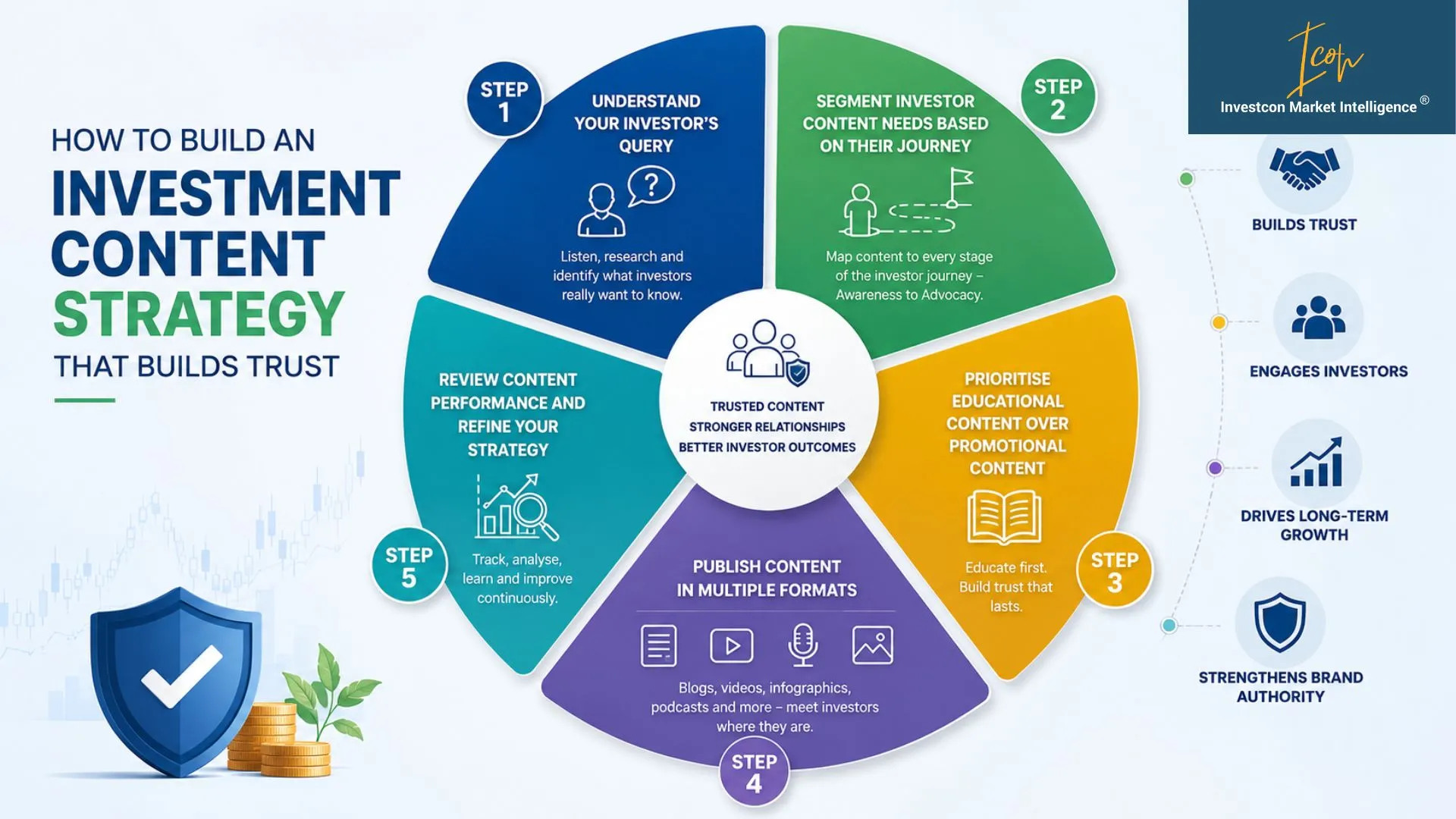
Step 1: Understand your investor’s query
Before curating content, find out what investors are genuinely inquiring about through distributor feedback, social media remarks, support ticket topics, and keyword analysis. The majority of fund houses prioritise ranking over solving actual investor concerns. However, genuinely prospective investors are more likely to engage with content that serves them. Therefore, the content calendar should be built around actual query gaps rather than hypothetical ones.
Step 2: Segment investor content needs based on their journey
Different investors want different kinds of information depending upon where they are in their investment journey. A brand must curate content targeting each stage of their investor’s journey. This can help target both beginner and seasoned investors.
- Awareness: This is the first stage of the investor journey, where they want to educate themselves before choosing. In this case, mutual fund basics, financial literacy explainers, and beginner guides to how mutual funds work are common topics.
- Consideration: In this stage, the investor compares the different investment options available to them before investing. The objective should be to facilitate comparison and position the brand’s products as a viable option, without exaggerating. Common topics include fund category comparisons, risk-return trade-offs, and SIP calculators to model outcomes.
- Investment: Once an investor has already decided to invest, the content should simplify the process and remove any hindrance. Account opening walkthroughs, KYC process guides, and first investment tutorials are common topic blocks in this category.
- Holding Period: It is crucial not to stop communicating with the audience once the investment is made. Content around market updates, portfolio review guidance, and FAQs on statements and redemptions help direct investors.
- Long-Term Investors: Investors staying invested for long require more detailed and targeted content that addresses their own unique queries. For example: goal tracking tools, rebalancing guidance, tax planning content, retirement-focused planning, etc.
Step 3: Prioritise educational content over promotional content
A constant sales pitch in content that does not deliver any value pushes prospective audience out of the investor’s portal. Instead, a brand that curates educational content that actually explains the nuances of mutual fund investing and helps investors make better investment decisions has a higher chance of converting its content audience to investors.
Step 4: Publish content in multiple formats
Different investors consume information in different media formats. Therefore, a brand must try to deliver a single message via various channels, like blogs, video content, live webinars, interviews, newsletters, etc.
Step 5: Review content performance and refine your strategy
Traffic and page views help measure the reach of content but not the trust it generates. To assess if investor confidence is being increased by the content, monitor:
- Returning guests
- Subscriptions to newsletters
- Attendance at webinars
- The mean duration of engagement
- Questions from investors
- Recurring investments
- SIP continuation rates
Since these trust measures indicate behaviour rather than just exposure, they are more significant than vanity metrics. An SIP calculator that investors bookmark and return to on a monthly basis has gained confidence, whereas a popular blog that no one returns to has not. Examine this data every three months and modify the content mix according to what encourages recurring interaction rather than one-time clicks.
Best Practices for Mutual Fund Content Marketing
The following guidelines help create content that generates trust:
- Focus on Educating More than Promoting: Always start with the question of the investor rather than with the product. Promote only occasionally and exceptionally.
- Make Risks Clear: Do not hide risks behind disclaimers. Talking about the risk next to the potential return demonstrates integrity and transparency.
- Keep the Language Simple: The first-time investor must be able to read the blog post without constantly switching tabs to look for meanings of financial jargon.
- Consistency across All Channels: The blog post, newsletter, and reel on the same issue must have the same facts and style.
Bottomline
Trust isn’t an outcome that happens after good content; it’s built through the accumulation of every explainer, newsletter, and webinar an investor interacts with over time. Fund houses that treat content as an ongoing education function, rather than a lead-generation tactic, end up with more informed investors who stay invested longer and refer others. In a market where products and returns look increasingly alike, mutual fund content marketing is one of the few differentiators a fund house can fully control.
Highlights
- Not only return highlights, but also trust in the fund house drives investment decisions in the mutual fund market.
- Content should educate first and promote second to aid investor interest and gain trust.
- Track trust metrics, like returning visitors, SIP continuation, and repeat investment, over vanity metrics like pageviews.
FAQs
1. How often should a mutual fund house publish new content to build trust?
Consistency matters more than volume. A mutual fund house should make a realistic content schedule that they can follow, rather than sporadic high-volume periods.
2. Should mutual fund content be created in-house or outsourced?
Most fund houses use a hybrid model: in-house teams or fund managers handle technical accuracy and compliance sign-off, while content specialists handle structure, SEO, and format adaptation.
3. How does regulatory compliance affect mutual fund content marketing?
SEBI’s advertising norms require standard risk disclaimers and restrict misleading return projections or claims that past performance predicts future results. This limits promotional overreach, not educational content. Content that stays educational rather than promissory rarely runs into compliance friction, which is another reason education-first content performs better long-term.

- 2 Bar Reversal Indicator - August 31, 2026
- Insurance Content Writing: How to Explain Policies Without Losing Readers - August 17, 2026
- Why Every Wealth Management Firm Needs an Industry Report (Not Just a Blog) - August 12, 2026