
Blogs can answer queries that investors already enter into Google search. It might be helpful but remains generic, with each rival curating content around the same keywords. This is where a wealth management industry report comes in. It becomes an authority-building and lead-generating tool based on unique data, polls, or market analysis, around which blogs and other content pieces can be made. This article explains why financial industry reports by wealth management firms perform better than regular blogs in terms of reputation, distinction, backlinks, and leads, such that businesses can create one to optimise their content game.
What is a Wealth Management Industry Report
A wealth management industry report is a stand-alone research tool that addresses a particular query on investor behaviour or market trends. It may be based on private client data, unique surveys, or a thorough synthesis of reliable external datasets. It is intended to be the main source that publishers, advisers, and journalists cite. It is positioned as a downloadable brand asset rather than just another page in a blog archive. It usually has an executive summary, a methodology section, and data visualisations.
The table below differentiates between wealth management industry reports and blogs.
| Parameter | Blog | Wealth Management Industry Report |
| Primary goal | Answer specific investor questions | Establish authority and generate leads |
| Content basis | Curated based on secondary information | Original data, surveys, or proprietary analysis |
| Shelf life | Needs frequent updates to stay relevant | Different types of content can be created over longer tenure using it |
| Distinctiveness | Easy to replicate | Hard to replicate |
| Backlink potential | Low to moderate | High |
| Production effort | Low, fast turnaround | High, but reusable for longer |
6 Reasons Why Wealth Management Firms Should Publish Industry Reports
Discussed here are the benefits a wealth management firm can anticipate if they publish an industry report:
- Build authority: A brand ceases to sound like every other advising blog publisher and begins to sound like an authoritative source when it releases original data, such as a poll of 500 HNI investors on changes in asset allocation. Unlike a well-written explanation, a wealth-management industry report based on original research provides journalists and advisers with something to cite by name.
- Differentiate from generic financial content: Blog content is built around keywords, resulting in generic content across different competitor platforms. The foundation of financial business reports is a company’s own data and analysis, which is hard to replicate. Differentiation of a report focuses on what the company truly understands that others don’t, rather than tone of voice.
- Visibility through high-quality backlinks: Journalists link to statistics and not generic explainers or opinion pieces. Writers have something tangible to mention when a report has novel figures. When credible platforms and journalists cite wealth management insights with hyperlinks, visibility of the brand publishing the report increases.
- Turn research into qualified leads: A blog is often free, which is beneficial for top-of-funnel traffic but seldom reveals to a business who is reading. A report can be partially gated such that the complete report requires an email and a few qualifying details, but the executive summary remains public for SEO and shareability. This transforms a content asset into a lead list.
- Months of content from one report: A single report can result in a range of different content types. A blog post, an infographic, a LinkedIn carousel, or a press pitch may be created from each data point or finding of a report. Businesses that use the report as a starting point rather than a final result can produce content for several months with far less research expenditure.
What Should a Wealth Management Industry Report Include
Listed below are different aspects a wealth management report must have:
- A clearly defined research question: Before gathering information, formulate a precise, manageable query, such as “how are Gen Z investors allocating their first ₹1 lakh?” rather than a broad topic like “the state of wealth management in India”. Compared to a broad industry overview, a specific query yields crisper, more citable results.
- Original and credible data: This distinguishes an actual Wealth Management Industry Report from a summary piece. Data can be accessed through a commissioned poll, a thorough synthesis of AMFI, SEBI, or RBI datasets with new research built on top, or the firm’s own clientele (anonymised suitably). Reusing someone else’s data without adding your own interpretation is a summary rather than a report.
- Expert interpretation: Interpretation establishes authority, not raw data. For example, the firm’s perspective on the reasons behind the 22% increase in SIP inflows from Tier-2 cities and its implications for allocation strategy are more valuable. Additionally, this is where the company’s positioning becomes apparent.
- Actionable takeaways: Each section concludes with something the reader can do. The statement “Investors should reconsider XX allocation given this shift” does more than just restating the data. Press and advisors are more likely to take up reports that have reader takeaways on how to use the data.
- Strong visualisation: Plain tables are rarely used in news stories and PowerPoint decks; instead, charts and infographics are often cited. Additionally, the report is easier to scan with clear, labelled images, which is important because most readers evaluate it based on the executive summary and important graphics before continuing to read.
How to Turn an Industry Report Into a Content Engine
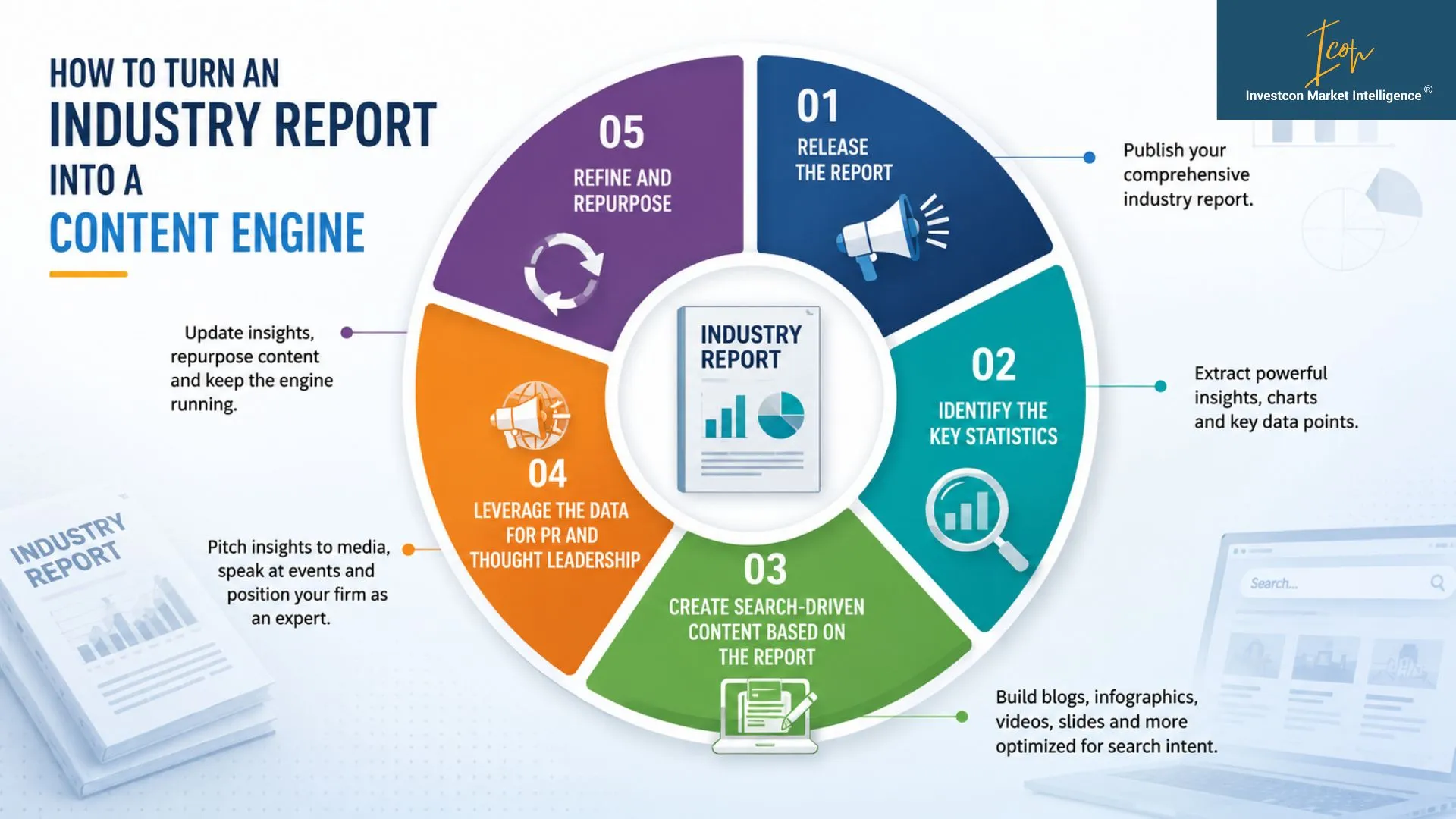
Follow the steps below to turn an industry report into a foundation that creates several distinct content verticals.
Step 1: Release the Report
Either publish the whole report as a downloadable PDF or put together an entire webpage about the report. The landing page must carry an SEO-optimised summary and the downloadable PDF link for lead generation.
Step 2: Identify the Key Statistics
Identify the five to eight most relevant statistics or findings of the report that can help investors. These become the foundation for all other content repurposing.
Step 3: Create Search-Driven Content Based on the Report
Turn each statistic into a separate blog post, reel, LinkedIn post, etc., based on keywords or an optimised search query. A statistic regarding retirement savings can serve as the basis of a blog on “how much do you need to save for retirement?”.
Step 4: Leverage the Data for PR and Thought Leadership
Send out the most newsworthy statistic to financial journalists and newsletters with a senior company official ready to do interviews. The report with real data is more newsworthy than the generic company news.
Step 5: Refine and Repurpose
Update your report once a year or every two years using fresh data, and document how your research question has evolved. Your second and third editions will create a trend that is even more citation-worthy than the first.
How to Create a High-Impact Wealth Management Industry Report
A concise five-step framework:
- Spot an information gap: Identify the question asked by investors, advisors, or journalists that is not answered comprehensively by any current reports.
- State the particulars: Define the research question and target audience accurately so that data gathering can be done efficiently instead of trying to answer everything.
- Research: Collecting and validating the data can be done through the company’s internal client information (after permission), a commissioned survey, or a thorough compilation of publicly available datasets of RBI, SEBI, AMFI, etc.
- Translating the results into a story: Numbers do not create authority; only the right interpretation of the results can do so.
- Distribution: Finalising the distribution and repurposing strategy before publishing the report to have a proper launch strategy and content calendar ready is crucial.
Bottomline
Industry reports and blogs are not competitive formats; rather, they address distinct issues. By responding to queries that investors already enter into Google, a blog generates consistent search traffic. A wealth management industry report generates unique citations, gated leads, and a reputation for analytical depth that peers can’t match by crafting a better-optimised piece. Businesses that use the report as the cornerstone and distribute it through blogs, PR, and social media gain more out of each study cycle than those that publish either format separately.
Key Highlights
- A wealth management industry report builds authority through original data that competitors can’t replicate.
- Reports generate high-quality backlinks, PR opportunities, and gated leads that blogs typically can’t.
- One report can be repurposed into months of blog posts, social content, and press pitches.
FAQs
1. How often should a wealth management firm publish an industry report?
Most firms get the best return from an annual or biannual report. It is frequent enough to build a trend line across editions, resulting in citations. However, it is spaced out enough to gather meaningful new data cost-effectively.
2. Can a smaller or boutique wealth management firm produce a credible report without a large research team?
Yes. Scale matters less than data quality and a narrow research question. A boutique firm can commission a focused survey of a few hundred clients rather than attempting an industry-wide study; a small, well-executed report often earns more citations than a broad, thin one.
3. How is the success of an industry report measured, beyond downloads?
Track referring domains and backlinks earned, qualified leads captured through the gated download, media mentions, and whether findings get reused in relationship manager sales conversations. Download count alone understates a report’s real impact on authority and pipeline.

- 2 Bar Reversal Indicator - August 31, 2026
- Insurance Content Writing: How to Explain Policies Without Losing Readers - August 17, 2026
- Why Every Wealth Management Firm Needs an Industry Report (Not Just a Blog) - August 12, 2026