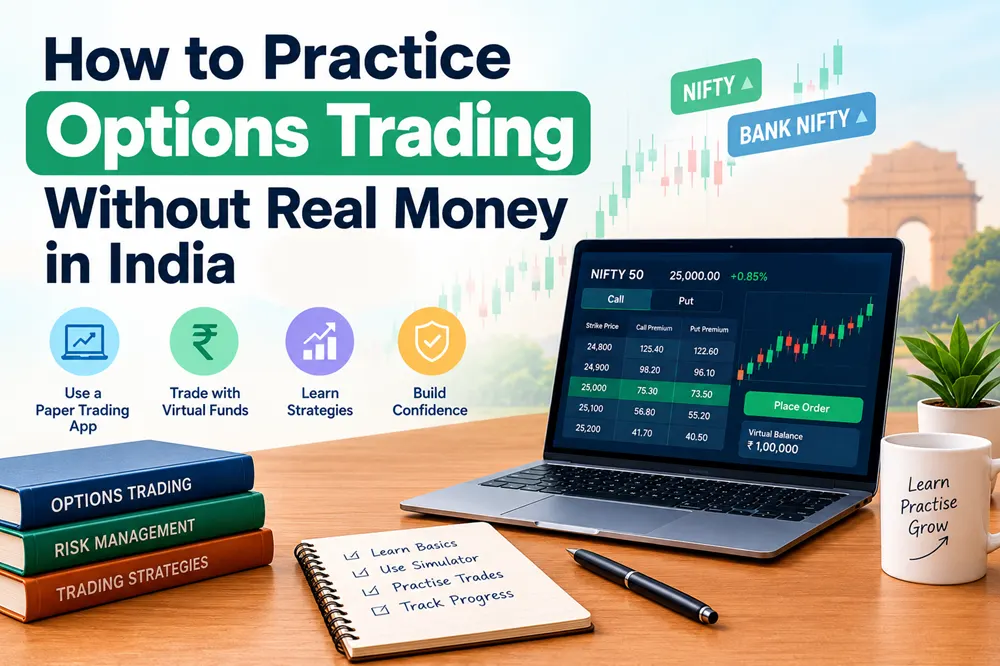
Options trading attracts beginners, but it involves risks that should be understood before investing real money. Learning about calls, puts, strike prices, premiums, and expiry dates takes time. Options paper trading lets you practise strategies with virtual funds instead of risking your savings.
This guide explains how to practise options trading without real money in India, choose a simulator, and build safer learning habits.
Quick Answer:
Options paper trading in India lets beginners practise calls, puts, and trading strategies using virtual money without risking real savings. Choose a simulator that supports NIFTY or BANK NIFTY options, practise risk management, and track trades in a journal. Remember, simulated profits do not guarantee success in live markets.
Key Takeaways
- Options paper trading lets beginners practise trading with virtual money without risking real savings.
- Choose a simulator that supports Indian options contracts, virtual funds, simulated orders, and trade history.
- Follow risk management rules, maintain a trading journal, and remember that simulated profits do not guarantee real-market success.
What Is Options Paper Trading?
Options paper trading is a simulated method of practising trades with virtual money. A simulator lets you observe prices, place hypothetical orders, and track potential profits or losses without executing real transactions.
For example, suppose you expect NIFTY to rise. You select a call option and record its premium. If the premium increases, your virtual position may show a profit; if it falls, it may show a loss. These results help you learn, but they do not guarantee similar outcomes in live markets.
How to Practise Options Trading Without Real Money?
1. Learn the Basics
Understand these essential terms before opening a simulator:
- Call option: Gives the buyer the right, but not the obligation, to buy the underlying asset at a specified strike price.
- Put option: Gives the buyer the right, but not the obligation, to sell the underlying asset at a specified strike price.
- Strike price: The price specified in an options contract.
- Premium: The price paid by an option buyer.
- Expiry date: The date on which the contract expires.
2. Choose a Suitable Paper Trading App
Find a paper trading app that supports Indian market instruments and the options contracts you want to practise. Check for:
- NIFTY or BANK NIFTY options.
- Live or clearly labelled delayed market data.
- Virtual funds and simulated orders.
- An options chain with strike prices and expiry dates.
- Trade history and performance reports.
- Stop-loss and target features, where available.
- Clear information about free and paid features.
3. Set Up Your Virtual Account
Many simulators provide virtual funds after registration. Choose a balance that encourages realistic decisions, and avoid taking unusually large positions simply because the money is not real. Virtual funds cannot be withdrawn as profits.
4. Place a Simulated Trade
Choose NIFTY or BANK NIFTY if your simulator supports it. Review the options chain, compare strike prices, and note the premium and expiry before entering a trade.
Suppose an option has a hypothetical premium of ₹100 and a lot size of 50 units. Its premium value is ₹100 × 50, or ₹5,000. If the premium rises to ₹120, the gross simulated profit is ₹1,000. If it falls to ₹80, the gross simulated loss is ₹1,000.
5. Practise Risk Management
Before each simulated trade, define your entry, target, stop-loss, and position size. Write down why you are entering and what conditions would make you exit. This routine encourages discipline and helps prevent impulsive decisions.
6. Keep a Trading Journal
Record the date, instrument, strike price, expiry, entry and exit premiums, reason for entry, and final result. Note whether you followed your plan.
Review your journal carefully. You may discover that you enter too late, ignore time decay, or exit without following your rules. Focus on improving decisions rather than simply increasing virtual profits.
Choosing a Free Paper Trading App in India
A free paper trading app India beginners consider should provide learning features and explain its limitations. Compare platforms using this checklist:
| Feature | What to Check |
| Market coverage | Supports your preferred options contracts |
| Market data | Identifies live, delayed, or simulated prices |
| Virtual funds | Provides a practice balance |
| Order types | Offers useful simulated orders |
| Trade history | Lets you review previous trades |
| Trading costs | Helps account for applicable charges |
| Pricing | Explains free and paid features |
What Can You Learn in a Simulator?
Practise calls and puts, compare in-the-money and out-of-the-money options, and observe how premiums respond to changes in the underlying market. Study time decay, which generally reduces an option’s time value as expiry approaches, all else being equal.
Common Mistakes to Avoid
Avoid these common mistakes:
- Ignoring costs: Brokerage, taxes, and other charges can reduce returns.
- Taking excessive risks: Use realistic position sizes rather than enormous virtual trades.
- Ignoring expiry: Options can lose value as expiry approaches.
- Changing strategies constantly: Test consistent rules before evaluating results.
- Assuming profits prove skill: A few winning trades do not establish a reliable strategy.
- Ignoring market conditions: Results vary with volatility, liquidity, and market direction.
Frequently Asked Questions
Can I practise options trading without real money in India?
Yes. You can use a simulator to place virtual trades and observe hypothetical profits and losses without executing real transactions.
Is paper trading free?
Some platforms provide free access or limited free features, while others charge for advanced functionality. Check the current pricing before registering.
Can I practise NIFTY and BANK NIFTY options?
Yes, if your selected simulator supports these instruments and provides the relevant contract details.
Does paper trading guarantee profits?
No. Simulated performance does not guarantee future results. Live trading involves financial risk, transaction costs, and execution conditions that may differ from those in a simulator.
Conclusion
Options paper trading helps beginners learn about the Indian derivatives market without risking capital on simulated trades. Start with the basics, choose a suitable simulator, practise one instrument at a time, and keep a detailed trading journal. Review decisions across different market conditions instead of focusing only on virtual profits.
Paper trading is a learning tool, not a promise of success. Before considering real trades, understand the risks, your financial circumstances, and the possibility of losing money.

Raksha is a BBA LL.B. graduate specialising in Corporate Law from Delhi, with over six years of experience in financial writing. She specialises in financial markets, investments, mutual funds, taxation and personal finance. With a strong foundation in legal research and a keen eye for detail, she focuses on translating complex financial concepts into accurate, accessible and engaging content.