India’s largest IPO till date, the Reliance Jio Platforms IPO, listed at ₹1,358.00/share on BSE and NSE on 28 October 2026, securing a 21.36% premium. The Jio Platforms IPO share price was set at ₹1,119.00/share.
Its ₹30,213 crore issue size attracted over 1.38 crore applications and was fully subscribed within 100 minutes of opening. At the end of the third day, the IPO was subscribed 22.19 times.
Jio, whose telecom business serves over 53 crore (530 million) customers, has become one of India’s largest companies by market capitalisation with this listing.
Even so, its listing is about more than the opening-day gain. Since its entry in the telecom industry in 2016, Reliance Jio brought a complete change to mobile data pricing, intensified competition and accelerated India towards a shift in digital services.
The current question is: What’s next? What does this massive influx of cash mean for Jio’s next big moves in technology? Read ahead to uncover!
Quick Answer:
Jio Platforms listed at ₹1,358 per share on 28 October 2026, a 21.36% premium over its ₹1,119 issue price. The ₹30,213 crore IPO was subscribed 22.19 times. Future growth could depend on 5G, broadband, enterprise technology and AI services.
Key Takeaways
- Jio Platforms debuted at ₹1,358.00/share, a 21.36% premium over its issue price, marking a major telecom market milestone.
- Jio’s low-cost data plans and free voice calls changed pricing practices and pushed the industry players to re-evaluate their business models.
- The future growth of Jio could come from its 5G, home broadband, enterprise technology, AI services and satellite connectivity.
- The higher 5G usage and broadband adoption could support the company’s revenue growth, but profitability will depend on costs, customer spending and demand.
Reliance Jio Platforms IPO: Listing Details
The following table summarises the key details of the Jio Platforms IPO share price, listing performance, issue size and subscription figures:
| Listing date | 28 October 2026 |
| IPO issue price | ₹1,119.00 |
| Jio IPO listing price | ₹1,358.00 |
| Listing premium | 21.36% |
| Subscription (in times) | 22.19 times |
| Total issue size (₹ crore) | ₹30,213 crore (19,75,25,934 shares) |
| Total bids received | 4,38,44,11,932 shares |
| Total bids received at Cut-off price | 35,70,75,564 shares |
| Jio IPO price band valuation | ₹1,065.00 to ₹1,119.00 |
| Lot size | 12 shares |
Explore our guide on how to evaluate a mainboard IPO before investing to understand the factors investors should assess beyond listing gains.
How Jio Changed the Indian Telecom Industry Game
The average cost of wireless data fell from ₹308.00/GB in 2014 to ₹7.51/GB in 2026. One of the major factors for this shift was Jio.
In September 2016, when Jio launched its commercial services, free voice calls and low-cost data plans disrupted established pricing models. The competitors had to respond and make mobile internet more accessible as part of everyday life.
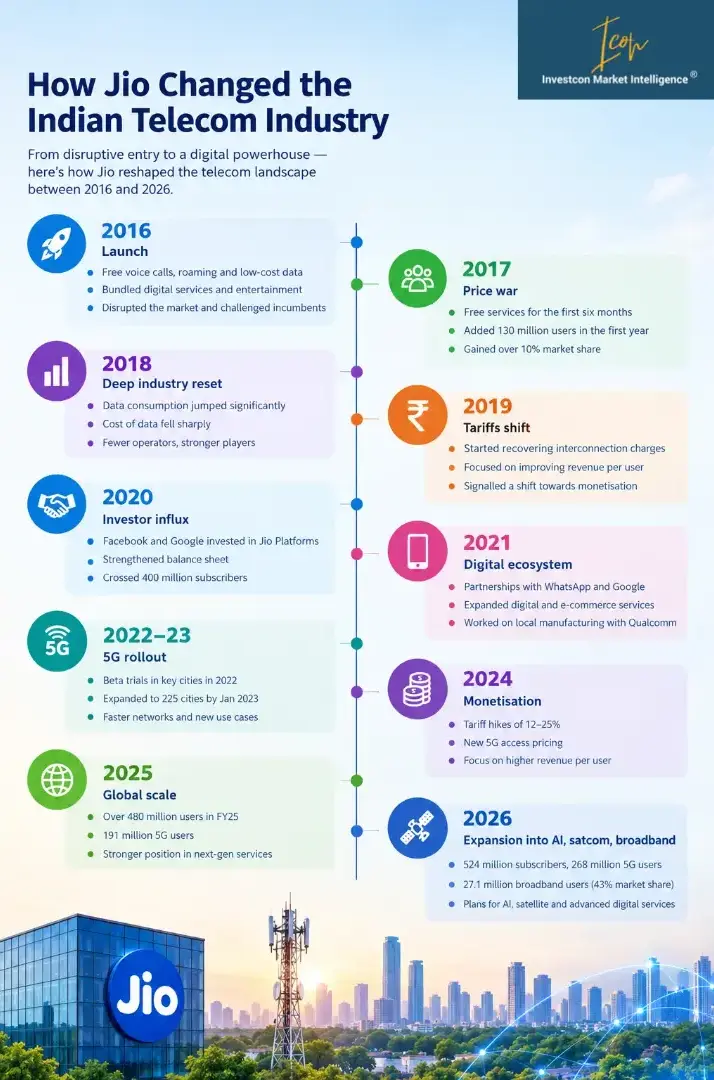
Here are some key game-changing strategies that Jio implemented to bring about change in the telecom industry:
- 4G-only network: Back when competitors used to rely heavily on the legacy 2G and 3G infrastructure, Jio built an all-IP, 4G-only nationwide network from day one.
- Free calls and data at launch: Its free voice calls, free SMS and free high-speed data for months quickly attracted millions of users and dismantled the old pricing models.
- Shift from voice to data: It changed the fundamental rule of the game from charging per minute for voice calls to charging specifically for data megabytes/gigabytes, which made voice calls technically free.
- Massive industry consolidation: The aggressive price war forced multiple smaller telecom operators out of business or into mergers.
For example, Vodafone-Idea merged into Vi, while competitors like Aircel, Telenor and RCom exited or folded. This left the market to just a few major players like Jio, Airtel and BSNL.
- Rapid subscriber growth: Jio had over 524.4 million subscribers as of March 2026, with 268.5 million 5G users, which makes it a dominant market leader.
Jio Platforms vs Bharti Airtel: Market Capitalisation and 5G Reach
This aggressive disruption completely restructured the financial ranks of Indian telecom. The Jio Platforms IPO effectively replaced Bharti Airtel in market capitalisation, to take up the second-most valuable listed company in India at the opening of trading on 28 October 2026.
| Metric | Jio Platforms | Bharti Airtel |
| Market capitalisation at listing | ₹12.50 lakh crore | ₹12.15 lakh crore |
| Rank by market capitalisation | 2nd | 3rd |
| 5G subscriber base | 268.5 million | 296.8 million |
Where Jio’s Next Growth Could Come From
Jio Platforms’ future growth could come from an expansion beyond mobile connectivity and earning more from its existing network. Its priorities include 5G services, home broadband, enterprise technology and artificial intelligence (AI).
These opportunities could influence the long-term outlook for the Jio Telecom share price. However, future returns will depend on earnings growth, investment needs and market valuation.
5G Services and Higher Revenue per User:
With 268.5 million 5G customers, Jio can develop premium connectivity plans and services that encourage users to spend more. The challenge is to turn growing 5G usage into higher revenue without relying only on tariff increases.
Home Broadband Expansion:
By March 2026, the company had 27.1 million JioFiber and JioAirFiber subscribers. The AirFiber can bring broadband to homes where laying fibre is difficult or expensive. Jio’s ability to add customers while maintaining its service quality and controlling installation costs will be important for profitable growth.
Enterprise Technology and Cloud Services:
Jio is expanding its offerings for businesses through private 5G networks, cloud computing, managed connectivity, cybersecurity and Internet of Things (IoT) solutions. These services could help it to generate revenue from businesses apart from basic telecom connections, including small and medium-sized enterprises.
Artificial Intelligence and Digital Services:
It is further positioning AI as a part of its consumer and business services. This includes personalised digital experiences and AI-enabled enterprise solutions. However, while the company’s large customer base and network infrastructure could support these offerings, commercial demand and their contribution to profits are key factors to watch for.
Explore our analysis of Reliance Industries’ AI and green energy expansion to learn more about the group’s technology ambitions.
Satellite Connectivity and International Markets:
Reliance has also explored satellite-based connectivity and opportunities to take Jio’s technology to overseas markets through partnerships. These could expand its reach over the conventional mobile networks. But again, regulatory approvals, investment requirements and commercial viability will impact their progress.
Conclusion
Jio moves from a pure telecom operator to a monetisation-led digital powerhouse to provide the conglomerate multi-industry leverage, adding a longer-term growth dimension to the Jio Platforms IPO share price outlook. As Jio expands its 5G network, AI services and digital business, it could create more sources of income.
In fact, Jio Platforms’ growth projections could also influence how investors view the wider Reliance group, keeping the Jio Finance share price target 2030 in focus as Jio Financial Services expands its lending and asset management businesses.
Ultimately, sustaining growth will depend on execution, profitability and the ability to turn these opportunities into lasting shareholder value.
FAQs
Q: How can I check Jio Platforms’ share price after listing?
Ans: You can check the latest share price through the BSE and NSE websites, your brokerage trading platform or financial market websites.
Q: What factors could affect Jio Platforms’ share price in the future?
Ans: The factors such as revenue growth, average revenue per user, subscriber additions, 5G adoption, capital expenditure, competition and overall market conditions could affect its share price.
Q: How does Jio Platforms make money apart from mobile services?
Ans: Jio Platforms earns revenue through digital services, home broadband, enterprise connectivity and related technology offerings. The contribution of each business depends on its commercial performance.
Q: What is the difference between Jio Platforms and Jio Financial Services?
Ans: Jio Platforms focuses on digital technology and connectivity businesses, while Jio Financial Services operates in financial services, including lending, payments and asset management.
Q: How could 5G expansion affect Jio’s future earnings?
Ans: Jio’s 5G expansion could support premium plans, greater data usage and enterprise services. However, returns will depend on customer demand, network costs and the revenue generated from these services.
References
- Chittorgarh – Jio Platforms IPO Details
- Reuters – Jio Platforms’ Market Debut
- The Indian Express – Jio’s Market Debut and Airtel Comparison
- Press Information Bureau – Telecom Industry Data

Lakshmi Sundari is a finance content writer and editor with over four years of experience across financial content and content strategy. She holds an MBA in Finance and writes on investing, personal finance and fixed-income markets. Her work spans long-form articles, PR, thought leadership, newsletters and social media, along with editorial planning and content strategy. She focuses on explaining financial developments and investment concepts through research-backed, practical writing.