When we say “IPO” in day to day conversation, it usually means a mainboard IPO: the large, well-covered issues that make business headlines, get anchor investors, and fill your broker app’s home screen. In these IPOs, a first-time applicant, a mutual fund, and a foreign institution can all place their bid during the same window.
That visibility is also the risk. Because a mainboard IPO is so widely discussed, it’s easy to assume someone else has done the checking. Usually, nobody has done it for your money, at your price, over your time horizon. This guide shows you how to do that yourself, in a sensible order.
Quick Answer:
A mainboard IPO is a public issue by a company that gets listed on the main platform of NSE or BSE, unlike companies listed on SME platforms. To evaluate one, look at the business model, revenue, profit, and cash flow for the last three years, the valuation compared to listed peers, how the money will be used, the risk factors mentioned in the DRHP/RHP, and subscription data. Treat GMP as a sentiment signal only.
Key Takeaways
- Understand the company’s business model and growth potential.
- Check financial performance, debt, and cash flow.
- Compare IPO valuation with listed peers and review risk factors.
- Use GMP and subscription data as supporting indicators, not the sole basis for investment decisions.
What Is a Mainboard IPO?
A “Mainboard IPO”, (or Initial Public Offering), is when a company goes public and gets listed on the main trading segment of the National Stock Exchange (NSE) or Bombay Stock Exchange (BSE). Once listed, its shares trade alongside the large and mid-sized companies that make up the benchmark indices’ wider universe.
Mainboard issuers need to meet the eligibility rules that are set by SEBI, including track-record and net-worth requirements. They also need to file a “Draft Red Herring Prospectus” (DRHP) with SEBI for review before going ahead. The final “Red Herring Prospectus” (RHP) includes details such as the price band, issue dates, and lot size.
In practical terms, mainboard IPOs are usually bigger, more widely held after listing and more closely followed by analysts as compared to SME issues. That doesn’t make them safe. It just means more information and more buyers and sellers around.
Mainboard IPO vs SME IPO
| Factor | Mainboard IPO | SME IPO |
| Where it lists | Main platform of NSE/BSE | NSE Emerge / BSE SME |
| Company size | Generally larger | Generally smaller |
| Liquidity | Generally higher | Can be thin |
| Who participates | Retail, HNIs and institutions | Different participation structure, with larger lot sizes |
| Minimum retail ticket | Roughly ₹14,000–₹15,000 per lot | Usually ₹1 lakh or more |
| Price swings after listing | Can be sharp, but usually deeper market | Can be extreme when few buyers are active |
The difference that matters most to you is what happens on the day you want to sell. In a mainboard stock, there is generally a bid under the price. In an SME stock, a handful of sellers can leave you without buyers. Check the latest SEBI and exchange rules for each segment, since SME norms in particular have been tightened in recent years.
To see which mainboard issues are open or coming soon, with dates, price bands and issue sizes, check https://maliktimes.in/mainboard-ipo/ and then go to the prospectus.
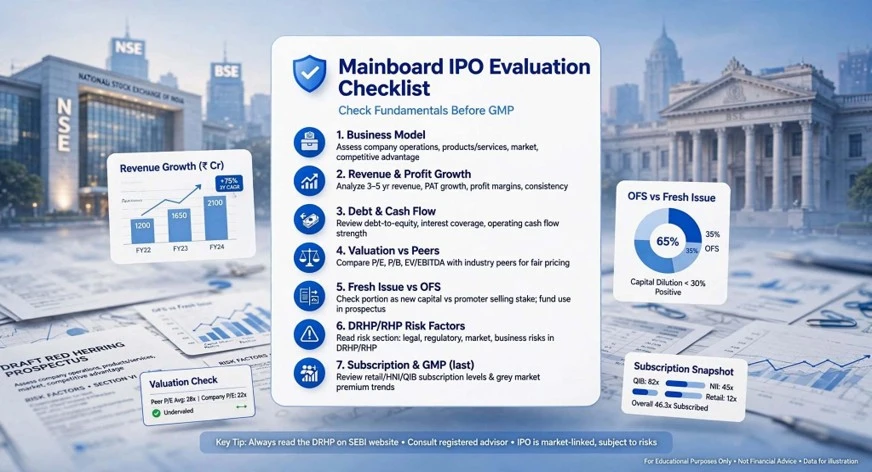
7 Factors to Check Before Investing in a Mainboard IPO
1. The Company’s Business Model
First of all, write down in two sentences how the company actually makes money. Never focus on what it “enables” or “empowers” , just explain who pays whom and what they are paying for.
Then test how durable that income is. Do a few large customers dominate sales? Is revenue repeat or project-based? Whether the business rely on a licence, subsidy, or government pricing? Plus, what could stop a competitor from copying the model in the next few years?
The industry prospectus usually has quotes from a report that the company has paid for. This can be used for market size and definitions, not for judgement.
2. Revenue and Profit Growth
Second, you must consider three full years along with the latest stub period, and focus on the overall trend, not just the last number.
Be wary of a “pre-IPO surge,” where growth jumps sharply in the final year before filing. It could be real. And, it could also be a one-time order, a change in accounting treatment, or a push to look good for the issue. For this, you have to make sure that profit is growing with revenue and that margins are holding. If revenue rises while margins fall, it usually means either the growth is being bought with discounts or there is heavy spending.
3. Debt and Cash Flow
Two checks do most of the work here.
Debt: Look at the debt-to-equity ratio and how many times operating profit covers interest. A company that barely covers its interest has little room for a slow quarter.
Cash flow: You can compare profit after tax with cash flow from operations, year by year. Suppose a company reporting profits of ₹40 crore, ₹55 crore and ₹70 crore, but operating cash flow of ₹5 crore, negative ₹10 crore and ₹12 crore (hypothetical figures). The profit is sitting in unpaid customer bills or unsold stock. That may be collectible, but the prospectus should explain why it hasn’t been collected in three years.
4. IPO Valuation and Price Band
A good company at a high price can still be a poor investment. Start with the market capitalisation at the upper end of the price band. The RHP discloses the P/E at that level.
Then build your own peer list. The prospectus names “listed peers,” but companies naturally choose comparisons that flatter them. Find two or three listed businesses with a similar product mix and size, and compare multiples. In the case of “loss-making or early-stage” companies, you can use price-to-sales or EV/EBITDA. Plus, consider when they’re likely to become profitable.
Let’s understand with this example.
An issue asks for 45 times earnings while comparable listed companies trade at 25 to 30 times. To justify a premium of that size, it should be growing much faster or earning clearly better returns on capital. If its numbers look like the peers’, you are paying extra for the IPO label.
5. Fresh Issue vs Offer for Sale
Open the “Objects of the Issue” section and split the issue into three:
- Fresh issue, where money goes into the company
- Offer for sale (OFS), where money goes to the selling shareholders
- Use of the fresh issue, such as expansion, debt repayment or general corporate purposes
If OFS dominates, find out who is selling and how much of their holding they’re selling. A founder trimming a small stake is a very different signal from a fund exiting most of its position.
On use of funds, specifics inspire more confidence than slogans. “A 50,000-tonne plant in Gujarat, completion by March 2028” is checkable. “Strengthening market position” is not. Also note that SEBI caps general corporate purposes at 25% of the fresh issue, so a figure near that cap means the company has told you little about its plans.
6. DRHP/RHP and Risk Factors
You don’t need to read 400 pages. These sections catch most problems:
- Litigation: cases against the company, promoters and directors, especially tax disputes and any amount large relative to net worth
- Customer and supplier concentration
- Related-party transactions: business with companies owned by the promoter’s family
- Promoter holding: before and after the IPO, plus any pledged shares
- Auditor’s remarks: qualifications or “emphasis of matter” notes
- Risk factors: the first ten usually matter most
If one of these bothers you, that is enough reason to skip. Another issue will come along.
7. Subscription and GMP
Subscription data is published through the bidding window. It shows who is turning up, and I’ll cover it in more detail below.
GMP, stands for “Grey Market Premium”, is basically the unofficial price at which IPO shares are traded before listing. It can change quickly, and shows short-term market interest rather than the quality of the business. That’s why you should check it last and treat it as a mood indicator.
Why Institutional Participation Matters
A mainboard IPO is split among investor categories, and each tells you something different.
QIBs (or “Qualified Institutional Buyers”) include mutual funds, insurers and foreign institutions. They usually bid on the final day. Strong QIB demand suggests professional analysts liked the numbers, though they are not infallible.
NIIs (non-institutional investors) are HNIs and corporates. They often bid late and heavily, which can swing the headline subscription number, so don’t judge an issue on day one.
Retail investors can bid up to ₹2 lakh per application. This segment tends to reflect public enthusiasm more than analysis.
You should also look at the anchor investor list, announced a day before the issue opens. Anchors invest at the issue price and are subject to a lock-in, so a roster of long-term funds is a fair positive signal.
The caution: heavy oversubscription shows demand, not fair pricing. Plenty of issues subscribed many times over have listed flat or below the issue price. Read subscription alongside valuation, never instead of it.
Should You Invest in Every Mainboard IPO?

No, and this may be the most underrated decision in IPO investing.
Each issue is a separate bet with its own mix of valuation, business quality, growth and risk. A better question than “Is this a good company?” is “Is this a good price for what I’m getting?” An excellent business at an aggressive valuation can leave you waiting years for the earnings to catch up. A merely decent business at a sensible price can be a perfectly good holding.
Skipping an IPO costs nothing. Applying to a weak one costs you the money and the chance to use it elsewhere.
Common Mainboard IPO Investment Mistakes
Buying because of hype. If your only source is a Reel or a Telegram post, someone has a reason to promote the issue.
Looking only at GMP. It is a rumour with a number attached.
Ignoring valuation. Good company and good IPO are different things; the price decides which one you own.
Ignoring debt. Rising borrowings behind flat profits is a warning, not a footnote.
Not reading company disclosures. The risks are in the document. Nobody hides them; they just expect you not to look.
A 15-Minute Screen Before You Apply
- First of all, read the opening of “Our Business” and note down how the company earns.
- After that, you should check its revenue, profit & operating cash flow for the last three years.
- Then, calculate the “P/E” at the upper band and compare it with two or three listed peers.
- Check the fresh issue vs OFS split and the top three uses of funds.
- Scan the litigation table and promoter details.
Only if it passes should you look at anchors, subscription and GMP.
How to Track the Latest Mainboard IPOs
Good evaluation needs early notice. Track:
- IPO dates: opening, closing, allotment and listing
- Price band and lot size
- Issue size and the fresh issue/OFS split
- GMP and subscription updates, read after you’ve checked fundamentals
- Official sources: the DRHP and RHP on SEBI’s website and lead managers’ sites, plus NSE and BSE notices
For a running list of mainboard issues with their dates, price bands and issue sizes, you can check https://maliktimes.in/mainboard-ipo/. If you really want to see what’s coming next, you can find upcoming mainboard and SME issues together on https://maliktimes.in/upcoming-ipo/. It’s ideal to always cross-check dates and price bands with the RHP, as they can change.
Common Mistakes Investors Make
Following the hype: If your only source is a Reel or a Telegram channel, remember that someone has a reason to promote the issue.
Reading GMP as a promise: It is a rumour with a number attached.
Ignoring valuation: “Good company” and “good IPO” are different statements, and the price decides which one you have.
Skipping risk factors: Nobody hides the bad news. They just expect you not to read it.
Calling a trade an investment: If you plan to sell on listing day, be honest that this is speculation and size the bet accordingly.
Applying to everything: You don’t have to. Skipping a weak IPO costs you nothing, and applying to one costs you the money and the opportunity to use it elsewhere.
A 15-Minute Screen Before You Apply
If you have limited time, this order gets you to a decision fast:
- Read the first page of “Our Business” and write down how the company earns money.
- Check revenue, profit and operating cash flow for three years.
- Find the P/E at the upper band and compare it with two or three listed peers.
- Check the fresh issue vs OFS split and the top three uses of proceeds.
- Scan the litigation table and promoter details.
If it passes, then look at anchors and subscription. If it fails at any step, move on.
How to Track Upcoming IPOs
You need early notice to do the above. The sources worth using:
- An IPO calendar: An upcoming IPO calendar lets investors track expected issues, important dates and other IPO-related developments in one place, so you aren’t reading a prospectus the night before the issue closes.
- DRHP and RHP filings: Available on SEBI’s website and on lead managers’ sites. The DRHP often appears weeks or months before the issue, which gives you time.
- Exchange notices: NSE and BSE publish issue details, subscription status and allotment information.
- Company announcements: Press releases and investor pages, read alongside the prospectus.
Cross-check any date or price band you see on a third-party site against these. They get revised, and the official documents are the final word.
Conclusion
Now we can conclude this by saying that a mainboard IPO is easier to research than most, because the disclosures are detailed and there are enough peers to compare.
The work is actually doing it:
- understand the business,
- test the numbers,
- price it against peers, and
- read what could go wrong.
One question has filtered out more weak applications than any ratio: would I be comfortable owning this company at this price if the stock went nowhere for a year? If yes, you’re investing. If it only works with a listing-day jump, you’re guessing.
Frequently Asked Questions
Q: How do I analyse an upcoming IPO in India?
Ans: Read the business section of the DRHP or RHP, check minimum three years of revenue, profit, debt and operating cash flow, compare the valuation with listed peers, see how the money will be used, read the risk factors, and look at subscription data once bidding opens.
Q: What should I check first before applying for an IPO?
Ans: How the company makes money. If you can’t explain it simply, the financials won’t help.
Q: Is a high GMP a reliable sign of listing gains?
Ans: No. GMP is an unofficial sentiment indicator and can change quickly before listing.
Q: What’s the difference between a DRHP and an RHP?
Ans: The DRHP is the draft filed with SEBI for review. The RHP is the near-final version issued before the IPO opens, with the price band and dates.
Q: Is an oversubscribed IPO always a good investment?
Ans: No. Oversubscription shows demand, not that the business is strong or the price is fair only on the focus company data and growth future of business.
Q: How much can a retail investor apply for?
Ans: Up to ₹2 lakh in application value, in multiples of the lot size. The lot size and price band are in each issue’s RHP.
Disclaimer: Kindly note that this content is only for “informative” purposes. It’s not investment advice. For that, we’d recommend you to please consult a SEBI-registered investment adviser and verify current rules and figures from SEBI, NSE, BSE and the issue’s official documents.

- Before You Invest a Single Rupee: 7 Questions to Ask - October 12, 2026
- Mainboard IPOs in India: How to Evaluate a Mainboard IPO Before Investing - October 12, 2026
- White Papers vs Case Studies: Fintech Trust Explained - October 8, 2026