
Investing in start-ups, private companies and infrastructure projects can offer opportunities beyond the stock market. However, these investments often require more money, specialised knowledge and professional management. This is where an Alternative Investment Fund (AIF) comes in. It pools money from eligible investors and invests it in assets and strategies that are not commonly available through traditional investment options.
By understanding what an Alternative Investment Fund (AIF) is it can help investors explore these opportunities. In India, SEBI regulates AIFs and classifies them into three categories based on their investment strategies.
Let’s understand how they work, their types, benefits, risks and tax treatment.
Quick Answer:
An Alternative Investment Fund (AIF) pools money from eligible investors and invests in opportunities such as start-ups, private companies, real estate and infrastructure projects. The article explains the three SEBI-regulated AIF categories, eligibility and minimum investment requirements, how to invest, potential benefits and risks, and the tax treatment of AIF returns in India.
Key Takeaways
- An Alternative Investment Fund (AIF) pools money from eligible investors to invest in assets such as start-ups, private companies, real estate and infrastructure.
- It collects money from eligible investors to invest in assets such as start-ups, private companies, real estate and infrastructure.
- The taxation for Category I and II AIFs receives pass-through tax treatment, while Category III AIFs follow different taxation rules.
- AIFs offer portfolio diversification, access to private investment opportunities and professional management.
What is an Alternative Investment Fund (AIF)
Imagine investing in a promising start-up, a private company or a large infrastructure project. These opportunities are not commonly available through regular mutual funds. An Alternative Investment Fund (AIF) makes such investments possible by pooling money from eligible investors and investing it according to a specific strategy SEBI regulates AIFs under the SEBI (Alternative Investment Funds) Regulations, 2012.
Who can invest
AIFs are primarily suitable for investors who have the capability and interest to invest a larger sum of money and are comfortable with the risks associated with alternative investments. They are mostly open to eligible Indian and foreign investors, including:
- High-net-worth individuals (HNIs): Individuals looking to invest in opportunities such as start-ups, private companies and infrastructure projects.
- Institutional investors: Banks, insurance companies and financial institutions.
- Corporate investors: Companies diversifying their portfolios.
- Foreign investors: Investors who are citizens or residents of other countries.
Regarding the minimum investment requirements, the minimum investment in an AIF is generally ₹1 crore per investor, under SEBI regulations. However, the minimum amount is ₹25 lakh for employees or directors of the AIF or its investment manager. Angel funds also have a separate minimum investment requirement of ₹25 lakh for eligible angel investors. Accredited investors are exempt from the general ₹1 crore minimum investment requirement.
Types of AIF
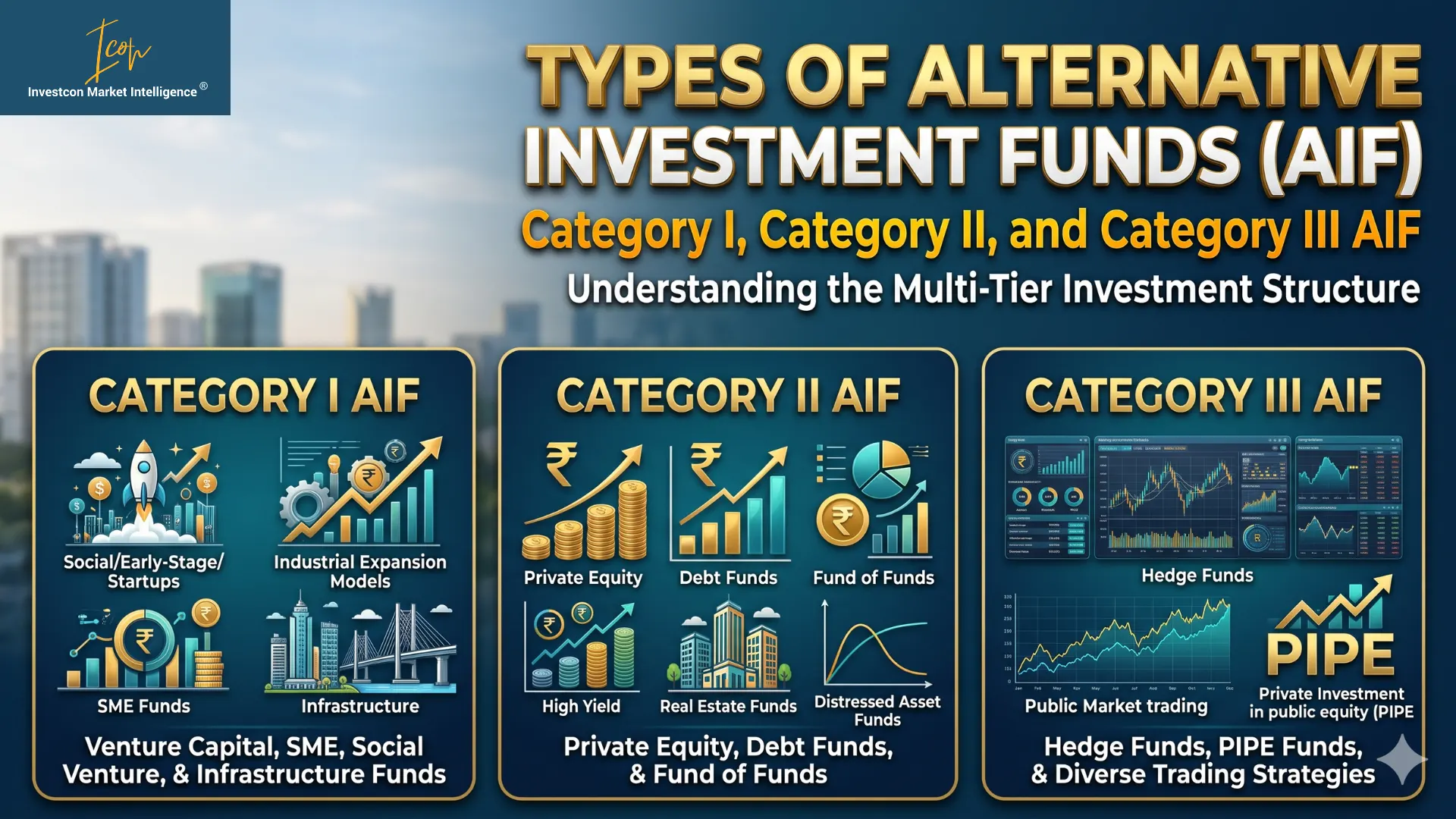
Some AIFs invest in new and small-scale businesses, others in established private businesses, while some use several trading strategies to earn returns. SEBI classifies AIFs into three categories based on where and how they invest.
1. Category I AIF
Category I AIFs invest in businesses and projects that support economic growth, such as start-ups, small businesses, infrastructure and social enterprises. Common examples are venture capital funds, angel funds, SME funds, infrastructure funds, and social impact funds, which support businesses that aim to create positive social or environmental change.
2. Category II AIF
Category II AIFs invest in private companies, debt securities, real estate and other assets that do not fall under Category I or Category III. They generally do not use leverage, except for permitted operational needs. Its example include private equity funds, which invest in privately held companies; debt funds, which invest in company-issued debt securities; real estate funds, which invest in property-related projects; and fund of funds, which invest in units of other investment funds.
3. Category III AIF
Category III AIFs use complex trading strategies to generate returns. They may choose to invest in listed and unlisted securities and use derivatives, such as short selling and leverage. Hedge funds are a common example, as they use strategies such as arbitrage and short selling to benefit from market movements. PIPE funds also fall under this category and invest in publicly listed companies through private placements.
How do AIFs Work
An Alternative Investment Fund brings together money from multiple investors to invest in opportunities such as start-ups, private companies or infrastructure projects. Instead of each investor selecting and managing these investments, a professional fund manager handles the process.
- Fund creation: A sponsor sets up the AIF, and a fund manager is appointed to manage its investments.
- Collection of money: It raises money from appropriate investors through private placement. Investors receive units in the fund in return for their contributions.
- Choosing of investments: The fund manager invests the pooled money according to the fund’s strategy, which is explained in its Private Placement Memorandum (PPM).
- Managing investments: The manager tracks the investments, reviews their performance and makes decisions to meet the fund’s objectives.
- Distributing the returns: When investments generate profits or are sold, the proceeds are distributed among investors according to the fund’s terms.
How to invest in an AIF
Investing in an AIF is not as simple as buying mutual fund units. The AIFs raise money through private placements. Hence, investors must review the fund’s terms, complete the required paperwork and meet the investment conditions before joining.
Step 1: Choose the right AIF: First, decide whether you want to invest in start-ups, private companies, infrastructure or funds that use trading strategies. Select a Category I, II or III AIF based on your investment goals and risk appetite.
Step 2: Check the fund’s SEBI registration: Ensure that the AIF is registered under SEBI regulations. You can verify its registration details through SEBI’s official website.
Step 3: Read the Private Placement Memorandum (PPM): The PPM represents where the fund will be invested, its strategy, expected tenure, fees, risks, redemption conditions and other important information. Read it carefully before committing your money.
Step 4: Complete the KYC process: You need to submit your PAN, identity proof, address proof and other required financial details to complete the KYC verification process.
Step 5: Sign the contribution agreement: Once the application is accepted, sign the agreement that includes payment terms and rights as an investor.
Step 6: Transfer the investment amount: Once the investment agreement is signed, you commit to investing the entire amount, i.e., typically ₹1 crore or more. However, you may not have to pay the entire amount immediately. Category I and Category II AIFs usually collect money in smaller instalments over 2 to 4 years as they find suitable investment opportunities. These payments are called drawdowns or capital calls. In contrast, Category III AIFs generally ask investors to pay the full committed amount upfront.
Step 7: Track your investment: Review the fund’s periodic updates, account statements and performance reports to understand how your money is being managed.
Benefits and Risks of AIF
The benefits of investing in AIF are given below.
- Diverse Portfolio: AIFs allow investors to put their money into assets such as private companies, start-ups, real estate and infrastructure.
- Access to Private Investment Opportunities: Investors can participate in businesses that are not listed on stock exchanges. For example, venture capital funds allow investors to gain exposure to early-stage start-ups.
- Different Investment Strategies: They offer several investment approaches, from funding growing businesses to investing in debt and using trading strategies. Investors can choose appropriate funds as per their financial goals.
- Professional Fund Management: Experienced fund managers research investment opportunities, select assets and monitor their performance. This allows investors to access professionally managed strategies.
- Potential for Higher Returns: They also offer investors to invest in early-stage businesses or private companies that have high growth potential. Investors may earn significant returns if the business performs extremely well.
The risks associated with AIF are given below.
- Market and Business Risks: Risks such as a start-up failing, a private company struggling to grow, or an infrastructure project facing delays can lead to a reduction in the fund’s value and affect the overall returns.
- Fund Manager Risk: he performance highly depends on the fund manager’s investment choices. Poor asset selection or an unsuccessful strategy can lead to subsequent losses.
- Leverage Risk: Some Category III AIFs use borrowed money or use derivatives to increase the market exposure, which can result in magnified losses.
- Valuation Risk: The private companies and unlisted securities do not have regular stock exchange prices. Their valuations may depend on estimates and financial models, which may not reflect the price they can actually fetch when sold.
- Limited Liquidity: Unlike other listed shares, AIF units may be harder to sell in an urgent situation, as some of them may have a longer investment duration and withdrawal restrictions.
Taxation of AIF
Understanding what an Alternative Investment Fund (AIF) is also involves knowing how its returns are taxed. The taxation policy on AIF returns depends on the fund’s category and the type of return earned on it. Under the Income-tax Act, 2025, which is effective from 1 April 2026, the Category I and Category II AIFs receive pass-through tax treatment, while the Category III AIFs do not receive this general benefit.
- Taxation of Category I and Category II
These funds follow a pass-through taxation system, which means most income is taxed directly in the hands of investors rather than at the fund level.
- Capital gains: These are taxed under the applicable capital gains rules.
- Dividend income: Taxed at the applicable rates for investors.
- Interest income: Taxed according to the applicable income tax rules.
- Business income: Taxed at the fund level and exempt in the hands of investors.
- Taxation of Category III
The Category III AIFs do not receive the general pass-through benefits under Section 224. Therefore, the tax treatment depends on their legal structure and applicable tax provisions. For example, a Category III AIF set up as a trust may be taxed under the rules applicable to trusts.
Conclusion
An Alternative Investment Fund (AIF) allows eligible investors access to the investment opportunities beyond traditional stocks, bonds and mutual funds. Hence, depending on the category, an AIF may invest in start-ups, private companies, infrastructure, debt securities or use complex trading strategies.
However, these funds also carry risks, including limited liquidity, uncertain valuations, and potential capital loss. Before investing, check the fund’s SEBI registration, understand its investment strategy, read the Private Placement Memorandum (PPM) and review its fees and tax treatment. Understanding what an Alternative Investment Fund (AIF) is and how it works can help investors decide whether it fits their financial goals, investment horizon and risk appetite.
FAQs
Q: What is the difference between an AIF sponsor and an AIF fund manager?
Ans: An AIF sponsor establishes the fund and ensures it meets SEBI’s requirements. The AIF fund manager handles its day-to-day operations, selects investments and monitors performance.
Q: What is the lock-in period for an AIF investment?
Ans: Category I and II AIFs are generally close-ended, with a minimum tenure of three years. Category III AIFs can be open-ended or close-ended, depending on their structure and terms.
Q: Can an AIF invest in multiple companies at the same time?
Ans: Yes. An AIF can invest in multiple companies, but SEBI limits its investment in a single company. Category I and II AIFs can invest up to 25% of their investable funds in one company, while Category III AIFs can invest up to 10%. Large-value funds for accredited investors have higher limits.
Q: How are AIF returns distributed among investors?
Ans: Returns are distributed according to the fund’s contribution agreement and PPM. Investors receive their share based on their contributions and the agreed terms. Some funds also pay the manager a share of profits, known as carried interest.

Raksha is a BBA LL.B. graduate specialising in Corporate Law from Delhi, with over six years of experience in financial writing. She specialises in financial markets, investments, mutual funds, taxation and personal finance. With a strong foundation in legal research and a keen eye for detail, she focuses on translating complex financial concepts into accurate, accessible and engaging content.