Investing in the share market may sound like a task reserved for financial experts. But getting started is not as complicated as it seems!
In fact, investing in shares is not limited to a small group of experienced market participants. The National Stock Exchange of India (NSE) reports 13.7 crore unique registered investors as of 30 September 2026. This highlights the growing participation in the Indian stock market.
You do not need a large fortune or years of market experience to buy your first share. So, how to invest in the share market in India?
What you do need is a basic understanding of how the market works, the right accounts, and a sensible investment approach.
Whether you want to build long-term wealth or explore the world of stocks, learning the basics can make your first investment less intimidating. Read ahead to learn how to invest in the share market in India, step by step!
Quick Answer:
The share market allows investors to buy shares of publicly listed companies and become partial owners of those businesses. This guide explains how beginners can start investing in India through six steps, including setting a budget, opening a Demat and trading account, completing KYC, researching companies, placing orders and monitoring investments. It also covers applicable taxes, transaction charges, investment benefits and key precautions to manage market risks.
Key Takeaways
- You can invest in the share market by opening Demat and trading accounts with a SEBI-registered broker, completing KYC, researching and buying quality stocks or mutual funds.
- Equity shares, mutual funds, ETFs and bonds offer different investment opportunities and risk levels.
- Company financial statements help in assessing profitability, debt levels and business performance before purchasing shares.
- Diversification and regular review of the portfolio help in managing investment risks and keeping financial goals on track.
What Is the Share Market?
The share market, also known as the stock market, is a financial marketplace where you can buy and sell shares of publicly listed companies. When you purchase a company’s shares, you acquire partial ownership in that business and may benefit from capital appreciation and dividends.
The market connects companies that want to raise capital with investors looking for investment opportunities.
In India, there are two major stock exchanges, the primary platforms where trades occur, which are the National Stock Exchange (NSE) and the Bombay Stock Exchange (BSE). The Securities and Exchange Board of India (SEBI) governs and regulates the market to maintain transparency and protect investors.
The share market operates in two main segments:
- Primary Market: This is where companies issue new shares to the public for the very first time, for example, through an Initial Public Offering (IPO), to raise capital.
- Secondary Market: Once shares are issued and listed on a stock exchange, investors buy and sell those existing shares among themselves.
You can also track the Sensex, which tracks the performance of 30 major companies listed on the BSE, and the Nifty 50, which follows 50 leading companies listed on the NSE. These indices help you to understand the overall direction of the stock market.
How to Invest Money in the Share Market: Step-By-Step Guide
The following steps provide a practical guide on how to invest money in the share market:
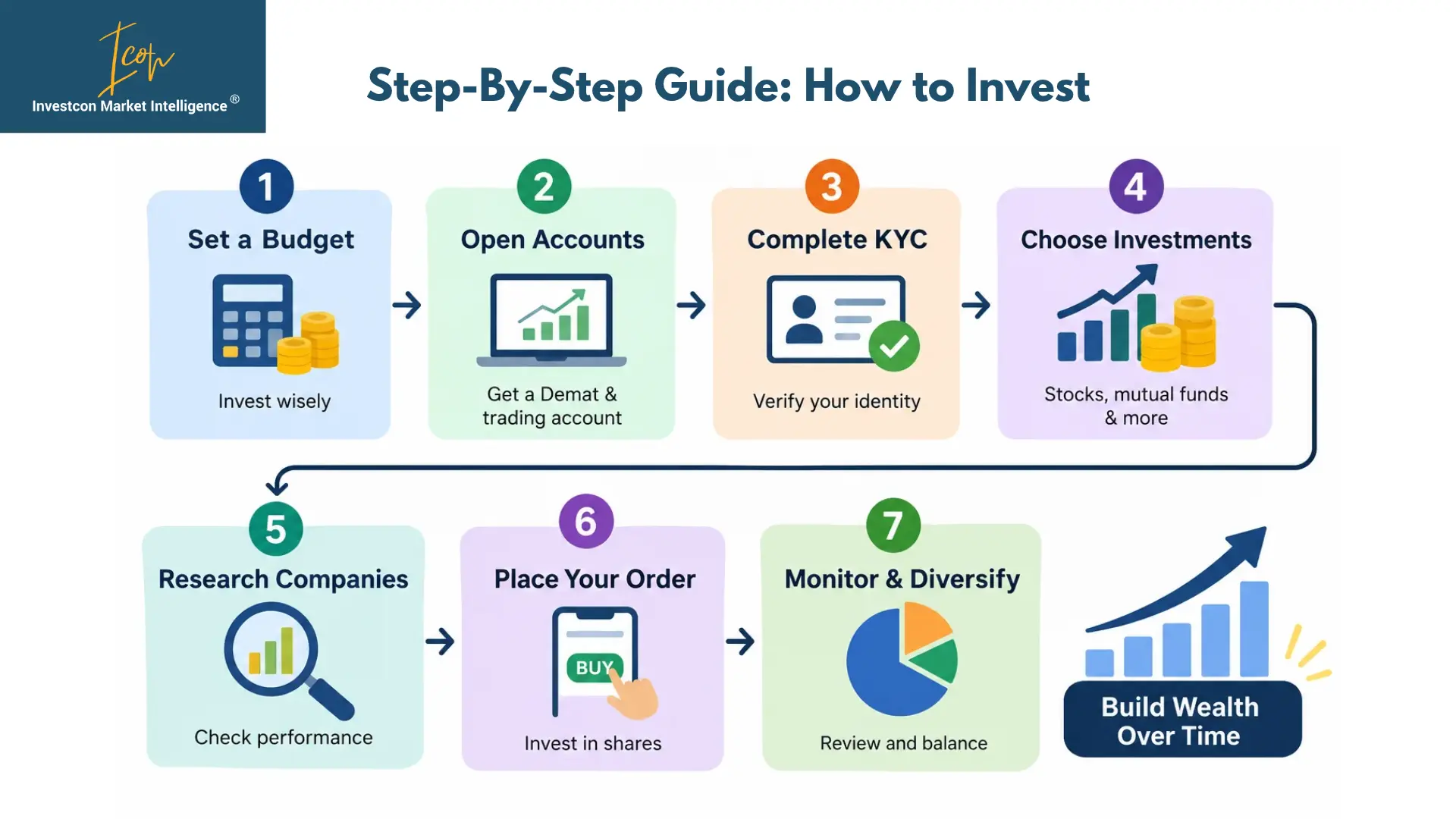
Step 1: Set an Investment Budget
The first rule should be to use an amount of money you can invest without affecting your monthly expenses. You should keep your emergency savings separate and avoid using borrowed money to purchase shares as a beginner.
Say, if you can spare ₹3,000 every month, you could begin with a few shares or invest through a mutual fund SIP. With a fixed monthly budget, it will also prevent impulsive purchases when stock prices rise or fall.
Step 2: Open a Demat and Trading Account
To buy and sell listed shares, you will need a bank account, a trading account and a Demat account.
The trading account lets you place orders through a broker, while the Demat account holds your purchased shares electronically. You can open these accounts through a SEBI-registered broker.
You can either buy and sell shares through the NSE and BSE or use stockbroking platforms such as Groww, Zerodha, Angel One and Upstox to trade in shares listed on these exchanges.
Brokers offer several services such as purchase or sale of equity, debt and derivative products, mutual fund units and IPOs. Select the broker by verifying the availability of your requirements.
Also, for a single-holder Demat account, SEBI requires you to provide nominee details or submit an explicit opt-out declaration. However, nomination is optional for jointly held Demat accounts and trading accounts.
The following is a quick checklist before selecting a broker:
- Account opening and annual maintenance charges (AMC).
- Brokerage fees on delivery and intraday trades.
- Platform usability and customer support.
- Additional charges, including transaction fees and statutory levies.
Step 3: Complete KYC and Verify Your Broker
Once you have submitted your account-opening application, complete the Know Your Customer (KYC) process.
Before you proceed any further, you can verify whether a broker is registered with SEBI through SEBI’s intermediary directory.
Your broker will verify your identity, address, PAN and other submitted details through document-based or digital verification. You may need to complete an Aadhaar OTP verification or video-based verification, depending on the platform.
The brokers also require Two-Factor Authentication (2FA), such as OTP or biometric verification, when you log in to your trading account. This adds an additional layer of security to prevent unauthorised access.
Upon successful verification, you will receive a trading account and a Unique Client Code (UCC) for your transactions.
Note: You should avoid unsolicited stock tips, fake WhatsApp or Telegram investment groups and unregistered “finfluencers” promising guaranteed returns. Also, do not share your Demat or trading account passwords, login credentials or OTPs with anyone.
Step 4: Decide What You Want to Invest In
With your accounts activated, decide whether you want to purchase individual shares or invest through diversified market-linked products. Your options may include physical assets, such as gold and real estate, or financial assets, such as fixed deposits, bonds, mutual funds and equity shares.
The NSE lists investment options available in India, categorised by their investment duration:
| Short-term Investments | Long-term Investment |
| ● Savings Bank Account
● Money Market Funds ● Bank Fixed Deposits |
● Post Office Savings Schemes
● Public Provident Fund (PPF) ● Company Fixed Deposits ● Bonds and Debentures ● Mutual Funds (including ETFs and FoFs) ● Life Insurance Policies ● Equity Shares |
Step 5: Research Companies Before Buying Shares
If you decide to purchase individual shares, shortlist companies based on their financial performance. Fundamental analysis helps you to analyse the revenue, net profit, debt-to-equity, EPS, and P/E ratios rather than speculative tips.
For example, if the revenue of, say, GHJ Ltd is rising, it would indicate business growth, but if its debt is increasing even faster, its higher interest costs could reduce future profits. Comparing these figures across financial periods helps in to identifying such changes.
You can find this information in quarterly results and annual reports published on company websites and the NSE and BSE portals. Also check whether the company has been issuing new shares, known as share dilution.
Step 6: Add Funds to Your Trading Account and Place Order
Once your trading account is active, transfer money from your linked bank account using UPI, net banking or NEFT. Next, open your broker’s app or website and search for the company whose shares you want to purchase.
You can find stocks by entering the company name or searching through indices such as the Nifty 50 or Sensex.
The regular equity trading session on NSE and BSE operates from 9:15 AM to 3:30 PM, Monday to Friday, except on exchange-declared trading holidays. A pre-open session generally runs from 9:00 AM to 9:15 AM.
While placing your order, you will come across two common order types:
- Market Order: It purchases shares at the best available market price when you place the order.
- Limit Order: It allows you to set the maximum price you are willing to pay. The order executes only if the share becomes available at that price or lower.
Select the order type, enter the number of shares you want to purchase and review the total amount. Upon confirmation, the order is executed by the exchange, and the purchased shares are credited to your Demat account after the applicable settlement process.
Under the standard T+1 settlement cycle, shares purchased on a trading day (T) are generally credited to your Demat account on the next working day (T+1). Saturdays, Sundays and exchange-declared holidays are excluded from the settlement calculation.
Let’s see an example!
You want to purchase 50 shares of JNM Ltd that is trading at ₹245/share. Your order would look like this:
| Order details | Example |
| Company | JNM Ltd. |
| Share price | ₹245 |
| Number of shares | 50 |
| Order type | Market order |
| Total purchase value | ₹12,250 |
| Amount payable | ₹12,250 + applicable charges |
Step 6: Monitor Your Investments and Diversify
Buying shares is only the beginning. Track company announcements, quarterly results and financial performance to understand whether your investment reasons remain valid.
You should also avoid selling shares simply because their prices fall on a particular day. Instead, review whether the company’s business performance has changed.
You can also diversify across sectors, companies and investment options to reduce dependence on a single stock. SEBI recommends reviewing investments periodically and adjusting asset allocation as financial goals change.
Taxes and Charges on Share Market Investments in India
The following sections highlight the taxation rules and applicable charges for stock market investments in India:
- Capital Gains Tax
The tax rules vary depending on the investment options.
| Investment Option | Short-Term Capital Gains (STCG) | Long-Term Capital Gains (LTCG) |
| Equity Shares | 20% for listed shares held for up to 12 months | 12.5% on gains above ₹1.25 lakh annually, after holding for more than 12 months. |
| Equity Mutual Funds | 20% for units held for up to 12 months | 12.5% on gains above ₹1.25 lakh annually, after holding for more than 12 months. |
| Debt Mutual Funds | Taxed at the applicable income tax slab rate. | Taxed at the applicable income tax slab rate. |
| Physical Gold | Taxed at the applicable income tax slab rate when held for up to 24 months. | 12.5% after holding for more than 24 months. |
| Real Estate | Taxed at the applicable income tax slab rate when held for up to 24 months. | 12.5% after holding for more than 24 months. |
| Unlisted Bonds and Debentures | Taxed at the applicable income tax slab rate | Taxed at the applicable income tax slab rate |
Note: Applicable surcharge and 4% Health and Education Cess may also apply to capital gains tax.
- Charges Applicable to Share Market Transactions
| Charge | Applicable Rate |
| Brokerage | ₹0 to ₹20 per executed order or 0.1%, whichever is less |
| STT (Delivery) | 0.1% on purchase and 0.1% on sale value. |
| Exchange Transaction Charges | NSE: 0.00297%; BSE: 0.00375% (delivery equity). |
| SEBI Turnover Fees | ₹10 per crore of transaction value. |
| Stamp Duty (Delivery) | 0.015% on purchase value. |
| GST | 18% on brokerage and applicable taxable charges. |
| DP Charges | ₹15.34 to ₹20 per scrip + GST, based on applicable terms |
Why Should You Invest?
The following are the key reasons why you should invest:
- Grow Your Savings: Money that sits idle in a savings account earns limited interest. But investing in shares, mutual funds and other financial products to earn relatively higher returns over time.
- Achieve Financial Goals: Investments can help you accumulate money for future expenses, such as purchasing a house, funding higher education or building a retirement corpus. Diversifying across different assets also reduces dependence on a single investment.
- Benefit of Compounding: Reinvesting your earnings money generates returns on both your initial principal and the accumulated interest or gains over time. Further, starting at an early age provides your money more time to compound.
- Protection Against Inflation: Inflation increases the cost of goods and services, reducing the purchasing power of traditional savings accounts over time.
Things to Take Care of While Investing
Investing money in the share market requires careful consideration. Consider the following important factors before making an investment:
- Read the Documents: Obtain the written documents explaining the investment and read them carefully to understand its terms and conditions.
- Verify Its Legitimacy: Check whether the investment and the intermediary offering it are authorised and registered with the relevant regulatory authority.
- Compare Costs and Benefits: Find out the charges, potential returns and other benefits associated with the investment. Compare them with alternative investment opportunities.
- Assess the Risks: Examine the risk-return profile, liquidity and safety of the investment to understand potential losses and how easily you can withdraw your money.
- Match Your Financial Goals: Check whether the investment suits your financial goals, investment horizon and existing portfolio before committing your money.
- Clarify Your Doubts: Ask the intermediary about anything you do not understand. Invest only when you are satisfied with the information and have considered what options are available if something goes wrong.
Conclusion
Your first share purchase is only one part of investing. What matters next is how you evaluate businesses, respond to market movements and manage your portfolio over time.
Knowing how to invest money in the share market gives you a starting point to make these decisions. Investcon Market Intelligence explains the investment process, from selecting a broker to researching companies and placing orders, so beginners can approach the market with better preparation.
Keep researching, review your investments regularly and let financial goals guide your decisions rather than short-term market excitement.
FAQs
Q: What is the minimum amount required to invest in the share market?
Ans: This actually depends on your budget, financial goals and how much you can afford to lose. You can start with a small amount by selecting shares within your budget or investing through mutual fund SIPs, while considering applicable charges and market risks before investing.
Q: Are returns from share market investments guaranteed?
Ans: No. The share prices fluctuate depending on the market conditions and company performance. While you may earn profits, market-linked investments can also lose their value.
Q: Do all companies listed on the stock exchange pay dividends?
Ans: No. Companies are not obligated to distribute profits as dividends. Their boards may recommend dividends depending on profitability, cash requirements and business decisions.
Q: Can I invest in shares without a Demat account?
Ans: No. You need a Demat account to hold listed shares electronically. You can open one through a SEBI-registered Depository Participant (DP).
Q: Can I sell shares whenever I want?
Ans: Yes, you can generally sell listed shares during regular trading hours, provided trading is available and the shares are held in your Demat account.

Raksha is a BBA LL.B. graduate specialising in Corporate Law from Delhi, with over six years of experience in financial writing. She specialises in financial markets, investments, mutual funds, taxation and personal finance. With a strong foundation in legal research and a keen eye for detail, she focuses on translating complex financial concepts into accurate, accessible and engaging content.