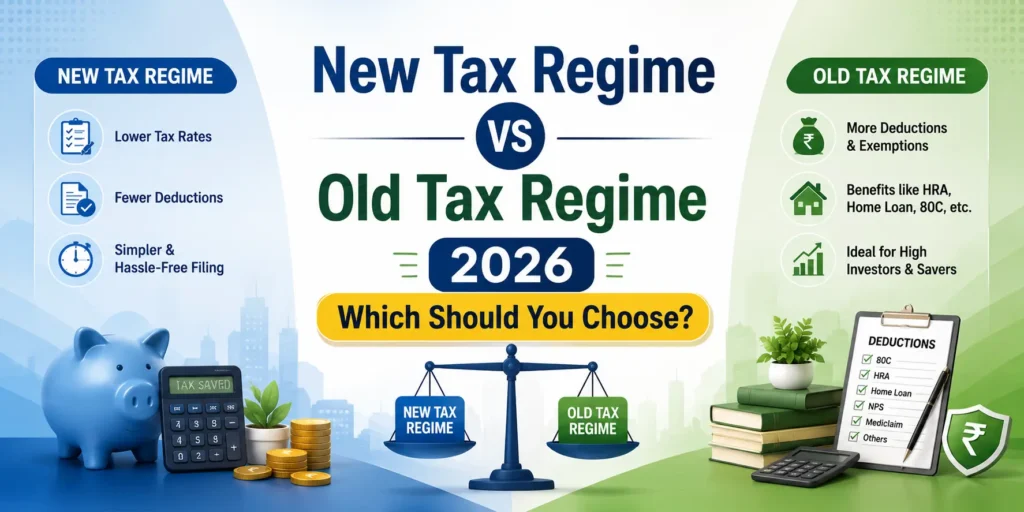
Efficient tax planning is crucial for optimal, well-rounded financial planning. Investors cannot accentuate gains without successfully planning their taxation. Subsequently, a critical and foundational question in securing tax efficiency is to choose a tax regime that fits the individual’s financial profile. Currently, in India, there exists the new tax regime and the old tax regime. Choosing between these two regimes requires a suitable understanding of the two, their meaning, unique features, and more.
This blog comparatively analyses the Old Tax vs New Tax Regime in India to aid decision-making.
New Vs Old Tax Regime India 2026: Decoding Tax Slabs
Tax slabs are the primary point of distinction between the new and the old tax regime. The slab rates under the new tax regime are lower than those of the old tax regime. While the slab rates under the old regime are categorised based on both income level and age group, the categorisation in the new regime is only based on income level. Moreover, the default tax system is the new tax regime. On the other hand, qualified taxpayers may choose to revert to the old system. Let’s take a closer look at each of these tax slabs.
2026 Tax Slabs Under the New Tax Regime
| Income Slabs | Tax Rates |
| Up to INR 4,00,000 | Nil |
| INR 4,00,001 to INR 8,00,000 | 5% |
| INR 8,00,001 to INR 12,00,000 | 10% |
| INR 12,00,001 to INR 16,00,000 | 15% |
| INR 16,00,001 to INR 20,00,000 | 20% |
| INR 20,00,001 to INR 24,00,000 | 25% |
| Above INR 24,00,000 | 30% |
2026 Tax Slabs Under the Old Tax Regime
| Income Slabs | Age-wise Tax Rates | ||
| < 60 Years | >= 60 Years to < 80 Years | >= 80 Years | |
| Up to INR 2,50,000 | Nil | Nil | Nil |
| INR 2,50,001 to INR 3,00,000 | 5% | Nil | Nil |
| INR 3,00,001 to INR 5,00,000 | 5% | 5% | Nil |
| INR 5,00,001 to INR 10,00,000 | 20% | 20% | 20% |
| Above INR 10,00,000 | 30% | 30% | 30% |
Apart from the tax slabs, deductions are another key basis of classification between the old tax vs new tax regime in India.
Treatment of Deductions Under the Old Tax Vs New Tax Regime in India
Taxpayers who choose the old tax regime often get access to greater deductions, while those who choose the new tax regime have lower tax slabs. The tax slab rates under both regimes have been discussed before in detail; discussed here is the deduction treatment under both regimes.
Tax Rebate and Standard Deductions
Both tax rebates and the standard deduction allow taxpayers to reduce their tax burden. While the applicability of a deduction is subject to the fulfilment of certain conditions, these two tax deduction avenues are levied on both the new and old tax regimes, as discussed below.
| Particulars | Old Tax Regime | New Tax Regime |
| Tax Rebate | INR 12,500 | INR 60,000 |
| Tax-Free Income | INR 5 Lakhs | INR 12,00,000 |
| Standard Deduction | INR 50,000 | INR 75,000 |
Other Key Deductions
The table below comparatively analyses the deductions applicable to both the new tax regime and the old tax regime.
| Section | Explanation | Old Tax Regime | New Tax Regime |
| 24(b) | Deduction on income generated from the house due to interest on the home loan | Allowed | Allowed |
| 80CCD (2) | Deduction for contributions by the employer to a pension scheme | Allowed up to
|
Allowed up to 14% of salary |
| 80CCH | Deductions for contribution to Agniveer scheme | Allowed | Allowed |
| 80C | Includes life insurance premium, provident fees, national security certificate, etc, with an overall ceiling of up to INR 1.50 lakhs | Allowed | Not Allowed |
| 80CCC | Annuity plans | Allowed | Not Allowed |
| 80D | Deduction for the health insurance premium paid for self and parents | Allowed based on limits up to
|
Not Allowed |
| 80DDB | Deduction for medical treatment of specified diseases | Allowed up to INR 40,000 for regular taxpayers and up to INR 1 lakh for senior citizens | Not Allowed |
| 80TTA | Deduction on the savings bank account interest of a non-senior citizen | Allowed up to INR 10,000 | Not Allowed |
| 80TTB | Deduction on the interest of deposits by senior citizens | Allowed up to INR 50,000 | Not Allowed |
Many other deductions that are applicable under the old tax regime but not the new tax regime exist, like Section 80DD, 80E, 80EE, etc. Before choosing between the old and the new tax regime, aligning the deductions available with individual investments, expenses, etc., is crucial to make the right choice.
However, there exist a few strategies or standards that often indicate which tax regime might suit which investor category.
Suitable Investor Categories of the New Tax Regime vs Old Tax Regime in India
The choice between the old tax regime and the new tax regime is governed mainly by parameters like salary structure, deductions or exemptions an individual can claim, and investment habits. Although the choice of the tax regime should be based on individual profile analysis, certain broad investor categories can choose particular tax regimes. Discussed below are each of them in detail.
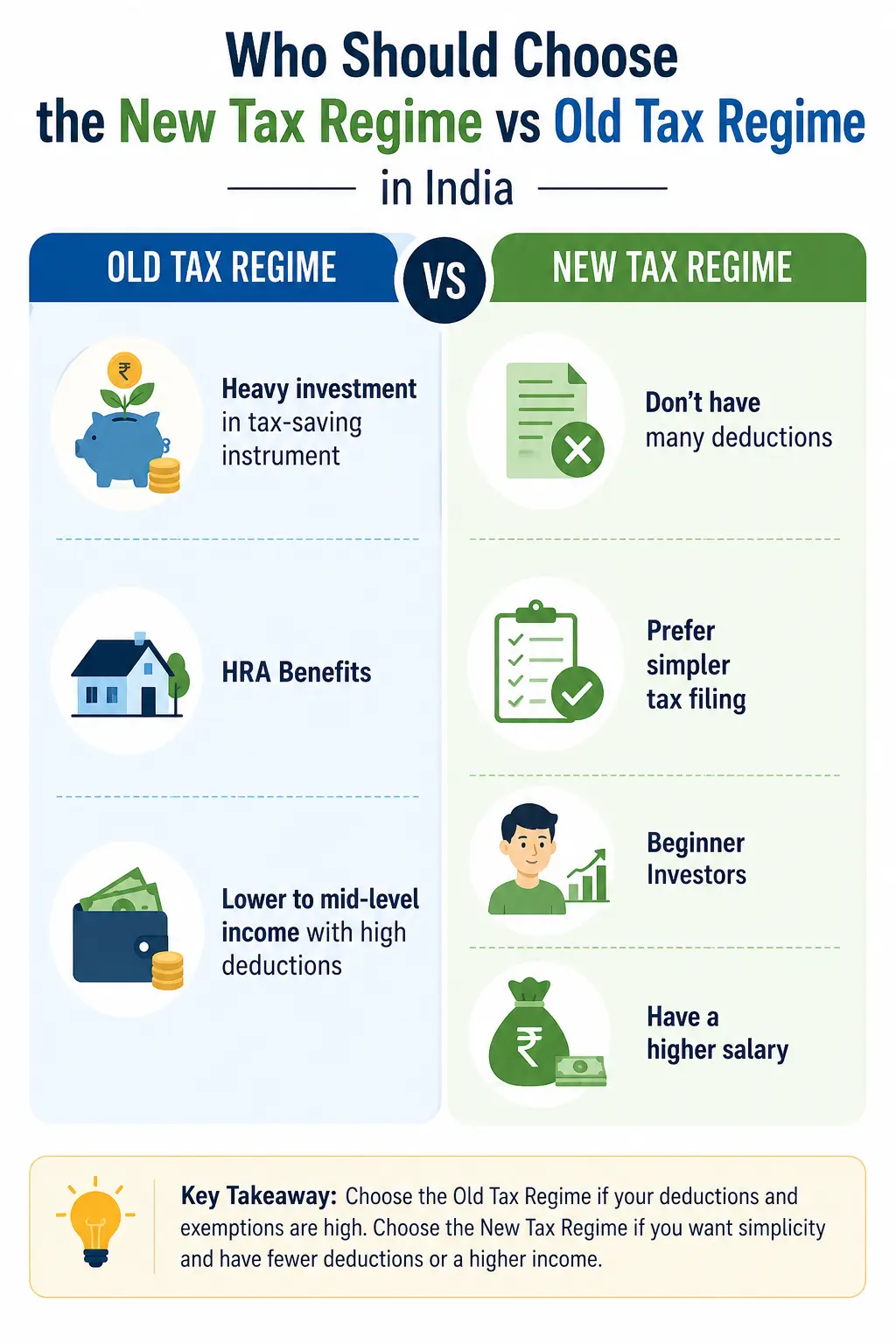
Old Tax Regime
- Heavy investment in tax-saving instruments: If an investor’s portfolio holds assets such as PPF, LIC, ELSS, etc., that offer tax deductions under the Income Tax Act, they might prefer the old regime over the new one.
- HRA Benefits: Salaried employees in metro cities with high rents and HRA benefits often save more in taxes under the old regime.
- Lower to mid-level income with high deductions: The primary benefit of the old tax regime is the deduction under Chapter VI-A. Therefore, if the income is between the lower and mid-level, such that the tax payable is less, the old tax regime can further reduce taxes through deductions.
New Tax Regime
- Don’t have many deductions: If a taxpayer does not have enough eligible deductions to claim and reduce their tax burden, the new tax regime tax slabs are lower than the old regime, providing a reduced tax burden.
- Prefer simpler tax filing: The new regime does not have most exemptions and deductions, making the filing process simple and convenient.
- Beginner Investors: The new regime is the default income tax regime. Furthermore, given the simple and less complex filing process, it is often more convenient for beginners.
- Have a higher salary: If an individual has a high salary and not enough deductions to claim, the new income tax regime becomes a convenient choice. It allows a lower tax burden, compared to the old regime.
Typical Errors to Avoid When Selecting a Tax System
Choosing between the old and the new income tax regimes without optimal analysis often leads to mistakes and unnecessary tax burden. Here are some common mistakes that taxpayers must avoid when choosing an income tax regime.
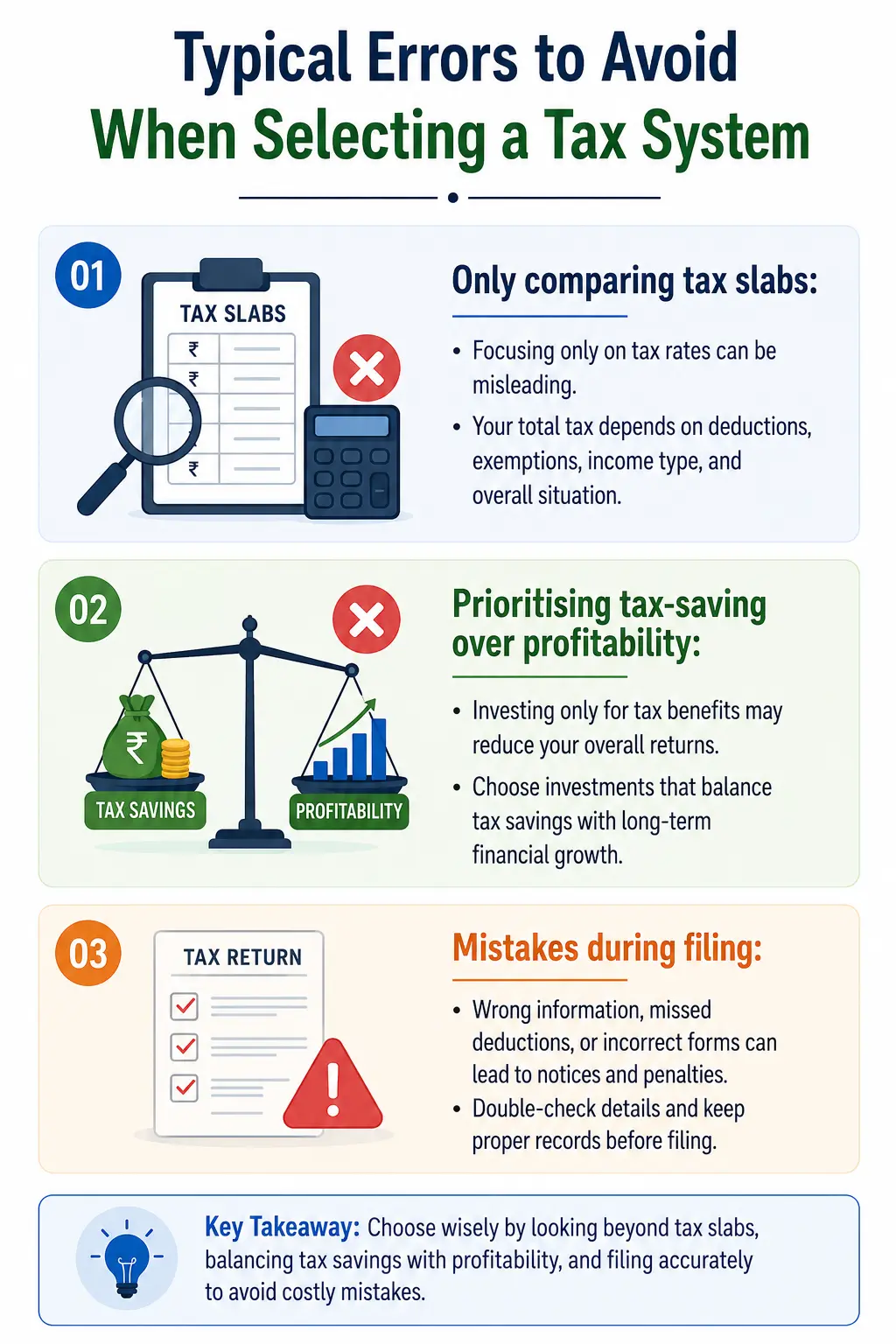
- Only comparing tax slabs: While the tax slabs are an important point of distinction, they are not enough to make a choice. Investors ought to take the deductions into account. An aggregate view of both tax slabs and deductions can reveal the regime under which a taxpayer can get the lowest tax burden.
- Prioritising tax-saving over profitability: Tax saving is one of the important goals for investing, but it does not supersede profitability. Investors should not concentrate assets only in tax-saving avenues, as it might reduce the gains from their investments.
- Mistakes during filing: Choosing the right regime is the first step. If investors fill in incorrect information in their ITR forms, they might receive an income tax notice or lose the opportunity for tax savings. Therefore, the taxpayers should carefully fill in their tax details in the form.
Bottomline
People should pick between the new and old income tax system by properly analysing their individual portfolio, depending on their investments and salaries. Making an optimal decision here is necessary to reduce the tax burden and get the complete gamut of benefits under the Income Tax Act. Although the new tax regime is the default system and offers lower slab rates, some taxpayers choose the old regime as it offers greater deductions. A comparative understanding of both systems is critical to make an optimal choice.
FAQs
| 1. Which is better, the old tax regime or the new tax regime? |
| The new tax regime is the default tax regime and offers lower slab rates than the old tax regime. However, the old regime is eligible for greater deductions. Therefore, taxpayers should choose regimes that suit their individual profile. |
| 2. Which is the default income tax regime? |
| The new income tax regime is the default Income Tax regime, and taxpayers have to actively switch to the old regime if they want to file under it. |
| 3. Is salary up to INR 12 lakhs have zero tax? |
| Under the new income tax regime, income up to INR 12 lakhs is exempt from taxes, and in the case of salaried citizens, it extends up to INR 12,75,000. |
| 4. What are the disadvantages of the old tax regime? |
| The old tax regime has higher slab rates and is often more complicated to fill out due to the array of deductions that come under it. |
| 5. What are the disadvantages of the new tax regime? |
| The new tax regime is not eligible for all deductions under Chapter VI-A. This reduces its viability for taxpayers with high investments in tax-saving avenues. |

- 2 Bar Reversal Indicator - August 31, 2026
- Insurance Content Writing: How to Explain Policies Without Losing Readers - August 17, 2026
- Why Every Wealth Management Firm Needs an Industry Report (Not Just a Blog) - August 12, 2026