Summary
- A content strategy should help a fintech become visible, explain its product and move interested readers towards action.
- Blogs, website copy, onboarding guides, case studies and the investor pitch deck should carry one consistent business narrative.
- Performance must be measured through qualified traffic, registrations, product activation, sales enquiries and investor follow-ups.
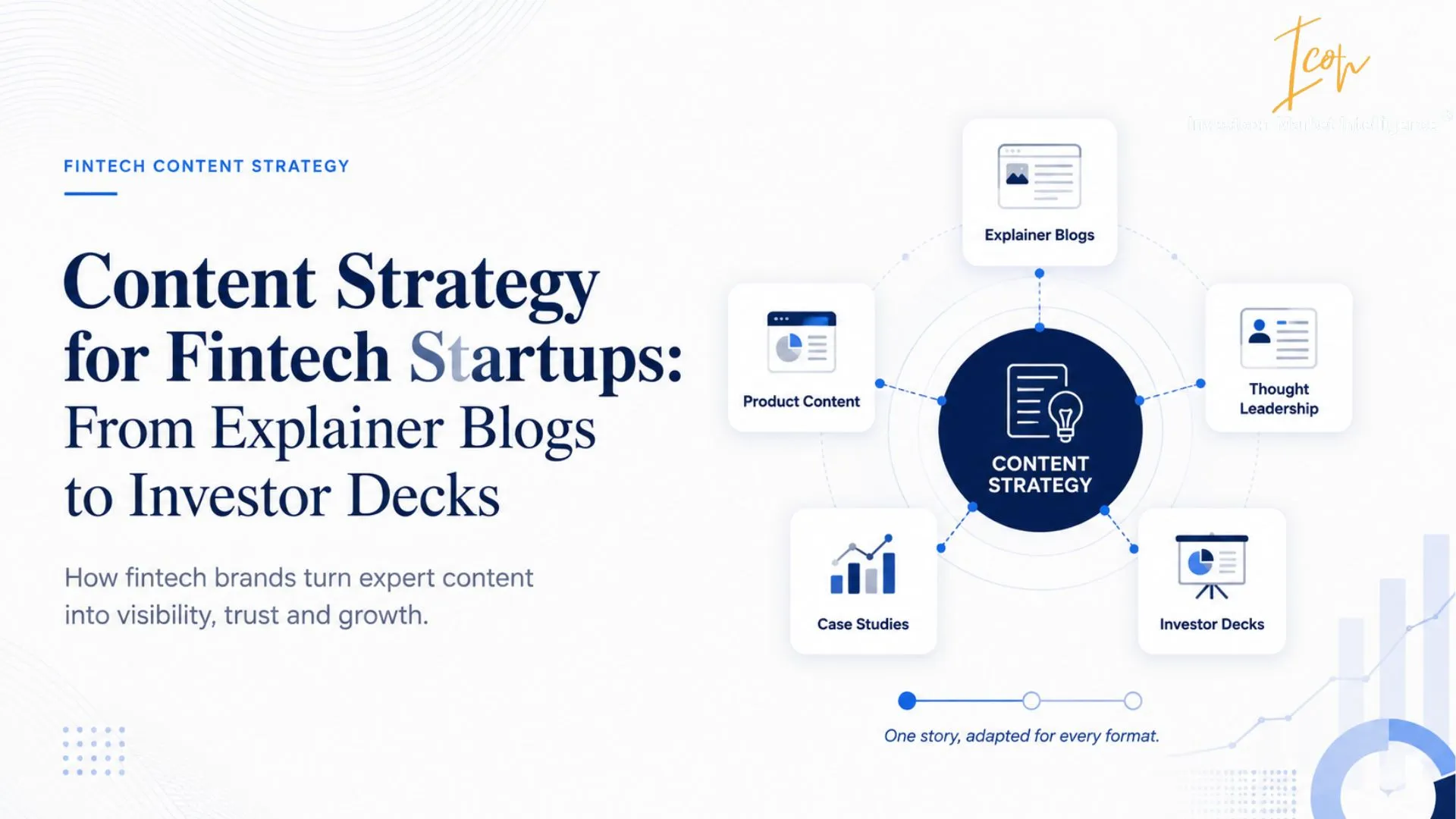
Content Strategy for Fintech Startups: From Explainer Blogs to Investor Decks
A content strategy for fintech startups connects what the company knows with what its customers, partners and investors need to understand. It goes far beyond publishing a fixed number of blogs every month.
A new fintech may have limited brand recognition. Its product may still be evolving, and potential users may not fully understand the problem it solves. Content helps the business build visibility, explain its value and create trust before it has a large customer base or advertising budget.
This gap between awareness and action is common in financial services. Although 63% of Indian households recognise securities market products, only 9.5% currently invest in them. The difference shows that awareness alone does not lead to participation. People also need clear information, confidence and a reason to act.
A clear startup content strategy supports that journey. It helps the company get discovered, explain the product, improve conversion and present a credible business case to investors.
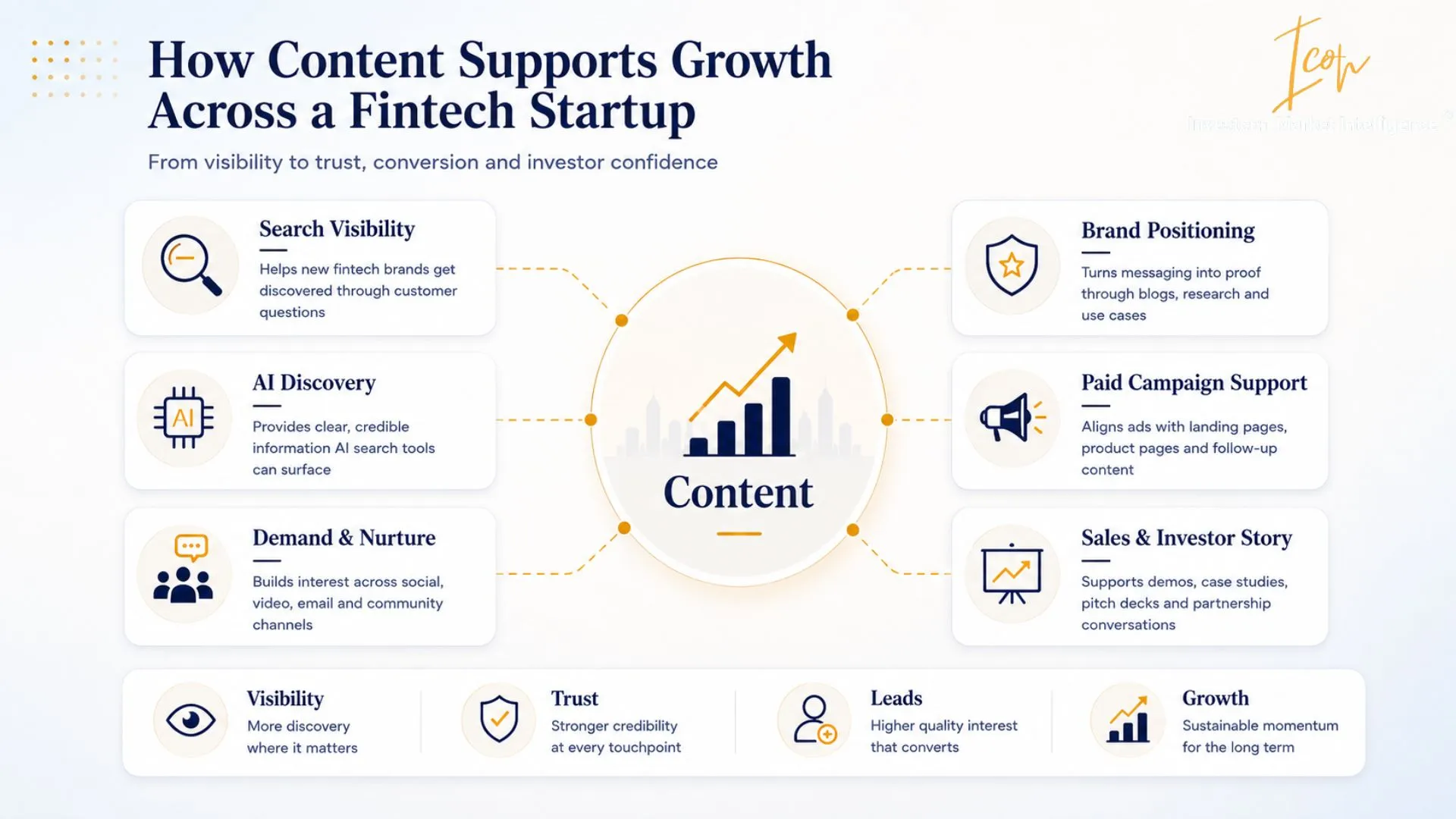
How Startup Content Strategy Supports Growth
A new fintech may have a strong product but little recognition in the market. Potential customers may not know the brand, understand the category or see why the product is relevant to them.
Content closes that gap. It helps the startup explain the problem, show where its product fits and build familiarity across search, social media, advertising and sales channels. Over time, this visibility can support trust, enquiries and customer action.
Content Helps an Unknown Fintech Get Discovered
People rarely search for the name of a newly launched fintech. They search for the financial problem they need to solve.
A customer may look for:
- How invoice financing works
- Charges on international payments
- Ways to automate business expenses
- Risks involved in digital lending
- How to compare investment platforms
- Tax treatment of an investment
Blogs, product guides, comparison pages and calculators allow the startup to appear during this research. Each useful page becomes another route through which a potential customer can reach the website.
For FinnPick, we produced research-led pages covering more than 390 upcoming IPOs. Each page addressed live investor questions around issue dates, price bands, financial performance and listing expectations.
Together, the pages generated around 2–3 lakh impressions at launch. The reach came from covering separate search needs through one consistent research process, while keeping every company analysis specific.
Google recommends useful, reliable content created for readers rather than pages produced mainly to manipulate search rankings. For a fintech, current calculations, regulatory explanations and clearly sourced product information help establish both relevance and credibility.
The website therefore needs both subject knowledge and editorial discipline. Our guide on ranking financial content without triggering YMYL issues covers this requirement in greater detail.
Content Turns Brand Positioning Into Proof
A fintech’s positioning may first appear in its website copy. A homepage explains what the company does, who it serves and why the product is different.
Content then gives that positioning depth.
This may include:
- Explainer blogs
- Original research
- Founder-led articles
- Customer case studies
- Reports and white papers
- Webinars and videos
- Newsletters
- Industry commentary
For example, an expense-management platform may position itself around helping finance teams control company spending.
The website copy can state that promise clearly. The supporting content must then prove it through spend-management guides, customer results, product use cases and commentary on finance operations.
Without this supporting material, the brand claim remains a marketing statement. With consistent evidence, the market begins to associate the company with a specific problem and area of expertise.
Content also gives founders space to express a point of view. A detailed article on payment delays, lending behaviour or investment access can show how the company understands the market.
Copywriting introduces the brand position. Content reinforces it over time and gives customers, partners and investors reasons to believe it.
Content Creates More Opportunities for AI Discovery
Potential customers increasingly use AI-supported search tools to understand products, compare services and research financial questions.
Google applies the same fundamental SEO principles to its AI search features. Pages must remain accessible, useful and reliable, with no separate writing formula required for AI Overviews or AI Mode.
For a fintech, content containing clear explanations, original data and visible sources gives these systems more reliable material to draw from.
A potential customer could discover the company through:
- A definition quoted in an AI-generated answer
- A table comparing charges
- An original market statistic
- A guide explaining a financial process
- A product page answering a detailed question
- A chart showing customer or industry trends
AI discovery does not replace the website. It creates another point at which the brand can enter the customer’s research process.
Content Strengthens Paid Advertising
An advertisement can capture attention within seconds. The content behind it determines whether that attention develops into interest.
A paid campaign may require:
- Search and social ad copy
- Campaign landing pages
- Product comparisons
- Downloadable guides
- Webinar pages
- Retargeting messages
- Customer stories
- Follow-up emails
The message must remain consistent from the advertisement to the landing page.
An ad promising quicker business payments should lead to a page explaining how the service works, who can use it, what it costs and how long setup takes. A vague homepage may leave the visitor searching for the details that persuaded them to click.
Google Ads treats landing-page usefulness, relevance and consistency with the advertisement as part of landing-page experience and Quality Score. A better connection between the ad and its destination can therefore support both user experience and campaign performance.
Advertising buys the visit. Content gives the visitor enough information to consider the offer.
Content Builds Demand Beyond Search
Not every potential customer is actively searching for a fintech product. Social media, video, email and community content can reach people before they begin comparing providers.
These formats may include:
- Founder-led LinkedIn posts
- Short educational videos
- Long-form video explainers
- Carousels and infographics
- Newsletters
- Webinars
- Podcasts
- Regional-language content
- In-app education
- Community discussions
Search content responds to existing demand. Social and video content can introduce a problem, challenge an assumption or make an unfamiliar financial product easier to understand.
Our work for Groww covered YouTube Shorts, long-form videos, in-app copy and content across English, Hinglish and regional channels. Its subscriber base moved from around 90,000 to over 1.5 lakh during the engagement. The increase cannot be attributed to content alone, but it shows how coordinated communication can support a brand across several audience formats.
Email and lifecycle content continue the relationship after the first visit. Newsletters, abandoned-registration emails, product updates and webinar follow-ups give prospects a reason to return when they are ready to act.
Content Supports PR, Sales and Partnerships
Some content earns visibility outside the company’s own channels.
Original reports, surveys, founder commentary and market data can give journalists and industry publications useful material to cite. This helps the startup enter wider conversations without depending entirely on paid exposure.
The same research can support commercial teams through:
- Sales presentations
- Case studies
- Product one-pagers
- Partnership decks
- Competitor comparisons
- Proposal content
- Objection-handling documents
- Request-for-proposal responses
A marketing campaign may generate the lead. Sales content helps the buyer assess implementation, costs, security and expected outcomes.
For enterprise fintechs, several people may influence the final decision. A product manager may need integration details, a finance leader may examine costs and a compliance team may review risk controls.
One generic brochure cannot answer every concern. A connected content system gives each stakeholder the evidence needed to move the discussion forward.
Content Turns Attention Into Measurable Action
Visibility has limited value when the startup cannot connect it with customer behaviour.
Google Analytics allows businesses to record important actions as key events. These can include account registrations, form submissions, downloads, purchases or demo requests.
This shows whether content is only attracting readers or helping them move towards a business outcome.
| Explainer blog | Visits a product page | Shows product interest |
| Comparison page | Starts registration | Supports customer acquisition |
| Market report | Downloads the full report | Generates a potential lead |
| Case study | Requests a demo | Creates a sales opportunity |
| Help article | Completes account setup | Supports product activation |
| Founder article | Visits the company page | Supports investor or partnership interest |
A blog may receive 10,000 visits but send few readers towards the product. Another may attract 2,000 visitors and lead to 150 registrations.
The second page may contribute more directly to growth because it reaches people with stronger intent.
The article topics that lead to demo requests can show which customer problems are tied most closely to buying interest.
Content therefore works across discovery, branding, advertising, acquisition and sales. Once these roles are clear, the startup can match each format to the audience and decision it needs to support.
What Does Each Audience Need?
A fintech may speak to retail users, enterprise buyers, partners and investors. Each group needs different information before it can move forward.
The content should therefore reflect the decision being made, not only the audience’s age, job title or industry.
| Prospective customer | Do I understand this product? | Explainers, guides and videos |
| Interested user | Is this suitable for me? | Product pages, comparisons and FAQs |
| New customer | What should I do next? | Onboarding emails and in-app guidance |
| Enterprise buyer | Can this solve our business problem? | Solution pages, case studies and sales material |
| Investor | Can this become a scalable company? | Investor pitch deck and financial data |
Customer-facing content should explain what the product does, who can use it, what it costs and what happens after registration. It should also make risks, eligibility rules and limitations easy to find.
Enterprise buyers need stronger operational proof. They may assess security, integrations, implementation time, reporting and measurable outcomes before requesting a demo or approving a purchase.
Investors evaluate the same business differently. They look for market size, customer demand, revenue growth, acquisition costs, product differentiation, commercial risks and a credible use of funds.
The company’s message should remain consistent across all three audiences. What changes is the evidence used to support it.
Which Content Formats Does a Fintech Need?
A fintech does not need every content format at launch. The mix should reflect where the business needs support, whether that is customer education, product adoption, enterprise sales or fundraising.
From blog to investor deck, the formats below serve different functions. Each also demands a different balance of explanation, evidence and commercial intent.
Explainer Blogs
Explainer blogs help potential customers understand financial products, processes and risks before evaluating a provider.
A useful explainer should answer the main question early. It can then add practical examples, current figures, calculations and relevant limitations.
For example, an article about annual percentage rates should not stop with a definition. It should explain which charges enter the calculation and show how the rate changes the customer’s total repayment.
Strong fintech explainers generally contain:
- A direct answer
- A clear process or calculation
- Current data
- Costs and risks
- Primary sources
- A visible update date
- A relevant next step
The product may appear where it adds context. However, the article should not push a registration before resolving the reader’s question.
Zerodha Varsity began in November 2014 as a free education initiative designed to address limited market knowledge and restricted access to quality financial learning. It launched as a free, article-based resource with two modules covering stock-market basics and technical analysis.
Within its first month, Varsity had expanded to three modules and recorded 1,225 registered users, an average of 2,120 page views a day and 117,173 total page views.
The resource grew gradually. By May 2024, it covered 15 modules, while its mobile app had reached two million users and its YouTube channel had 400,000 subscribers.
These figures demonstrate reach and continued engagement. For a fintech startup, explainer content supports education and organic discovery. It can also introduce the brand before the reader is ready to compare products.
Product and Onboarding Content
By the time visitors reach a product page, they usually understand the problem. What they need next are the specifics: who can use the service, what it costs and what happens after sign-up.
Timing matters here. If users need certain KYC documents, telling them before the upload stage gives them time to prepare and may reduce abandoned applications.
Relevant content may include:
- Product and pricing pages
- Eligibility and application details
- Welcome emails
- KYC instructions
- In-app guidance
- Help-centre articles
- Integration guides
For B2B fintechs, the same clarity matters during implementation. Buyers may see the product’s value but pause when technical requirements, responsibilities or timelines are unclear.
Well-placed product and onboarding content can support sign-ups, activation and implementation. It may also reduce repeated questions reaching the customer-support team.
Thought Leadership
Thought leadership allows founders and senior teams to explain how they interpret the market.
It should not merely summarise news. The content needs a clear position supported by operating experience, customer observations or original evidence.
A strong piece may draw from:
- Customer conversations
- Product usage patterns
- Regulatory developments
- Internal market data
- Original surveys
- Lessons from building the business
A lending founder might argue that small businesses need better cash-flow visibility before taking on additional credit. The article should support that position using payment-cycle data, customer findings or observed borrowing behaviour.
This format is particularly useful for B2B fintechs with limited brand recognition. In the 2025 Edelman–LinkedIn study, 95% of hidden buyers said strong thought leadership made them more receptive to sales and marketing outreach. Around 79% said they were more likely to support that company internally.
Thought leadership can therefore support brand positioning, public relations and sales. It allows potential buyers to assess the company’s judgement before speaking to its commercial team.
The point of view must still be supportable. However, a strong opinion without evidence remains an assertion.
Case Studies and Sales Content
A case study replaces a product promise with evidence of what happened in practice.
It should establish the starting position, explain the work completed and show the outcome within a defined period.
Avoid:
The platform made international payments faster and more affordable.
Use measurable evidence instead. For example,
Wise reported that foreign-currency transfers through its Bank Mandiri partnership reached US$93.3 million during the first year. More than 20,000 active users saved US$2.3 million in fees, 66% of payments settled instantly and the payment success rate averaged 98%.
Those figures show scale, customer value and operational performance. They give an enterprise buyer more to assess than a broad testimonial.
A useful case study should include:
- The original problem
- The starting metric
- The solution implemented
- The period measured
- The final result
- The business implication
The client may remain anonymous when confidentiality applies. The industry, original challenge and approved outcome should still be specific.
The same evidence can support case studies, sales presentations, proposals and partnership material. The format may change, but the proof remains central.
Investor Pitch Decks
An investor pitch deck explains why the startup can build a viable business around its product.
It should not repeat homepage copy or fill slides with broad market statements. The deck must connect the customer problem with market demand, traction and the economics of serving that market.
A fintech investor pitch deck may cover:
- The customer problem
- The proposed solution
- Target market and market size
- Product traction
- Revenue model
- Unit economics
- Customer acquisition and retention
- Competition and differentiation
- Regulatory structure and risks
- Team
- Funding requirement
- Proposed use of funds
The most relevant financial metrics will depend on the model. A lending fintech may need to discuss approval rates, defaults and credit costs. A payments business may focus on transaction volume, take rate and payment success rates.
Y Combinator’s seed-deck guidance recommends building a clear sequence around the company, problem, solution, market, traction, business model, team and fundraising case. The slides organise the story, but the supporting claims still require detailed research.
“India has a large fintech market” is not enough. The deck should define the specific segment the company serves, estimate the realistic opportunity and show the basis of that calculation.
These formats serve different business functions. Their value depends on whether the facts remain aligned as the company story moves from education and product use to sales and fundraising.
How Do These Content Formats Work Together?
From blog to investor deck, they may use the same research, but they should not repeat the same wording.
The customer problem, product position and approved facts remain stable. The detail, proof and next step change with the format.
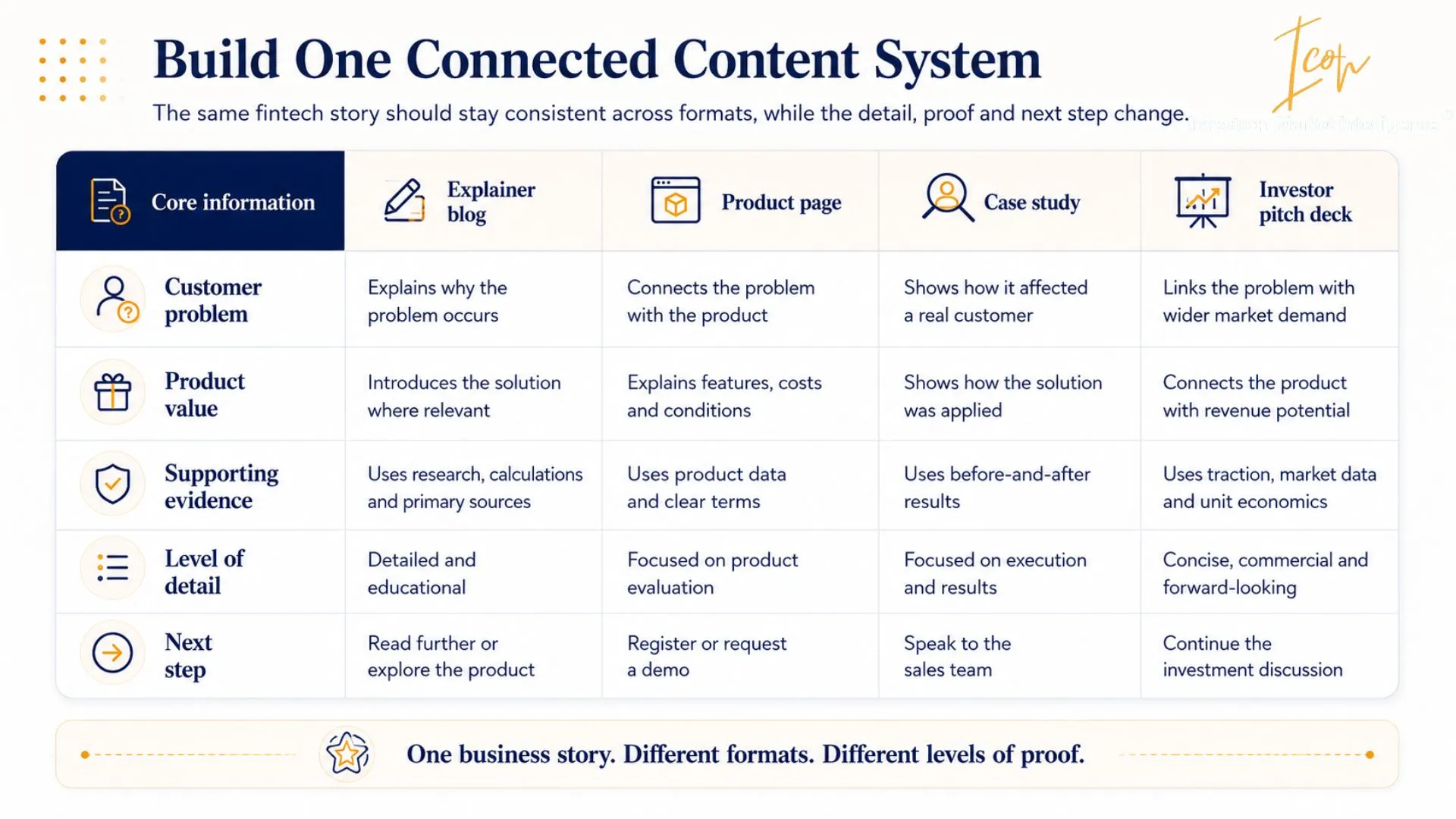
Consider an expense-management startup that helps finance teams gain better control over company spending. One customer problem can support several content formats, with each format developing a different part of the story.
Explainer Blog
Possible topic: Why Manual Expense Reporting Limits Spend Visibility
The blog can explain how spreadsheets, delayed submissions and missing receipts affect reimbursements, reporting accuracy and financial control.
Product and Onboarding Content
The product page can show how the startup addresses the issues discussed in the explainer blog.
It may connect approval controls, automated categorisation and real-time reporting with specific customer problems. Pricing, eligibility, integrations, setup requirements and limitations should also be easy to find.
Onboarding content continues the same explanation after registration. Welcome emails, policy-creation prompts and employee invitation guides can help users complete their first expense workflow.
The blog explains why the problem matters. Product and onboarding content show how the solution works in practice.
Thought Leadership
Possible topic: Expense Management Is a Control Problem, Not Just an Administrative Task
A founder-led article can take a stronger position on the same issue. It may explain how delayed expense reporting affects cash-flow visibility, budgeting and financial decisions.
The argument should draw from customer conversations, product usage patterns or finance-team workflows. It should not repeat the features already listed on the product page.
This format helps the startup demonstrate how it understands the market. It can also support founder positioning, media commentary and enterprise sales conversations.
Case Study
Case studies show what changed after a customer started using the product. The strongest ones begin with the earlier process, explain what was introduced and compare the result over a clear period.
For example:
Monthly reconciliation time dropped from 26 hours to 11 hours in four months. Missing-receipt cases also fell by 32%.
Specific results give sales and partnership teams something concrete to work with. The figures should come from approved customer data, even when the client’s name cannot be disclosed.
A vague statement such as “the platform improved efficiency” may sound positive, but it gives a buyer little reason to believe the claim.
Investor Pitch Deck
The investor pitch deck uses the same customer problem to explain a wider business opportunity.
For example, the argument could develop like this:
Mid-sized businesses still rely on spreadsheets and manual approvals to manage employee expenses. This increases reconciliation time, delays reimbursements and limits real-time control over company spending.
The deck can then add product evidence. One customer, for instance, may have reduced monthly reconciliation time from 26 hours to 11 hours in four months, while missing-receipt cases fell by 32%.
From there, the market opportunity becomes easier to frame. If 25,000 businesses face the same problem and the average annual subscription is ₹1.2 lakh, the target segment represents a potential revenue pool of ₹300 crore.
The figures above are illustrative. In an actual deck, they should come from market research, customer data and the startup’s pricing model.
By this stage, the startup has developed the full story, from the customer problem and product response to measurable proof and market opportunity. That research can now be adapted for other channels without rebuilding the argument from the beginning.
Repurpose the Research Across Channels
The research behind these formats can also support shorter content without repeating the full article.
For example:
- A workflow from the explainer blog can become an infographic
- A founder insight can become a LinkedIn post or short video
- A comparison from the product page can become a sales one-pager
- A case-study result can appear on a landing page
- A market figure can support an investor-deck slide
- The wider topic can become a webinar or email series
Repurposing should reuse the insight, data and research rather than copy the same wording across channels.
A LinkedIn post may focus on one sharp observation. A webinar needs more context and discussion, while an investor slide may require only one chart and its commercial implication.
Repurposing helps a fintech get more value from its research. As the content library grows, though, managing it becomes a larger job in itself.
How Can a Fintech Scale Its Content?
In the early stages, founders and product teams may review every article and website update. This works while the content volume remains small.
Growth changes the workload. A team producing five blogs a week may soon need 50 monthly articles, several product pages, video scripts and investor material.
Demand may also be uneven. A product launch could require 20 pages within a few weeks, followed by a quieter month. Pricing or eligibility changes may then need updates across the website, emails and sales content.
An internal team remains important because it understands the product and brand closely. Building every specialist role in-house, though, can be costly for a startup. Some months may need more financial research, while others require scripts, reports or investor communication.
External support can fill these gaps without replacing the internal team. Under a hybrid model, the fintech controls strategy and approvals while specialists handle research, writing and editing.
A fully outsourced model can also work when the startup does not yet have a dedicated content function.
Investcon supports both approaches. We can work alongside an existing team or manage the wider content programme, from financial blogs and product content to reports, scripts and investor communication.
The fintech retains control of its message. External support provides the capacity and finance knowledge needed as content demands grow.

- 2 Bar Reversal Indicator - August 31, 2026
- Insurance Content Writing: How to Explain Policies Without Losing Readers - August 17, 2026
- Why Every Wealth Management Firm Needs an Industry Report (Not Just a Blog) - August 12, 2026