In a conversation between Jenny and Joel, two people who won the lottery, they were both very happy because of their good luck. They were aware that this would not be enough since the amount of money they got could not go very far. Jenny has always been known for her habit of saving and managing her finances wisely, but Joel wanted to invest and earn more money from what they have won.
Joel told them that investing in distressed real estate, where problems become an opportunity for growth, could earn a lot of money in the long run. The point Joel tried to make was that you don’t need a finance background to become an investor – all you need is the answers to seven simple questions, where the first question is the most important one.
The Takeaway:
Financial literacy is not about forecasting the market. With an increasing number of investors and investment opportunities, the habit of asking good questions may become your best defence. Therefore, the next time you come across an investment discussion, emulate Joel and not Jenny.
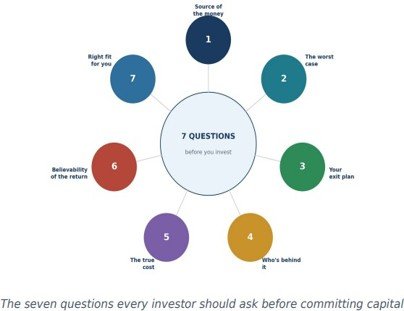
7 Questions to Ask Before Investing Your Money
Q1. Where Does the Money Really Come From?
All real gains have a source. So what is the source of our gain? Stressed real estate gains do not come from hype. It comes from solving a certain problem — like litigation, a stalled deal or unpaid loan — and recovery of the value of the property. The usual investment argument goes: “The source of any real gain can be expressed in one sentence.”
Q2. What is the Worst-Case Scenario?
The issue needs to be reframed from “How much can I earn?” to “How much could I lose?” This is because there are issues such as unclear title or incomplete construction that make the property inexpensive. When investing, one must think about all potential problems before profits.
Q3. Will I Be Able To Exit My Investment And How Quickly?
Liquidity impacts the value of any investment; while one can easily sell shares, real estate and AIFs are examples of assets that may be illiquid. Illiquidity is not necessarily a bad thing; do not put in money that you might need in the near future. Always match your investment horizon with your planned exit.
Q4. Whose Is It, and Who’s Watching Them?
The deal that you make is never really an opportunity but always a person or organization that takes your money on trust. In India, Alternative Investment Funds (AIFs) are privately held funds operating beyond the realms of stocks and bonds, such as real estate and private equity. They are regulated by SEBI and RBI and are classified according to their strategy. Always verify registration via SEBI’s or the Ministry of Corporate Affairs websites.

Q5. How Much Is This Really Going To Cost Me?
Costs will impact the returns that you receive because of compounding reasons. It is important to always ask for the entire fee structure in writing, along with any exit charges. In the case of an Alternative Investment Fund, all these details are outlined in the Private Placement Memorandum — read it thoroughly and ask the fund manager to explain every part.
Q6. Is It A Realistic Return?
When the offer sounds too good to be true, it is suspicious in nature. With higher returns from any investment, the risk associated with it increases. Legitimate investments can show past performance, but they can’t promise what will happen in the future.
Compare the promised return with things you already know. If the number is much higher than those, ask what extra risk you’re being offered. A clear and honest answer is the green signal.
Q7. Is This Suitable For Me?
Responsible investment considers individual circumstances such as time frame, earnings, and portfolio already on hand. Even the best-managed and well-regulated funds may not be suitable for all investors. Alternative funds appeal to individuals who are willing to invest for a longer period and accept higher risk. A wise investor chooses “no” for the right reasons, not “yes” impulsively.
The Hidden Eighth Factor: You
Why do people make poor financial decisions? Because making investments is not simply mathematics. It is natural to feel more comfortable doing what everyone else is doing, but that does not always work for you.
Your 60-Second Checklist
Before you invest, can you say yes to all of these?
- I understand the source of the
- I am aware of the major risks and possible
- I understand how and when to get
- I have investigated who manages the project and regulates
- I understand all the
- The expected return corresponds to the
- It fits my goals, timeline and
Should you choose “no” or “unsure” on any of these, don’t worry — it is the beginning of your journey. Conduct more research, ask more questions, and consult a qualified and registered professional.
Insight Into: Alternative Investment Funds (AIFs)
Alternative Investment Funds provide investment opportunities which are not available in traditional investment vehicles to qualified investors. Depending on the nature and objectives of the fund, AIFs may allocate capital to private equity, real estate, private debt, distressed assets, and other specialised sectors. Just because an AIF is registered doesn’t mean it is going to give good results. Past performance may not be a reliable indicator of future performance. Always study the Private Placement Memorandum before investing — understand the strategy, fees, liquidity, eligibility, and consult professional advisers.
Why is “Stressed Property” a Good Case Study?
In dealing with stressed property, there is a need for careful analysis. This involves examining the status of the property itself, its legal status, progress of the project, funding details, possible exit options, demand in the area, and the time required to recover value.
About This Guide
This article is based on investor education material provided by GHL India Ventures, a Chennai-based, SEBI-registered Category II Alternative Investment Fund (Registration No. IN/AIF2/24-25/1517) that specialises in stressed real estate. The information is shared here only for the purpose of improving financial literacy — helping people think better while making financial decisions.
Author: Dr. Bennet J Ragland, Vice President at GHL India Ventures
Disclaimer: This is informational only; it isn’t financial or legal advice. All investments carry risks, and professional consultation is recommended before any decision.

- Before You Invest a Single Rupee: 7 Questions to Ask - October 12, 2026
- Mainboard IPOs in India: How to Evaluate a Mainboard IPO Before Investing - October 12, 2026
- White Papers vs Case Studies: Fintech Trust Explained - October 8, 2026