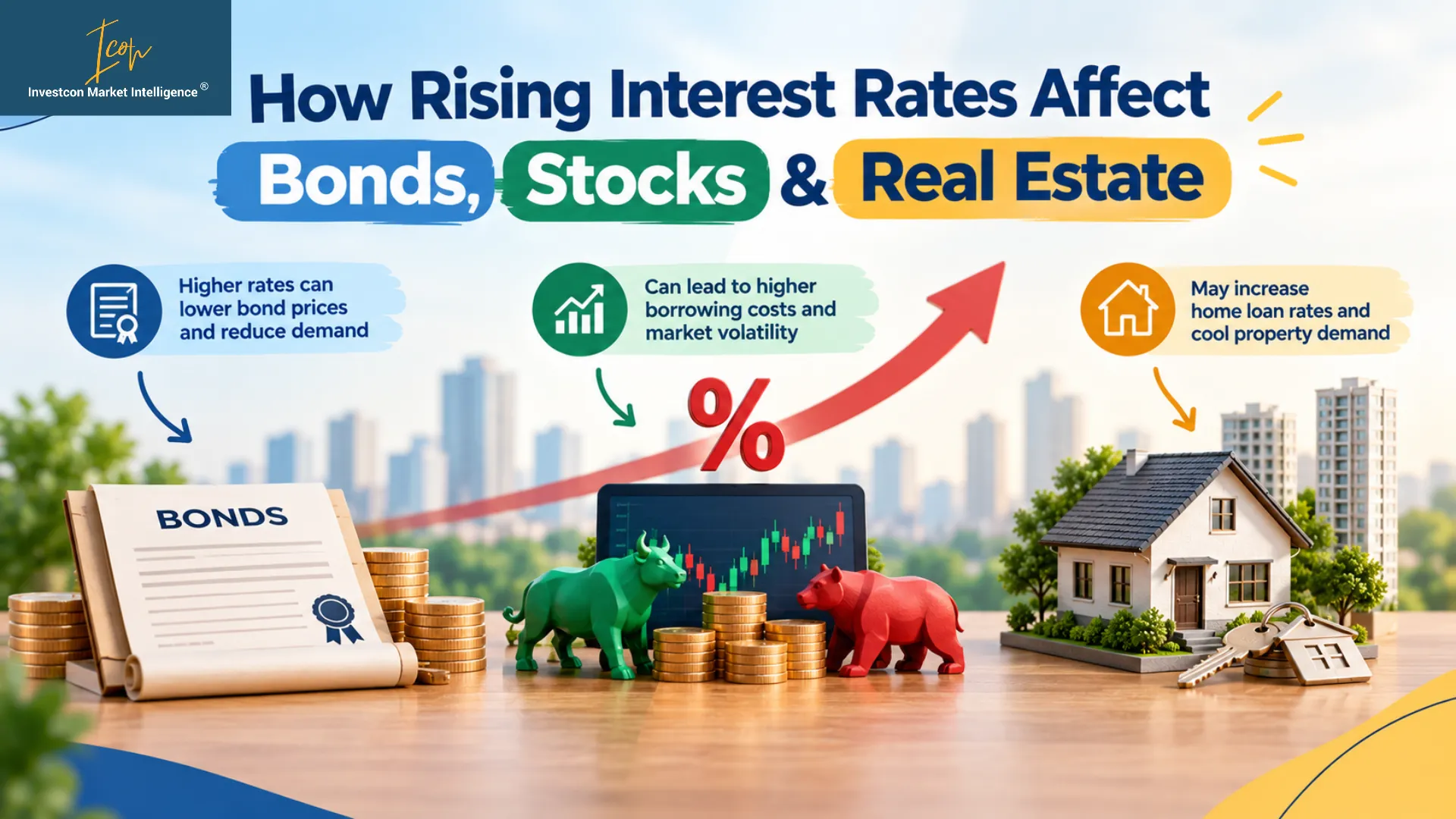
Interest rates are a significant factor in financial markets because they affect the cost of borrowing, investment returns, consumer spending, and business development. Higher interest rates mean that people will have to pay more on their mortgages, businesses will face higher financing costs, and investors may change how they allocate their funds.
This will lead to an influence of interest rates on various financial instruments. Knowledge of the effects of rising interest rates on Indian investments can impact investors assess market risks, compare financial instruments, and make sound financial decisions.
However, rising interest rates do not influence all types of investments in the same manner. The prices of bonds can drop, stock prices may come under pressure, and real estate can become less attractive due to high borrowing costs. However, some banks will be able to profit from this situation.
Quick Answer:
Rising interest rates in India make borrowing more expensive for individuals and businesses. They can put pressure on stock prices, reduce the market value of existing fixed-rate bonds, and affect property demand due to higher loan costs. Some banks may benefit, depending on their lending and deposit costs. Investors should review their portfolio, debt levels, and risk exposure when interest rates rise.
Key Takeaways
- Rising interest rates in India are affecting investments, with lower bond prices, lower equity valuations, and higher EMI costs for housing loans.
- The effects of rising interest rates on banks can be viewed through their lending margins, borrowing costs, and borrowers ability to repay loans. Although banks might see higher returns from increased interest rates, they may face various factors that can hinder profitability.
- For investors operating in an environment of rising interest rates, there are various issues to consider. Some of these issues include bond duration, debt levels, and liquidity requirements.
Increasing Interest Rates Explained
Interest rates are the cost of borrowing or the returns earned when money is lent. The Reserve Bank of India (RBI), which formulates the country’s monetary policy, uses the repo rate as a tool to achieve this objective.
An increase in the repo rate occurs when inflation remains high or when there is a need for stricter monetary policy. The lending and deposit interest rates may rise, but their frequency and magnitude may differ from bank to bank and from one financial product to another.
Higher interest rates discourage borrowing and spending because loans become relatively costly. Saving can be encouraged because some deposits and debt securities become attractive. The consequences affect business earnings, real estate transactions, bond valuations, and stock market performance.
Rising Interest Rates Impact Across Asset Classes

The effects of rising interest rates vary by asset type. They affect bonds, equities, real estate, and banks in different ways. Comparing these effects can help one to identify investment risks.
| Asset class | Potential impact | Important factor to monitor |
| Bonds | Existing fixed-rate bond prices may fall | Duration and credit quality |
| Stocks | Valuations and earnings may face pressure | Debt, cash flow, and valuation |
| Real estate | Loan affordability and demand may weaken | Mortgage costs and rental demand |
| Banks | Margins may improve or contract | Deposit costs and credit quality |
1. Bonds
The Repo rate was raised by the Reserve Bank of India to 5.50% on 7th October, 2026. In the Indian government bond market, the 10-year government bond yield rose to 7.25% from 7.19% (an increase of 6 basis points).
The yield on the 10-year government benchmark bond in India rose to 7.35%, which is its highest in the past three years.
What caused it?
- With the rise in the repo rate, further monetary easing became less likely in the near future.
- The subsequent steps taken by the RBI to tighten liquidity such as, plans for an open market sale of ₹25,000 crore of government securities.
What effect did it have on the investor?
When investors’ demand for a higher yield is increasing, the market value of a previously issued fixed-coupon bond falls. As in the case of an old bond with a fixed interest rate of 6.94%, as compared to the newer investments that provide higher yields, the price of such an old bond falls in order to make the yield competitive.
2. Real estate
When the RBI raised the interest rate to 5.50%, it resulted in a fall in share prices of major listed companies like DLF, Lodha Developers, Aditya Birla Real Estate, and Prestige Group in real estate on October 7. From the analysis of the market coverage, major listed real-estate stocks have been impacted negatively.
What is the cause of that?
- Real estate developers require money for purchasing land and constructing houses. This can result in increased interest payments due to the rise in interest rates.
- Higher EMIs for house buyers can result in an increase in the cost of buying a property.
- Increased financing costs and reduced demand may affect the valuation of real estate companies by investors.
3. Stocks
On 8th October, the decline trend continued with Sensex closing at 71,593.24, which is 1,045.46 lower than the previous session’s close, and the Nifty 50 closed at 22,231.80, which is 371.25 lower, or 1.64%.
Why did it happen?
- An increase in interest rates makes borrowing expensive for companies and lowers the present value of earnings.
- There was worry about inflation and monetary tightening.
- Higher crude oil prices, high bond yields, a weak rupee, and the sale by foreign investors were other reasons for the fall.
What was the impact of this change on investors?
If there is a fall in the index levels, this implies that the total market value of the shares has fallen. The investors in the stocks will have mark-to-market losses, and companies that have a lot of debt and are vulnerable to consumer expenditure might be under financial strain.
It should be noted that the drop in the market index on October 8th was not due solely to the RBI’s decision, since there were other factors that affected the market.
How did it impact the investors and home buyers?
Real estate stockholders witnessed a decline in the value of their stocks due to low stock prices. Floating interest rates may cause an increase in EMI payments or a longer repayment period if the conditions for the loan are changed.
An increase in financing costs can influence future demand for properties. A decrease in real estate stock prices does not necessarily mean a reduction in residential property prices.
Why Do Interest Rates Go Up?
Interest rates may go up for various reasons in economics. These include knowing how to assess whether interest rates will remain at elevated levels.
- Inflation: High inflation can compel a nation’s central bank to raise policy rates to cool demand and control inflation.
- Credit demand: If households and companies borrow excessively, then tight monetary policy can be implemented to prevent economic overheating and inflation.
- External environment: A change in global interest rates may affect capital flows, currency movements, and borrowing costs. Even when the policies of the RBI are driven mainly by domestic factors, there may be impacts of global events on India’s financial sector.
- Liquidity and inflation expectations: High inflation expectations and liquidity can lead to higher interest rates in financial markets. The government may have to borrow money, and the amount of bonds in the market can lead to high interest rates irrespective of the policy changes.
How Investors Should React When There Are Increases in Interest Rates
While investors cannot influence monetary policy, they can review the composition of their portfolios, their debt levels, the time horizons over which they invest, and their exposure to interest-rate-sensitive assets.
Rather than reacting to the possibility of higher interest rates, investors could focus on their vulnerability to financial stress and the characteristics of their investments.
Actual Measures for Various Asset Types
Below are measures that will help investors analyse their sensitivity to changes in interest rates.
- Duration of bonds: If investors are concerned about a rising interest rate environment, they could analyse the interest-rate risk of their bonds. Bonds with shorter durations are generally more insensitive to yield changes than those with longer durations.
- The valuation of stocks and debt must be assessed: Stocks with good debt levels, cash flow, and profit can support a higher cost of capital. Additionally, one should check whether stock valuations have accounted for optimistic growth projections.
- Assess the property’s affordability: The buyers must determine whether they can afford higher EMI levels and total expenditures.
Loan borrowers must assess the loan structure, loan amount, tenure, and additional repayment capacity.
- Ensure adequate liquidity: Emergency savings may reduce the need to sell investments during difficult market times. It is even more important for individuals with liabilities in the coming period.
- Diversification of assets: A diversified portfolio may ensure reduced dependence on any particular investment. Diversification does not guarantee against losses, and proper diversification depends on the individual’s goals and risk profile.
Factors behind the overall impact

Not all interest rate increases have the same effect. There are a variety of factors an investor needs to consider when deciding whether volatility or pressure will arise from interest rate increases.
- Inflation and Growth in the Economy: If interest rates rise due to higher inflation and strong economic growth, some companies could continue to earn money. However, in the event of interest rate increases and lower consumer demand, the company’s profits and earnings could face greater pressure.
- Nominal Interest Rates and Actual Return: Even though investments offering high nominal interest rates can sound good, they may deliver low actual returns in the presence of higher inflation.
- Expected Increase in Interest Rate Duration: Expectations about future interest rate increases are as important as current developments. In the event of higher interest rates over the next couple of years, there would be greater pressure on the valuations of long-term bonds, companies with debt, and property companies.
Bottom line
Increased interest rates affect bonds, shares, real estate, and banking operations through borrowing costs, investment pricing, consumer demand, and the state of the economy. Prices for fixed-rate bonds usually fall when market interest rates rise, whereas shares may face higher discount rates and higher company financing costs.
FAQs
Q: Why do bond prices go down with an increase in interest rates?
Ans: Whenever bonds with higher interest rates than previous bonds are issued, these older bonds become unpopular, and their prices drop until they become relatively attractive at current interest rates. This drop depends on duration, maturity, coupon rate, and credit ratings, among other factors.
Q: What are some examples of stocks that are greatly influenced by rising interest rates?
Ans: Highly geared stocks, real estate developer stocks, auto company stocks, stocks with future earnings potential, among others. However, the impact of rising interest rates varies depending on factors such as the company’s condition and its stock price.
Q: Does an increase in interest rates cause a decline in real estate prices?
Ans: This is not necessarily true. An increase in borrowing rates reduces purchasing power, thereby reducing demand and, consequently, causing prices to fall. On the other hand, scarcity of real estate property, employment levels, and demand for the property itself can raise its prices.

Lakshmi Sundari is a finance content writer and editor with over four years of experience across financial content and content strategy. She holds an MBA in Finance and writes on investing, personal finance and fixed-income markets. Her work spans long-form articles, PR, thought leadership, newsletters and social media, along with editorial planning and content strategy. She focuses on explaining financial developments and investment concepts through research-backed, practical writing.