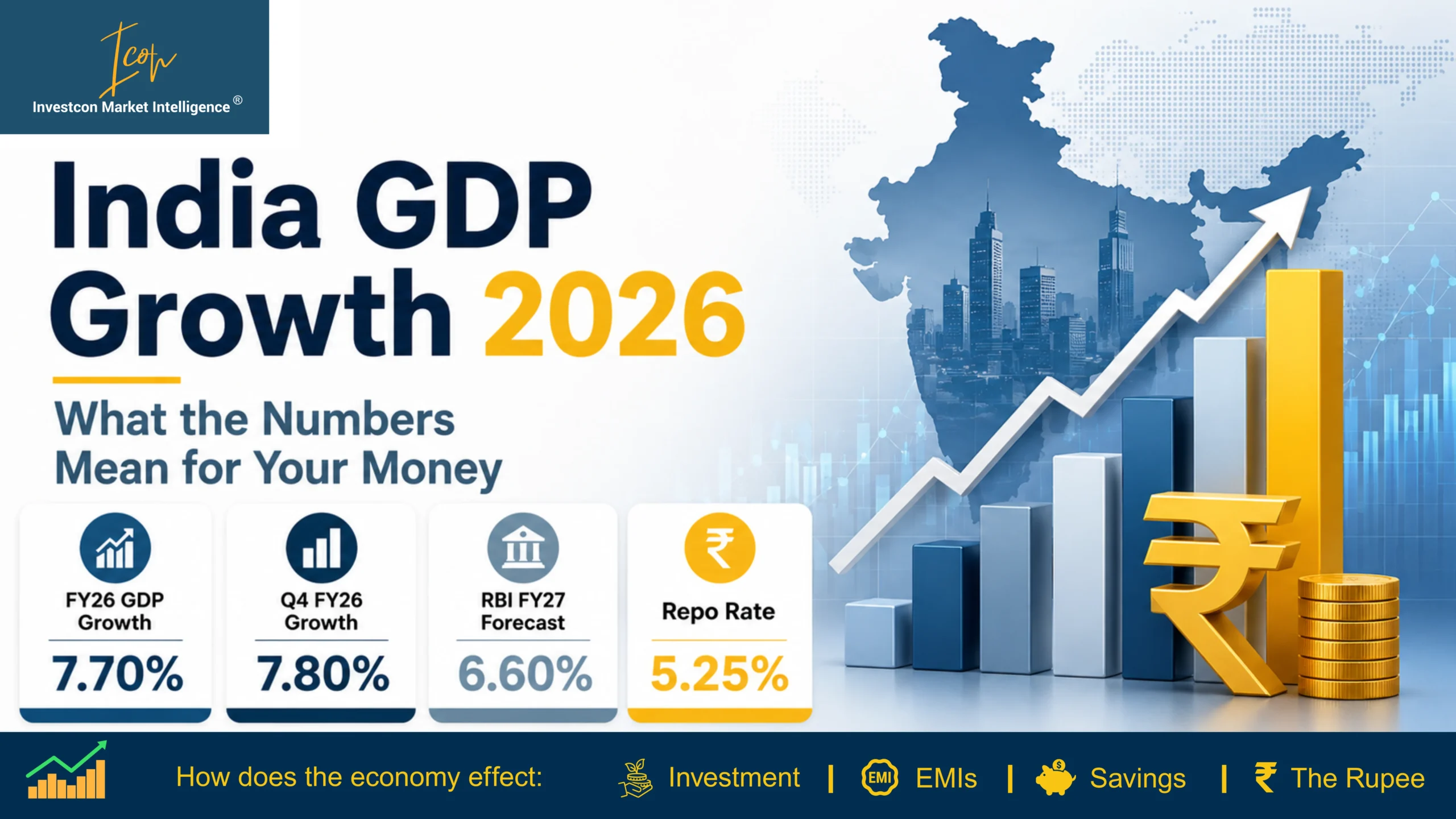
The Indian economy delivered a stronger-than-expected performance in FY26, with GDP growth accelerating to 7.70% and the January-March quarter expanding by 7.80%. The figures reinforce India’s position as the fastest-growing major economy in the world, supported by healthy domestic demand, investment activity, and resilience despite global uncertainties.
However, at the same time, the Reserve Bank of India (RBI) has adopted a cautious outlook for FY27, trimming its growth forecast to 6.60% amid concerns over geopolitical tensions, higher crude oil prices, weather-related risks, and supply chain disruptions.
As discussions around India projected GDP growth and the overall economic outlook gather momentum, investors are paying closer attention to what these numbers signal for the year ahead.
While the GDP may sound like a statistic reserved for economists, its impact reaches everyday finances. The India GDP 2026 investors impact extends across mutual fund performance, borrowing costs, job creation, and the rupee’s strength.
The economic growth also influences RBI policy decisions, making India projected GDP trends an important indicator for borrowers, savers, and long-term investors looking to understand what the latest growth figures mean for their money.
The Headline Numbers — What MoSPI’s Data Shows
India’s economic performance in FY26 exceeded expectations, with official data from the Ministry of Statistics and Programme Implementation (MoSPI) showing stronger growth than many economists had projected at the beginning of the year.
FY26 Full-Year Growth: 7.70% vs 7.10% in FY25
The Real GDP grew by 7.70% in FY26, compared with 7.10% in FY25, according to MoSPI’s provisional estimates released on 20 June 2026.

The improvement was driven by stronger domestic demand, healthy government spending, and continued growth across manufacturing and services.
Despite global challenges, including geopolitical tensions and uncertain trade conditions, the Indian economy maintained a steady growth trajectory throughout the financial year.
For investors, this growth rate is significant because higher economic activity generally supports corporate earnings, business expansion, and employment generation.
Q4 (Jan–Mar 2026) Growth: 7.80%, Nominal GDP up 8.90%
The momentum strengthened further during the final quarter of the financial year.
India’s GDP expanded by 7.80% in Q4 FY26 (January-March 2026), surpassing market expectations and making it one of the strongest quarterly performances of the year. At the same time, nominal GDP, which measures economic output at current market prices, grew by 8.90% during the quarter.

While real GDP measures economic growth after adjusting for inflation, nominal GDP captures the actual rupee value of economic activity. Nominal GDP influences government tax collections, corporate revenues, and overall income generation across the economy.
It also provides an overview of economic activity by incorporating both real growth and price movements.
For those tracking the India GDP 2026 investors impact, the strong fourth-quarter numbers indicate that businesses have entered FY27 with solid momentum despite emerging global risks.
Sector Breakdown
While GDP measures the value of all goods and services produced in the economy, Gross Value Added (GVA) shows how much each sector contributes to that output. In simple terms, GVA helps identify which parts of the economy are driving growth and ultimately feeding into overall GDP expansion.
According to MoSPI’s FY26 data, growth was broad-based across major sectors. The Financial, Real Estate, IT, Professional Services and Ownership of Dwelling segment accounted for the largest share of nominal GVA at 26.00%, highlighting the dominant role of services in India’s economy.
It was followed by Agriculture, Livestock, Forestry and Fishing, which contributed 18.00%, underscoring the continued importance of the rural economy alongside the services sector.


Why is the RBI Still Cautious?
India’s FY26 growth numbers were stronger than expected, but the Reserve Bank of India is looking beyond the recent performance and focusing on risks that could affect growth and inflation in FY27.
While domestic demand has stayed resilient, policymakers believe global developments could create fresh challenges in the months ahead.
Repo rate held at 5.25%, neutral stance
Since initiating its rate-cut cycle in February 2025, the RBI has reduced the repo rate four times, bringing it down by a cumulative 1.25 percentage points. However, during its June 2026 policy review, the central bank opted to keep the benchmark rate unchanged at 5.25%.

FY27 growth forecast cut to 6.60% from 6.90%
Despite India’s strong FY26 performance, the RBI lowered its India projected GDP growth forecast for FY27 to 6.60%, down from its earlier estimate of 6.90%. The central bank believes the economy remains resilient, but emerging global and domestic risks could slow the pace of expansion compared with the previous year.
The revised forecast reflects a more cautious assessment of the economic environment rather than concerns about any immediate weakness in domestic demand.
The West Asia conflict, oil prices, and the import bill risk
A major concern for policymakers is the ongoing conflict in West Asia. India imports a large portion of its crude oil requirements, making the economy sensitive to disruptions in global energy markets.
The risk of volatility in crude prices can increase transportation and manufacturing costs, push inflation higher, and widen the country’s import bill. The RBI has also highlighted risks from supply chain disruptions, commodity price volatility, weather-related uncertainties, and the possibility of weaker agricultural output if monsoon conditions become unfavourable.
Together, these factors could weigh on both economic growth and consumer spending during FY27.
What Does This Mean for Your Money?
Economic growth may appear to be a macroeconomic statistic, but it can influence everything from investment returns and borrowing costs to savings decisions.
For Equity & Mutual Fund Investors
A growing economy generally creates a favourable environment for businesses. Higher consumer spending, rising investments, and expanding economic activity can support corporate earnings over time, which is positive for equity markets and equity-oriented mutual funds.
However, strong GDP growth does not guarantee a smooth market journey. Investors should also consider factors such as foreign institutional investor (FII) movement, global market sentiment, crude oil prices, and currency movements.
For example, sustained FII outflows or a weaker rupee can create short-term market volatility even when the domestic economy is performing well.
In the case of long-term investors, the key takeaway is that the India GDP 2026 investors impact is overall positive, but market movements may not always mirror economic growth in the short run.
For Borrowers
The RBI’s decision to keep the repo rate unchanged at 5.25% means borrowers are unlikely to see significant changes in loan EMIs immediately. The home loans, vehicle loans, and other floating-rate borrowings might remain broadly stable as long as policy rates stay unchanged.
That said, future developments could alter the outlook. If economic growth slows than expected and inflation remains under control, the RBI could consider further rate cuts. Conversely, if inflation rises because of higher commodity prices or external shocks, the central bank may choose to keep rates elevated for longer.
For now, borrowers can view the current environment as one of relative stability rather than expecting immediate reductions in borrowing costs.
For savers
A moderation in India projected GDP growth does not necessarily mean savers need to change course, but it may affect where they allocate their money. The fixed deposits, however, continue to offer predictable returns and may appeal to investors who want stability during periods of uncertainty.
Debt mutual funds can also play a role in a diversified portfolio, particularly when investors want lower volatility than equities. The suitability of either option depends on individual financial goals, risk tolerance, and investment horizon.
Rather than reacting to short-term economic forecasts, savers may benefit from maintaining a balanced allocation aligned with their long-term objectives.
SIP discipline during volatility
Market volatility can also increase when investors respond to changing growth forecasts, geopolitical developments, or central bank policy signals. While such fluctuations can create uncertainty, they are a normal part of investing.
For investors using Systematic Investment Plans (SIPs), maintaining discipline during periods of market volatility can help keep investments aligned with long-term goals.
Instead of making decisions based on short-term market movements, a consistent approach allows investors to navigate changing economic conditions without constantly adjusting their strategy.
The lesson from India GDP growth 2026 is that strong economic growth can support long-term opportunities, but successful investing still depends on patience, diversification, and a focus on individual financial goals rather than short-term market noise.
Risks to Watch in FY27
Although India’s economic fundamentals are strong, the RBI has highlighted several factors that could influence India projected GDP growth in FY27. These risks do not guarantee a slowdown, but they are important variables that investors, borrowers, and policymakers will be monitoring closely.
Geopolitical tensions and crude oil prices
The RBI has identified developments in West Asia as one of the most significant risks to the economic outlook. India imports more than 85% of its crude oil requirements, making the economy sensitive to sustained increases in energy prices.
The volatility in crude oil prices can raise transportation and manufacturing costs, contribute to inflation, and affect household spending power.
While oil prices have recently eased as fears surrounding the Strait of Hormuz have moderated, policymakers continue to monitor the situation closely because any renewed disruption could quickly change the outlook.
Currency depreciation and current account deficit
A prolonged rise in oil prices could also affect India’s external balances. Economists have warned that higher energy imports could widen the country’s current account deficit, increasing pressure on the rupee.
A weaker currency makes imports more expensive and can add to inflationary pressures. The RBI has already intervened in foreign exchange markets to manage volatility after the rupee came under pressure amid global uncertainty and higher oil prices.
As a result, movements in the rupee and the current account deficit will remain important indicators for investors during FY27.
US tariff negotiations and trade deal timeline
Apart from energy-related risks, the RBI has also highlighted uncertainty surrounding global trade and tariff policies. Ongoing trade negotiations and changes in tariff regimes can influence export demand, investment decisions, and global supply chains.
While India’s domestic demand remains relatively strong, a slowdown in global trade or delays in major trade agreements could affect export-oriented sectors and business sentiment.
The central bank, therefore, continues to monitor international trade developments as part of its assessment of future growth prospects.
Conclusion
India’s 7.70% GDP growth in FY26 highlights the economy’s resilience amid a challenging global environment. The country’s strong domestic demand, healthy investment activity, and broad-based sectoral growth helped to retain its position as the fastest-growing major economy, creating a supportive backdrop for businesses, investors, and consumers.
At the same time, the RBI’s decision to lower its FY27 growth forecast to 6.60% shows that policymakers are preparing for potential headwinds, including geopolitical tensions, commodity price volatility, currency pressures, and global trade uncertainties. These risks may influence market sentiment and economic activity in the coming months.
The key lesson for the investors, borrowers, and savers is to focus on long-term financial goals rather than short-term economic fluctuations. While growth may moderate from FY26 levels, India’s economic fundamentals continue to support opportunities across investments, savings, and wealth creation.
Monitoring future GDP trends, inflation, and RBI policy decisions can help individuals make more informed financial choices in an evolving economic environment.
FAQs
What was India’s GDP growth rate in FY26?
India’s GDP grew by 7.70% in FY26, according to the Ministry of Statistics and Programme Implementation (MoSPI). The economy also expanded by 7.80% in the January-March 2026 quarter, reinforcing India’s position as the fastest-growing major economy.
Why did the RBI reduce its FY27 GDP growth forecast?
The RBI lowered its FY27 growth forecast from 6.90% to 6.60% due to concerns about geopolitical tensions, crude oil price volatility, weather-related uncertainties, supply chain disruptions, and global trade risks that could affect economic activity.
How does GDP growth affect mutual fund investors?
The high economic growth can support corporate earnings, business expansion, and market sentiment over time, which may benefit equity-oriented mutual funds. However, factors such as FII flows, global events, and interest rates can still create short-term market volatility.
Will the RBI’s neutral stance affect loan EMIs?
A neutral stance means the RBI is not signalling an immediate rate hike or rate cut. As a result, most floating-rate loan EMIs are likely to stay broadly stable in the near term unless economic conditions change significantly.
Why is crude oil important for India’s economic growth?
India imports 85% of its crude oil requirements. The high oil prices can increase transportation and production costs, raise inflation, widen the import bill, and affect consumer spending, making crude oil a key factor in the country’s growth outlook.