The stock market in India had 13.7 crore unique registered investors as of September 2026, according to the National Stock Exchange (NSE). With crores of Indians already participating in the stock market, you might be tempted to try your hand at trading too.
But would you risk your hard-earned money on a trading strategy you have never tested? This is where paper trading helps you.
It lets you buy and sell stocks using virtual money, helping you practise strategies, understand market movements and learn from mistakes without risking actual capital.
But which platforms offer the right tools for this practice? What are the best paper trading apps in India? Let us explore the top 5 platforms worth considering in 2026!
Quick Answer:
Paper trading allows beginners to practise buying and selling stocks, options and other financial assets using virtual money without risking real capital. The article compares five popular paper trading apps in India: FrontPage, ZeroStake, Virtual Trading App 2.0, Neostox and Stock Trainer, covering their features, virtual capital, market coverage and pricing. It also explains how to choose a suitable platform, understand risk management and recognise the limitations of simulated trading.
Key Takeaways
- The best paper trading apps in India include FrontPage, ZeroStake, Virtual Trading App 2.0, Neostox and Stock Trainer, based on Indian market coverage, virtual trading facilities and data quality.
- Paper trading allows you to practise stock market trading, understand different order types and track your P&L without risking actual money.
- Market coverage, data delays, virtual capital and risk management tools determine how useful an app is for trading practice.
What is paper trading?
Paper trading is a simulated method of practising buying and selling financial assets, including stocks, crypto, options or foreign exchange, using virtual cash instead of real money.
Originally, traders wrote down their hypothetical trades on paper.
Today, it is done digitally through stock market simulators and platform tools like screening platforms or brokerage apps that track live or delayed market prices in real time.
Here, you are given a fake account balance, say 5,000, to place orders. With this, you can interact with charts, order books and real market pricing without spending your real money.
It helps you to test various order types, including market orders, limit orders, stop-losses and take-profit targets.
The system also calculates your hypothetical profit and loss (P&L), win rates and portfolio growth, so that you learn from past actions.
Explore our guide to technical analysis for beginners to understand how traders use price movements, trends and indicators!
Best Paper Trading Apps in India 2026
The following are the best paper trading apps in India as of 17 November 2026, selected based on their Indian market coverage, virtual trading facilities, market data quality, available trading tools and accessibility.
They are ranked according to their suitability for practising different trading strategies, with significant weight given to Indian market support and simulated order execution.
1. FrontPage
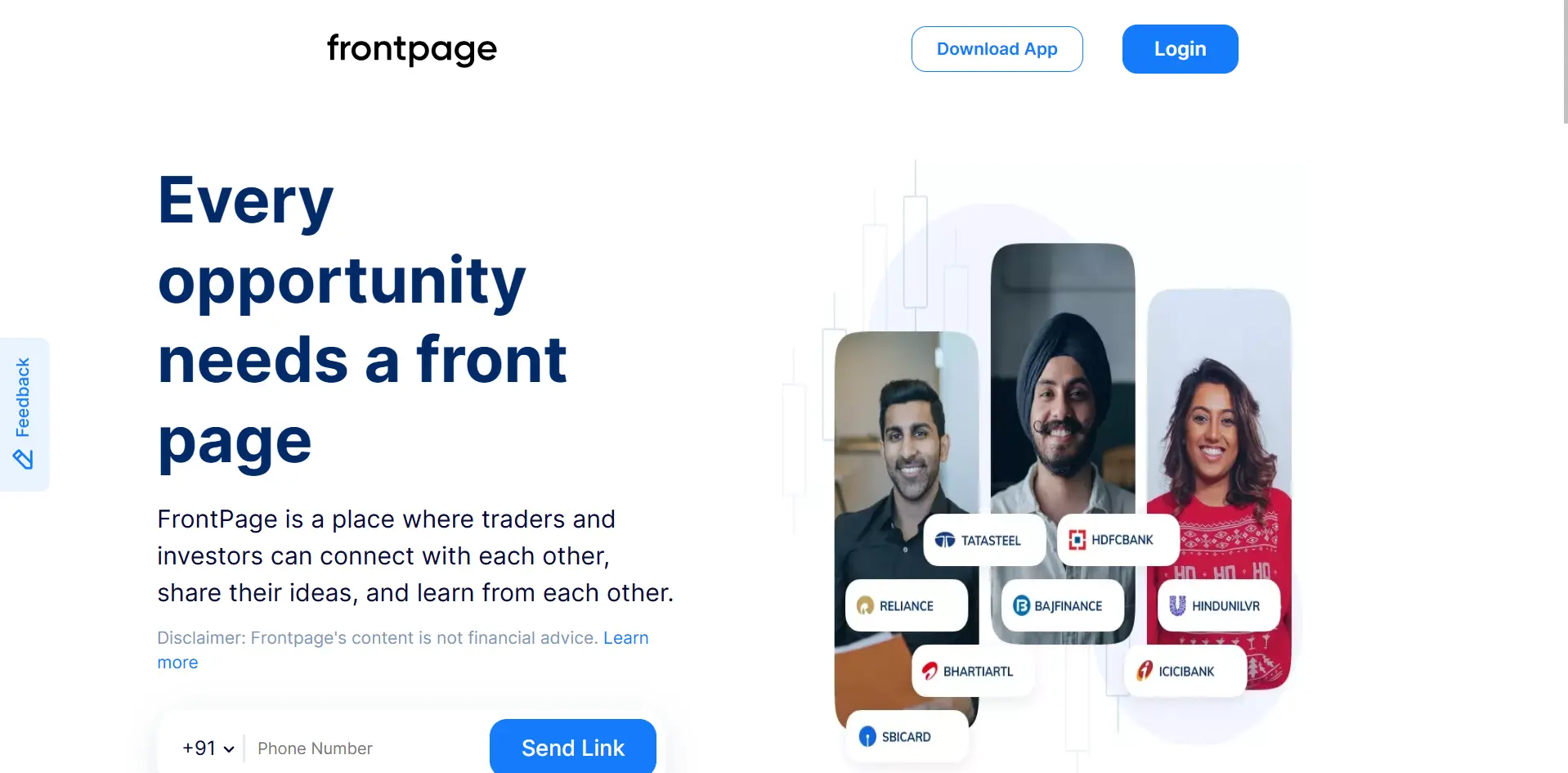
FrontPage provides a good starting point for beginners who want to practise trading Indian stocks and derivatives. The platform provides ₹10 lakh in virtual money and allows trading NSE stocks, futures and options at market prices. You can track profit and loss (P&L), win rates and trade history.
The app is free to use, with an optional premium subscription. It allows you to maintain a trading journal and discuss strategies with other traders on the platform, which makes it useful for learning and reviewing trades.
2. ZeroStake
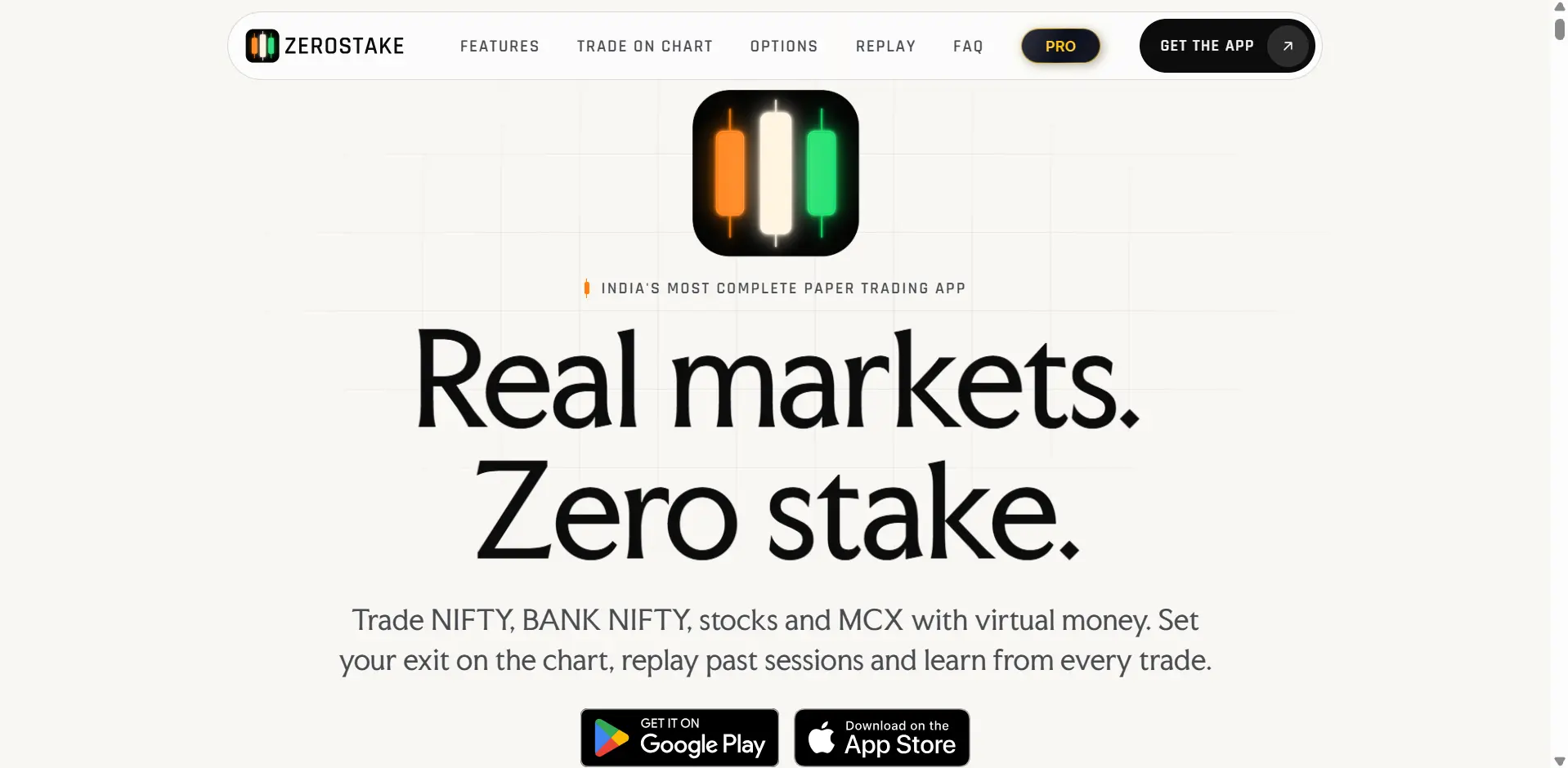
ZeroStake is best for advanced trading practice. It covers NSE and BSE stocks, indices, F&O, along with selected MCX contracts. Its features also include an options chain, basket orders, stop-loss, target orders, trailing stop-loss and historical market replay.
The app is free to download and allows you to start with a default of ₹5 lakh of virtual money, while ZeroStake Pro allows setting custom amounts from ₹10 up to ₹10 crore. Its tools such as LiveFill and Strategy Builder require ZeroStake Pro.
Interested in practising options strategies? Explore our guide on how to practise options trading without real money in India!
3. Virtual Trading App 2.0
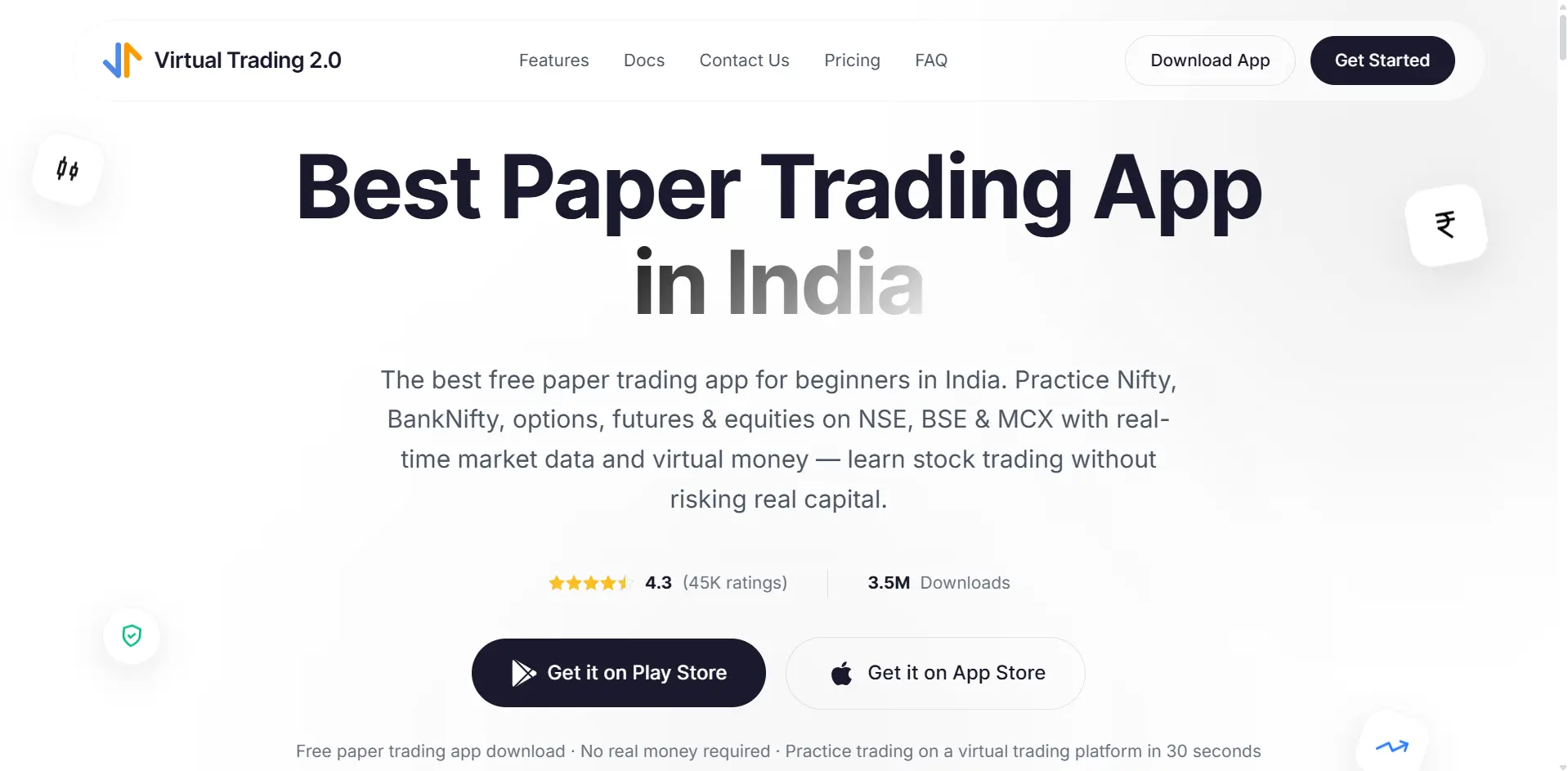
Virtual Trading allows its users to practise trading NSE, BSE and MCX instruments starting with ₹10 lakh in virtual capital. The app mainly covers Indian stocks and derivatives (futures and options), along with live market prices, watchlists, charts and P&L tracking.
While its free plan allows two trades daily, with two additional trades available after watching an advertisement, the paid plans offer unlimited trades, advanced orders, stop-loss and target settings.
4. Neostox
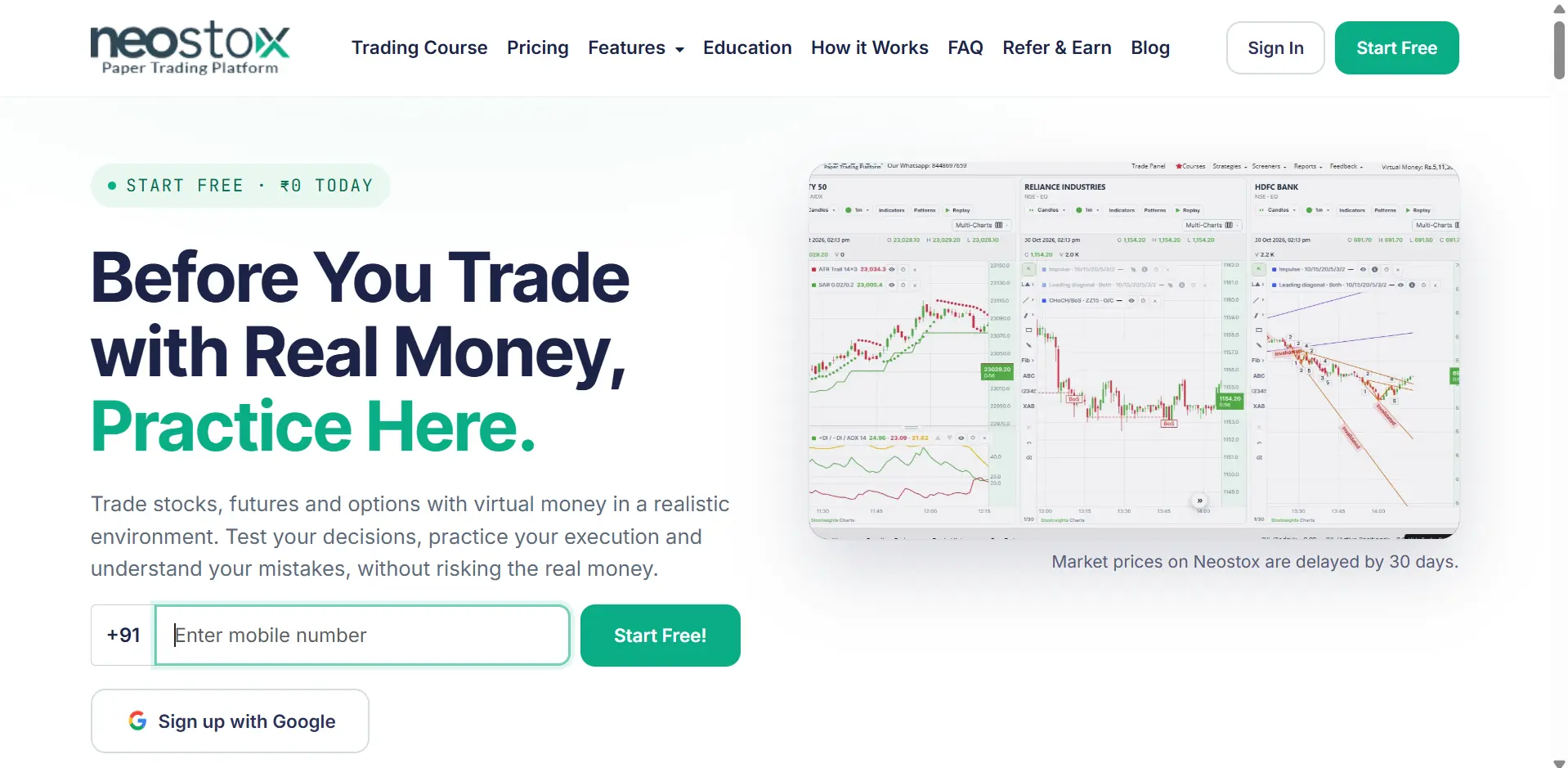
Neostox is an educational paper trading app that allows you to practice stocks, futures and options trading. Its tools include advanced charts, technical indicators, screeners, options chains and basket orders.
The app offers a 3-day free trial, after which you can use a paid subscription for virtual capital of ₹5 lakh on its Basic plan, ₹20 lakh on Silver and ₹1 crore on Gold.
However, its market prices are delayed by 30 days, limiting its use for current intraday practice.
5. Stock Trainer: Virtual Trading
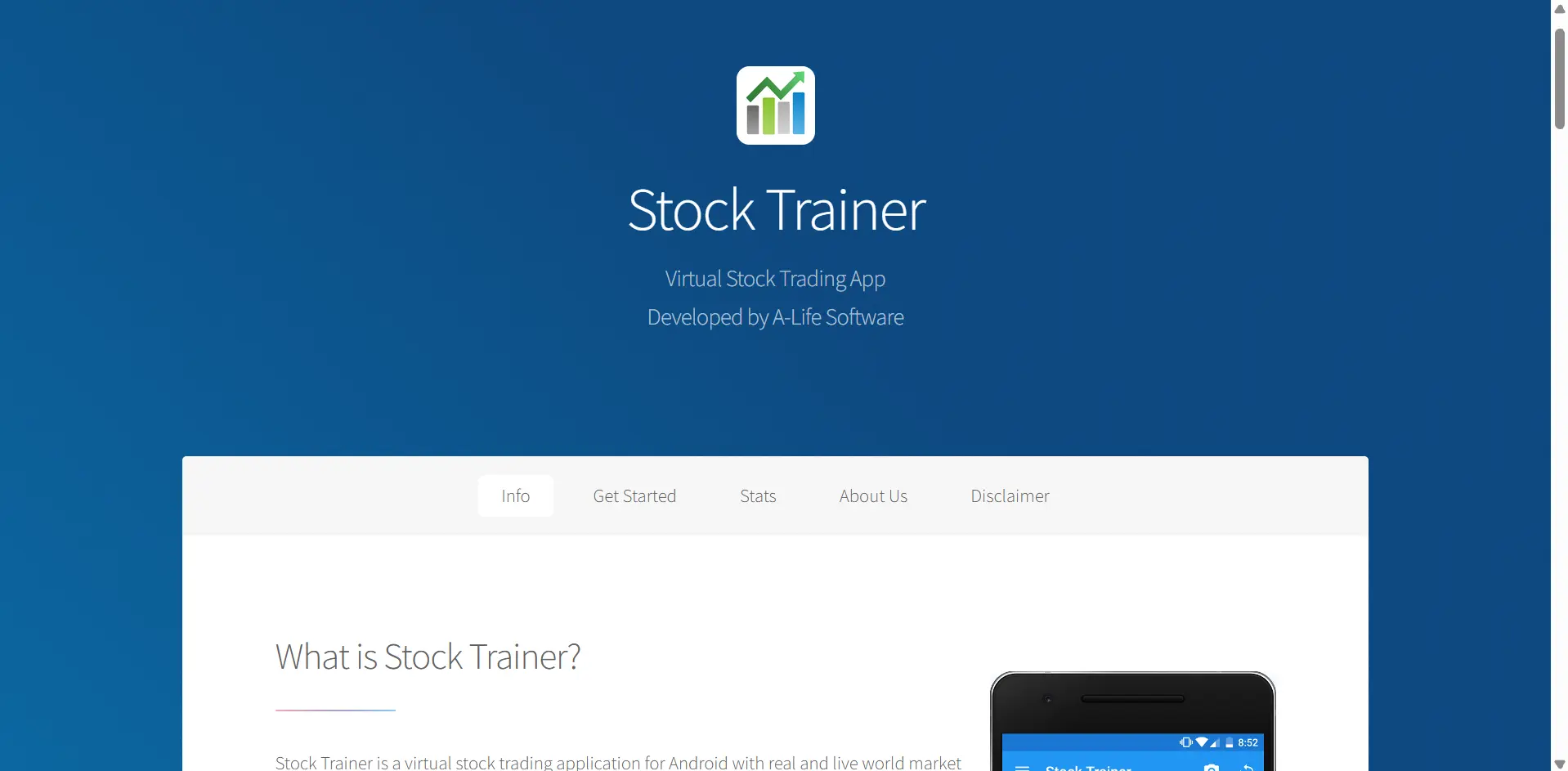
Stock Trainer, developed by A-Life Software, is suitable for beginners who want to practise stock trading across Indian as well as international markets.
The app supports NSE, BSE, NASDAQ, Dow Jones and S&P markets, along with access to stocks across 15+ countries.
Its features include virtual portfolios, watchlists, stop-loss orders, charts, technical indicators and market news. The app is free to use and provides limited virtual cash upon registration, while its optional premium version offers ad-free access, candlestick charts and cloud backups.
Note: Paper trading platforms are educational tools and are not substitutes for SEBI-registered stockbrokers. SEBI advisory issue in November 2024 cautions users against using unauthorised virtual trading and gaming platforms that involve listed securities’ market data.
Comparison of the Best Paper Trading Apps
Here is a comparison of the best paper trading apps discussed above:
| Features | FrontPage | ZeroStake | Virtual Trading App 2.0 | Neostox | Stock Trainer |
| Virtual Capital | ₹10 lakh | ₹5 lakh (default) | ₹10 lakh | Basic: ₹5 lakh; Silver: ₹20 lakh; Gold: ₹1 crore | Limited starting virtual cash |
| Market Coverage | NSE stocks, F&O | NSE, BSE, F&O, MCX | NSE, BSE, MCX | Stocks, futures and options | NSE, BSE and international markets |
| Data Feed | Live market data | Market-linked prices, may vary slightly | 15-minute delayed (Free), real-time (Pro) | 30-day delayed market data | Real market data; delay may vary |
| Key Features | P&L, trading journal, community | Options chain, basket orders, strategy builder | Live prices, charts, watchlists | Screeners, indicators, options chain | Virtual portfolios, charts, technical indicators |
| Pricing | Free, optional premium | Free, optional Pro | Free and paid plans | 3-day trial, paid plans | Free, optional premium |
| Best For | Beginners and community learning | Advanced trading strategies | Basic Indian market practice | Options trading practice | International stock market practice |
How to Choose the Best Paper Trading App
A paper trading app should reflect the market conditions and trading decisions you want to practise.
The following are the key factors you should consider before picking one:
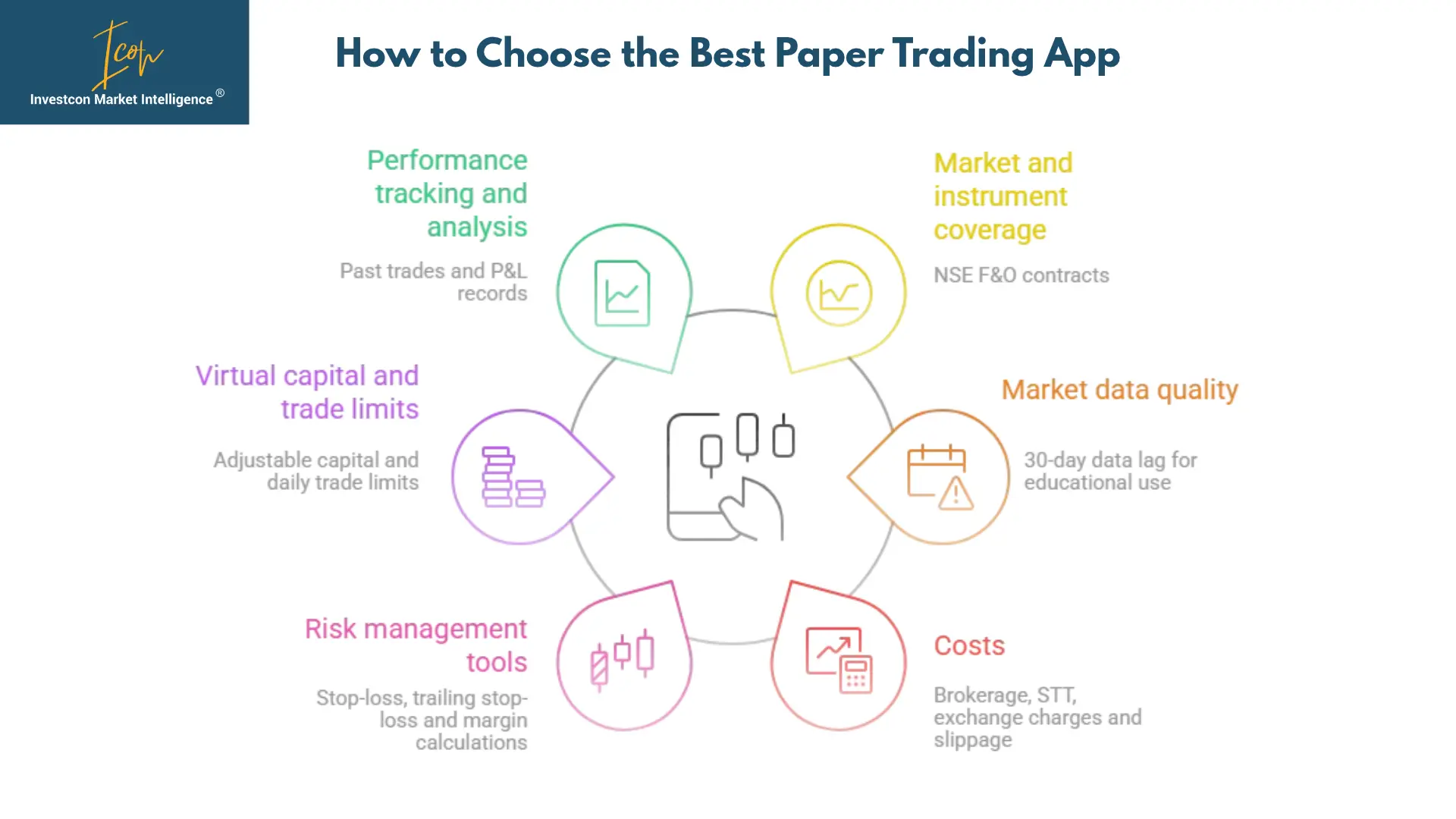
- Market and Instrument Coverage: All the stock trading apps do not cover everything, for example, futures and options. If you practise Nifty or Bank Nifty trading, you need an app that covers NSE F&O contracts.
- Consideration of Costs: The brokerage, STT, exchange charges and slippage reduce your actual trading profits. When the apps ignore such costs, it can show higher profits than traders might actually earn in the real markets.
- Risk Management Tools: Stop-loss, trailing stop-loss and margin calculations help practise risk management. Without these tools, it becomes difficult to understand potential losses, especially in futures and options trading.
- Virtual Capital and Trade Limits: The amount of virtual money provided by an app determines how much you can trade in the simulator. In this regard, adjustable capital can allow you to practise different trade sizes. But daily trade limits can restrict repeated practice.
- Performance Tracking and Analysis: The past trades and P&L records help in identifying profitable strategies and repeated mistakes. The win rates and trading journals also show how your trading decisions change over time.
SEBI’s 30-Day Data Lag Rule
- Earlier regulations: The May 2026 circular replaces the May 2024 1-day lag and January 2025 3-month lag requirements with a uniform 30-day rule.
- 30-day restriction: Effective 1 July 2026, SEBI mandates a 30-day data lag for educational use, preventing apps from reflecting current prices for intraday practice.
- NISM exemption: Only NISM, SEBI’s training and capacity-building arm, receives a one-day data lag for its internal simulation lab.
Explore our guide to timing stock market entries and exits using technical analysis to learn about indicators, trading signals and stop-loss levels!
Conclusion
Paper trading provides you with a space to learn the stock market, make mistakes and test strategies without losing your actual money. It also helps you to understand order types and develop better trading habits before committing capital.
The best paper trading apps in India may differ in their market coverage, virtual capital and tools and indicators. So, while picking one, understand your needs and align the instruments with what you want to practise.
But most importantly, know that paper trading profits do not guarantee actual returns. Live trading involves brokerage, taxes, emotions and good or bad market conditions that a simulator cannot fully recreate.
FAQs
Q: Do you need a Demat account for paper trading?
Ans: No. Since paper trading uses virtual money and does not involve buying or holding actual shares, you do not need a Demat account.
Q: Is paper trading legal in India?
Ans: Yes, paper trading is legal in India because it uses virtual money and involves no real financial transactions. But it is not regulated by SEBI.
Q: What is the difference between paper trading and backtesting?
Ans: Paper trading tests strategies through simulated trades as the markets move. On the contrary, backtesting applies trading rules to historical market data to assess past performance.
Q: How long should you practise paper trading before going live?
Ans: It does not have a fixed duration. You can practise until you are confident enough to follow your trading rules across market conditions.
Q: Can I earn real money through paper trading?
Ans: No. Paper trading generates only simulated profits and losses. So, you cannot withdraw virtual earnings because there are no actual securities transactions.

Raksha is a BBA LL.B. graduate specialising in Corporate Law from Delhi, with over six years of experience in financial writing. She specialises in financial markets, investments, mutual funds, taxation and personal finance. With a strong foundation in legal research and a keen eye for detail, she focuses on translating complex financial concepts into accurate, accessible and engaging content.