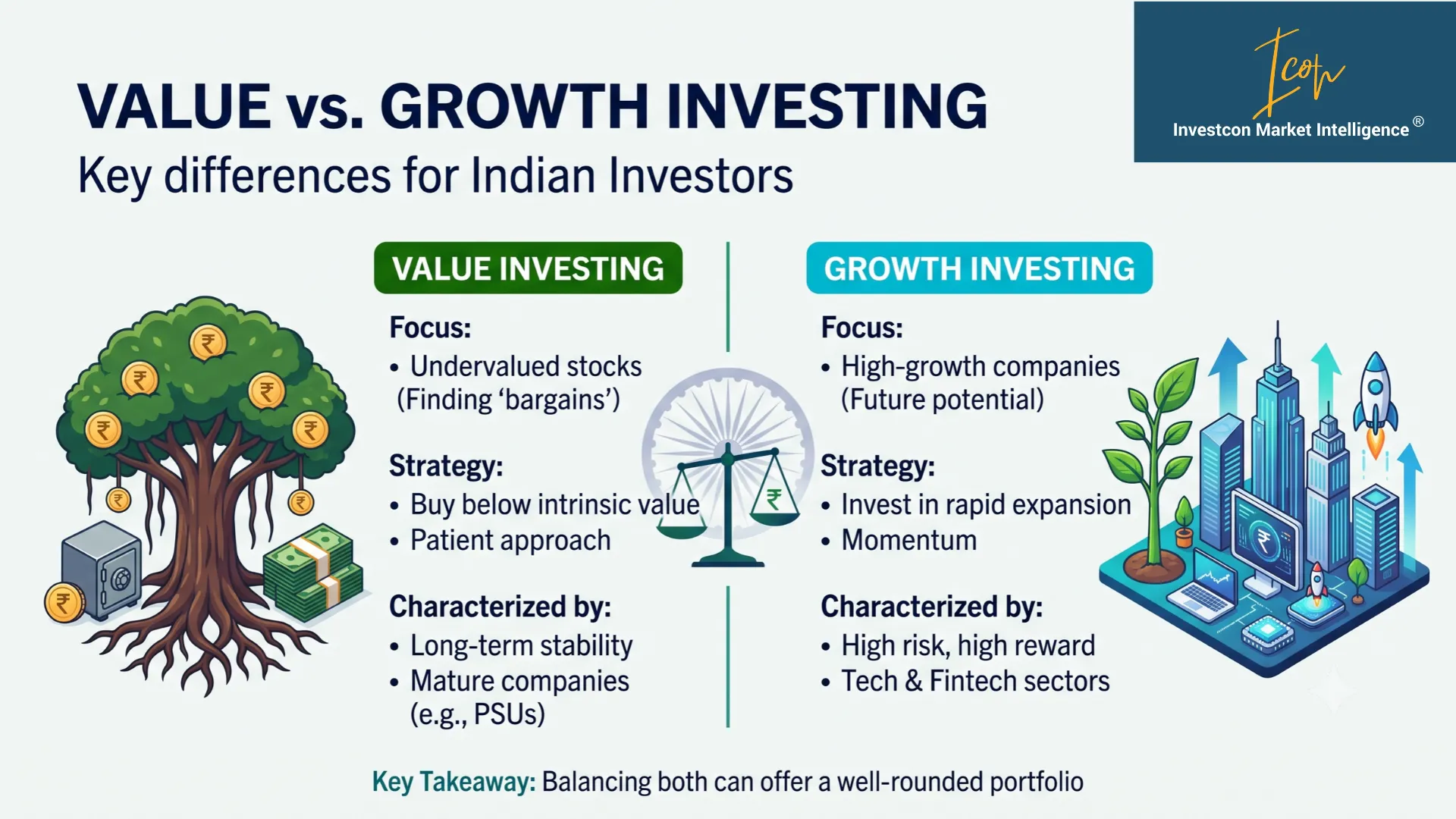
The Indian stock markets offer opportunities for investors seeking to accumulate long-term wealth. However, choosing the right investment approach can be difficult. Some investors favor well-known firms that are undervalued relative to their intrinsic value. Other investors like companies that will grow their income and profits fast. These are the major differences between value stocks vs growth stocks.
Both approaches can help an investor reach his or her financial goal, but they differ in stock selection, valuation, risk-taking, and returns. When comparing value vs growth investing, an Indian investor can analyze companies listed on the NSE or BSE.
Quick Answer:
Value investing focuses on buying undervalued stocks at prices below their estimated worth, while growth investing focuses on companies expected to grow their revenue and profits faster. Both strategies have different risks and returns. The right choice depends on an investor
Key Takeaways
- Value investing is characterized by purchasing stocks that are underpriced relative to their true value, whereas growth investing involves selecting companies that can grow their earnings and revenues significantly.
- Value stocks generally have low valuations and may even pay dividends, whereas growth stocks have high valuations and reinvest earnings to grow their businesses. As evidenced by the Indian stock market, the earnings outlook and economic conditions can affect these two investment methods differently.
- Investors in India need to take into account their financial objectives, risk tolerance, investment horizon, and other factors related to companies fundamentals.
What is Value Investing?
Value investing involves buying stocks that trade below an investor’s estimate of their intrinsic value. Intrinsic value is estimated using factors such as earnings, cash flows, assets, financial position and future business prospects.
Value investors look for cases where the market price appears low relative to the company’s fundamentals. They may also seek a margin of safety between the estimated value and the purchase price.
Characteristics of Value Stocks
There are various financial and operational characteristics that value stocks usually possess. But there isn’t a single criterion that can determine whether a stock is undervalued.
- Undervalued valuation multiples: The stocks are trading at lower P/E and P/B ratios relative to historical benchmarks or industry standards. The investor should research whether the undervaluation is the result of temporarily lower expectations or of the firm’s reduced ability to conduct its business effectively.
- Well-established business model: Many value firms are active in well-established industries like banking, energy, utilities and manufacturing. Their history and existing customer base might make their operations simpler to evaluate, even with cyclicality being still present.
- Ability to pay dividends: There are many value firms which pay part of their profits in dividends. They could provide income for investors, but that income isn’t guaranteed and depends on many factors.
What Is Growth Investing?
Growth investing involves selecting companies expected to grow their revenues, profits, cash flows, or market share more quickly than the broader market or their industry peers.
In a growth investment strategy, investors are willing to pay higher prices for firms whose anticipated growth justifies their current prices. These firms often retain most of their earnings for purposes such as technology investments, research and development, and growth rather than distributing them through high dividend payments.
A company may trade at a higher P/E ratio than its industry peers but still interest a growth investor if its expected earnings growth, competitive position and returns on reinvested capital appear strong enough to justify the valuation.
Features of Growth Stocks
Growth stocks are often associated with fast-growing industries; however, firms in conventional industries can also become growth stocks.
- High rates of revenue and profit growth: Stockholders analyze whether a firm has the potential to increase its revenue and profit growth. Consistent growth over years can serve as a rationale for the stock evaluation; however, high performance only for one quarter cannot be regarded as evidence of growth.
- Investments in growth: Companies having growth potential can invest heavily in product development, technology, logistics, and market penetration. Although these actions will help increase competitiveness in the future, unprofitable activities will destroy shareholder value.
- Overvaluation: Stockholders can overvalue growth firms because they assume these firms will generate income in the future. If the company’s actual performance does not meet investors’ expectations, a sharp drop in the stock price may occur even if the firm is profitable.
Value investing vs Growth investing
This is not just about whether a stock is inexpensive or expensive. Investors will have to consider the firm’s stage of development, earnings forecasts, valuation, and the returns the investment could generate.
The table below outlines the value vs. growth investing in India.
| Factor | Value investing | Growth investing |
| Primary objective | Buy stocks below estimated intrinsic value | Invest in businesses with strong future growth |
| Stock valuation | Often relatively low P/E or P/B ratios | Often higher valuation multiples |
| Business maturity | Frequently established businesses | Frequently expanding businesses |
| Earnings pattern | Stable, recovering or temporarily depressed earnings | Expected to grow faster than peers |
| Holding period | Medium to Long-term | Medium to Long-term |
| Suitable investor | Patient investor comfortable analysing undervalued companies | Investor comfortable evaluating future growth and higher valuations |
Value vs Growth Investing Techniques in India’s Stock Market
The analysis of value vs. growth investing strategies requires two different types of techniques. It is important not to search for the cheapest company or the fastest-growing one, but to understand whether it provides a good mix of price, quality, and future returns on investment.
Value Investing Techniques
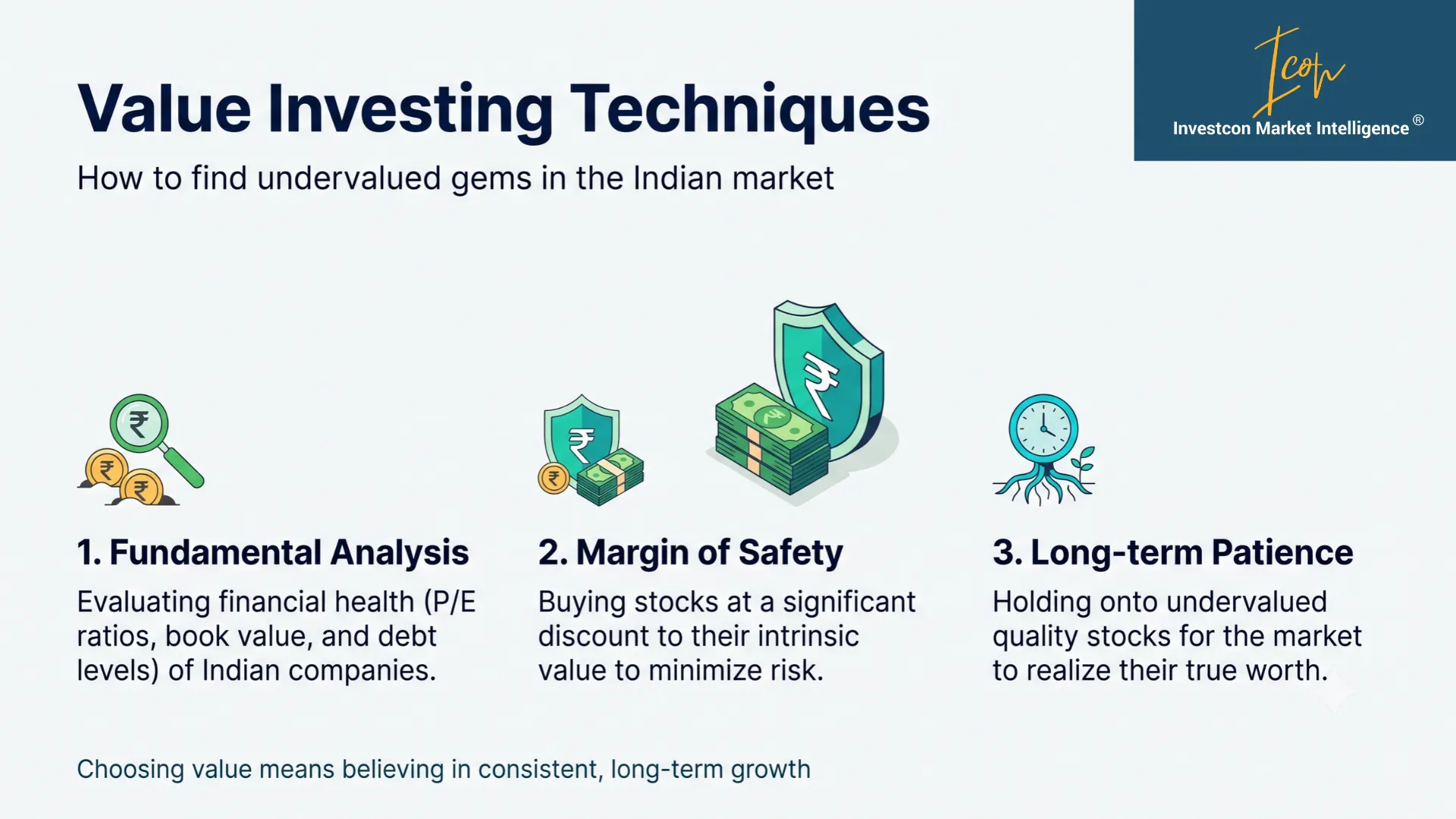
Value investing involves estimating a company’s intrinsic value based on its financial reports, ratios, and fundamentals. Such an approach is especially helpful when market sentiment is low and/or the company is fundamentally strong but faces some difficulties.
- Analyze valuation ratios: Compare the P/E, P/B, and EV/EBITDA valuation ratios with the industry average and the historical valuations of the company itself. Lower valuations may be a good sign, but they can also indicate declining earnings or fundamental problems with the company.
- Evaluate financial stability: Review debt levels, the interest coverage ratio, cash flows from operations, and ROCE. It is better for an entity that is financially sound and generates regular cash flow to withstand the shock than for one with financial problems.
- Identify the safety margin: Find out the intrinsic value through valuation techniques such as DCF and relative valuation. Buying an asset at a price below its intrinsic value reduces the impact of incorrect calculations in the forecast.
- Identify potential sources of recovery: There are specific companies that operate under pressure due to demand, cost, or industry conditions. Investors have to evaluate whether this is a temporary issue.
Growth Investing Strategies
Growth investors focus on the business’s future growth potential. They must be able to distinguish true growth from a temporary increase in revenue, or even an increase already priced into the stock price.
- Analyse the growth of the revenues and earnings: It should be done based on the trends in the last three to five years (if possible). If the growth resulted from customer demand rather than a one-off event or an acquisition, it might be more valuable.
- Assess scalability: This means that you need to determine whether it is possible for the firm to reach a larger number of clients while keeping its costs constant.
- Assess the effectiveness of reinvestments: Determine how profitable it is for the organization to reinvest capital, conduct research, and utilize working capital. Fast growth is not financially sound when there is an ongoing need for capital, and no additional profits are being generated.
- Consider valuation assumptions: the P/E ratio, the expected growth rates of earnings and cash flows, and the associated competitive risks simultaneously. A fast-growing organization may create little profit for investors when the stock is overvalued.
Comparison of Value vs. Growth Stock Performance Chart
Historical performance shows that value and growth stocks can lead over different periods. The Nifty500 Value 50 and Nifty500 Growth 50 provide a useful Indian-market comparison because both select 50 stocks from the Nifty 500 based on their respective value and growth criteria.
As of 30 September 2026, the Nifty500 Growth 50 Total Return Index delivered a 9.42% one-year return, compared with 6.89% for the Nifty500 Value 50. Over five years, however, the Nifty500 Value 50 recorded a 22.26% CAGR, ahead of the 15.89% CAGR of the Nifty500 Growth 50.
| Period | Nifty500 Value 50 TRI | Nifty500 Growth 50 TRI |
| 1-year return | 6.89% | 9.42% |
| 5-year CAGR | 22.26% | 15.89% |
The comparison shows that performance can vary depending on the period considered. Growth performed better over the latest one-year period, while value delivered stronger five-year returns.
Note: The Nifty500 Growth 50 was launched in August 2026, so returns for periods before its launch are based on historical index calculations.
Which Strategy Is Preferred by Indian Investors?
The selection of a growth or value strategy depends on investors financial goals, investment timeframe, and ability to analyze business fundamentals. No strategy guarantees better results.
- Prefer valuation: Investors who wish to compare the market price with intrinsic value will appreciate this strategy, which focuses on the margin of safety.
- Aim to obtain income through dividends: Well-known companies with steady cash flows can offer dividends, but dividend amounts can vary.
- Can wait for recovery: The undervalued stocks can stay undervalued for several years, and the investor has to be patient and check whether the initial investment thesis is still true.
Conclusion:
Value and growth stocks can perform differently across market cycles and investment periods. The choice between the two approaches therefore depends on how an investor assesses valuation, business growth, financial quality and investment horizon rather than an assumption that one style will consistently outperform the other.
FAQs
Q: What is the key distinction between value and growth investing?
Ans: Value investing focuses on purchasing undervalued securities at prices below their estimated intrinsic value. Growth investing entails targeting companies likely to grow earnings and revenue. The former involves valuation and safety margins, while the latter focuses on future business opportunities.
Q: Is value investing better than growth investing for Indian investors?
Ans: Neither investment method guarantees superior results, as their success depends on factors such as market conditions, the fundamentals of the targeted companies, and the prices paid. There are reasons to think that value investors will prefer the first one and vice versa.
Q: Is it possible for investors to employ both value and growth investment strategies simultaneously?
Ans: Yes, they can use the two investment styles in order to create a diversified portfolio of stocks representing different companies. They can include financially healthy, undervalued companies and companies growing earnings sustainably. It will provide investors with an opportunity to diversify rather than rely solely on one type of investment.

Lakshmi Sundari is a finance content writer and editor with over four years of experience across financial content and content strategy. She holds an MBA in Finance and writes on investing, personal finance and fixed-income markets. Her work spans long-form articles, PR, thought leadership, newsletters and social media, along with editorial planning and content strategy. She focuses on explaining financial developments and investment concepts through research-backed, practical writing.