The Federal Open Market Committee (FOMC) kept interest rates unchanged at 3.75% to 4.00% on 28 October 2026. The FOMC interest-rate decision passed by a 10–2 vote, with two officials preferring an immediate hike because inflation remains high. Fed Chair Kevin Warsh said economic growth is strong and the pause gives the committee time to review more data. This blog covers the decision, the market reaction and the direction of interest rates across the globe.
Quick Answer:
The Federal Open Market Committee (FOMC) kept the US federal funds rate unchanged at 3.75%–4.00% on 28 October 2026, following a 10–2 vote. Two officials favoured a 25-basis-point hike due to persistent inflation. The decision reflects the Fed’s cautious approach to balancing economic growth and price stability, while markets are watching for a possible rate increase in December 2026.
Key Takeaways
-
- The FOMC kept interest rates unchanged at 3.75% – 4.00% on 28 October 2026, while major central banks globally face potential rate hikes amid persistent inflation, with the Fed’s next move depending on upcoming economic data.
- The decision passed by a 10–2 vote, with two officials favouring an immediate 25-basis-point rate hike.
- US markets reacted modestly to the announcement, with stock indexes rising slightly and Treasury yields showing mixed movements.
- The ECB, Bank of Japan, Bank of England and RBI face upcoming rate decisions amid inflation and energy prices pressure.
- Markets price in an 85% probability of a Fed rate hike in Dec 2026, subject to incoming economic data.
What the FOMC Means for Investors
The FOMC is the official policymaking branch of the US Federal Reserve. This panel of central bankers manages the nation’s monetary policy to maintain steady job growth and stable prices.
When analysts discuss the FOMC interest rate, they are referring to the federal funds rate. This benchmark is the interest rate banks charge each other for overnight loans. Because it acts as the foundation for the global financial ecosystem, any shifts instantly change borrowing costs for consumer mortgages, credit card balances, and corporate loans worldwide.
Insights of the FOMC Interest Rate Decision:
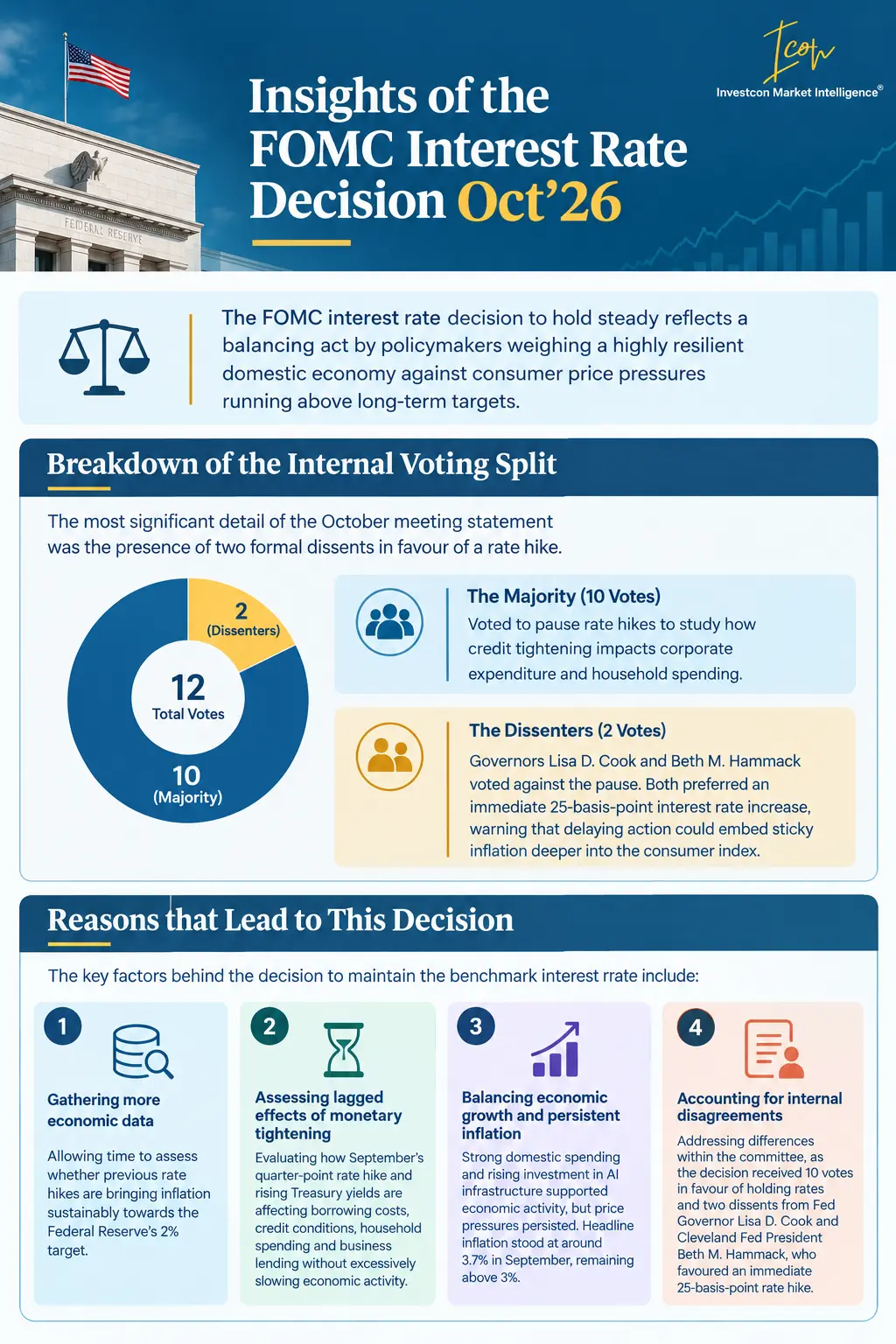
The FOMC interest rate decision to hold steady reflects a balancing act by policymakers weighing a highly resilient domestic economy against consumer price pressures running above long-term targets.
Breakdown of the Internal Voting Split
The most significant detail of the October meeting statement was the presence of two formal dissents in favour of a rate hike.
- The Majority (10 Votes): Voted to pause rate hikes to study how credit tightening impacts corporate expenditure and household spending.
- The Dissenters (2 Votes): Governors Lisa D. Cook and Beth M. Hammack voted against the pause. Both preferred an immediate 25-basis-point interest rate increase, warning that delaying action could embed sticky inflation deeper into the consumer index.
Reasons that Lead to This Decision
The key factors behind the decision to maintain the benchmark interest rate include:
- Gathering more economic data: Allowing time to assess whether previous rate hikes are bringing inflation sustainably towards the Federal Reserve’s 2% target.
- Assessing lagged effects of monetary tightening: Evaluating how September’s quarter-point rate hike and rising Treasury yields are affecting borrowing costs, credit conditions, household spending and business lending without excessively slowing economic activity.
- Balancing economic growth and persistent inflation: Strong domestic spending and rising investment in AI infrastructure supported economic activity, but price pressures persisted. Headline inflation stood at around 3.7% in September, remaining above 3% as energy prices and service costs continued to push costs higher.
- Accounting for internal disagreements: Addressing differences within the committee, as the decision received 10 votes in favour of holding rates and two dissents from Fed Governor Lisa D. Cook and Cleveland Fed President Beth M. Hammack, who favoured an immediate 25-basis-point rate hike due to persistent price pressures.
Strategic Shift in the FOMC Meeting Calendar
During his press conference, Chair Kevin Warsh announced a major structural update to how the Fed will operate in the future. The FOMC will continue to meet eight times a year, but the core focus of those meetings is changing:
- Starting in 2027: One out of the eight annual meetings will be dedicated entirely to long-term monetary strategy rather than voting on short-term interest rates. This leaves only seven rate decisions in 2027.
- Starting in 2028: Two out of the eight meetings will focus on broad strategy, leaving only six rate decisions for the year.
FOMC Interest Rate Movements Over 2026:
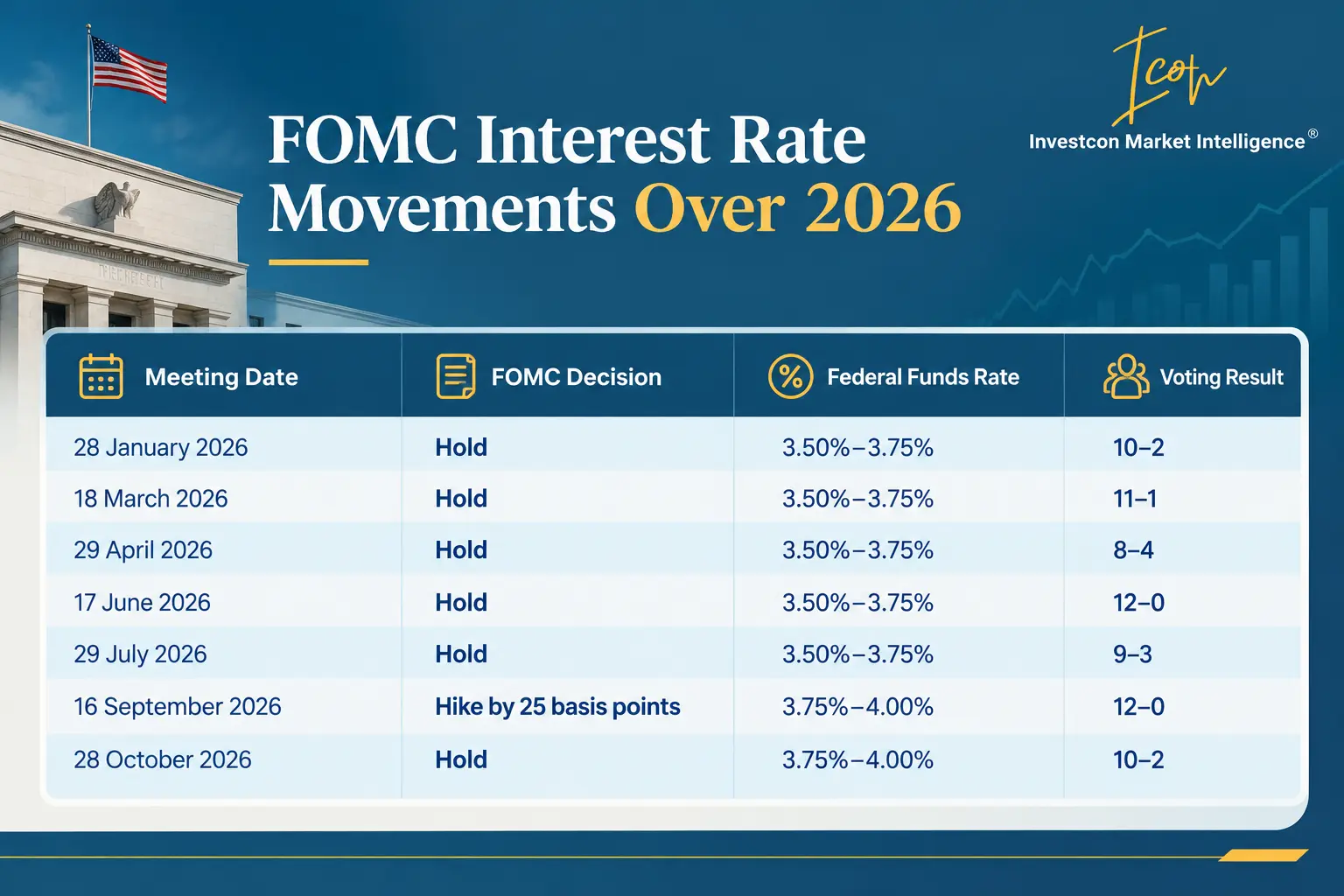
The table below shows the FOMC’s interest rate decisions in 2026, including changes in the target rate and voting results.
| Meeting Date | FOMC Decision | Federal Funds Rate | Voting Result |
| 28 January 2026 | Hold | 3.50%–3.75% | 10–2 |
| 18 March 2026 | Hold | 3.50%–3.75% | 11–1 |
| 29 April 2026 | Hold | 3.50%–3.75% | 8–4 |
| 17 June 2026 | Hold | 3.50%–3.75% | 12–0 |
| 29 July 2026 | Hold | 3.50%–3.75% | 9–3 |
| 16 September 2026 | Hike by 25 basis points | 3.75%–4.00% | 12–0 |
| 28 October 2026 | Hold | 3.75%–4.00% | 10–2 |
Market Reaction to the FOMC Interest Rate Decision Today
Markets moved, but only a little. Here is how the main indexes reacted after the decision:
| Market index | Reaction |
| US stocks (S&P 500, Nasdaq) | Up about 0.2% |
| 2-year Treasury yield (most sensitive to Fed policy) | Down to roughly 4.7% |
| 10-year Treasury yield | Up to above 5% (about 5.04%) |
| 30-year Treasury yield | Up to about 5.37% |
| Dollar index | Down about 0.12-0.2% |
Where Are Interest Rates Headed Across the Globe?
The federal open market committee interest rate pause offers no relief elsewhere. Most major central banks are leaning towards tightening, with energy-driven inflation linked to the Middle East conflict a common worry. Here is what each is expected to do next:
| Central bank | Policy rate today | What to expect next |
| European Central Bank | 2.50% (deposit rate) | Decision on 29 October, with a hold expected; markets price about a 75% chance of a December hike to 2.75% |
| Bank of Japan | About 1.25% | Decision this week, with a hold expected; analysts see the next hike in December |
| Bank of England | 3.75% | Decision on 5 November, with a hike to 4.00% widely expected |
| Reserve Bank of India | 5.50% (repo rate) | Next meeting on 2–4 December, where the choice is a hike or a pause |
What the FOMC Decision Means for India
The Fed’s interest-rate decisions can affect India through the rupee, bond yields and borrowing costs. When US rates rise, the return advantage of Indian assets may narrow, putting pressure on the rupee and influencing the RBI’s policy decisions. Higher US Treasury yields can also push Indian bond yields upwards. For borrowers with repo-linked floating-rate loans, higher EMIs are possible if lenders pass on the October rate hike. Savers, meanwhile, may benefit if banks offer better fixed-deposit rates.
FOMC Interest Rates December Outlook
The FOMC steady interest rates outlook now depends entirely on incoming data trends. According to sources, market tracking, interest-rate futures price an 85% probability that the Fed will raise rates by 25 basis points at its December 2026 meeting.
The Fed’s next step will depend on how the economy behaves during the upcoming weeks. Either higher inflation or a tight labor market will give policymakers grounds for increasing interest rates once again. Expectations of markets might be impacted by the situation after the midterms and the demand for capital associated with AI sectors.
Conclusion
The FOMC interest-rate decision to keep them steady at 3.75%–4.00% reflects the challenge of managing persistent inflation without slowing economic growth. With two officials favouring a rate hike and market pricing in an 85% chance of an increase in December, the next decision will depend largely on upcoming inflation and employment data. Investors should also watch global central-bank decisions and the Fed’s changing meeting schedule, as both could influence market expectations in the months ahead.
FAQs
Q: How does the federal open market committee set the FOMC interest rate?
Ans: The FOMC has 12 voting members: the seven Federal Reserve governors, the New York Fed president and four other regional Fed presidents who rotate each year. They vote on a target range for the federal funds rate, and the majority decides.
Q: What is a basis point?
Ans: One basis point is 0.01 percentage points, so 25 basis points equal 0.25 percentage points. Central banks use the unit because most rate moves are small.
Q: What is forward guidance?
Ans: Forward guidance is a central bank’s public hint about its future rate moves. Markets use it to price what comes next. When a bank withholds it, traders turn to vote counts, speeches and economic data for clues instead.
Q: What do hawkish and dovish mean?
Ans: Hawkish policymakers prefer higher interest rates to bring inflation down, while dovish policymakers favour lower rates to support growth and jobs. A hawkish hold means the central bank keeps rates unchanged but may still raise them later.
References:
- Federal Reserve – FOMC Press Release
- Google Search – FOMC Interest Rate Decision
- Mint – Why the US Federal Reserve Decided Not to Hike Rates
- The Times of India – US Federal Reserve Keeps Rates Unchanged

Raksha is a BBA LL.B. graduate specialising in Corporate Law from Delhi, with over six years of experience in financial writing. She specialises in financial markets, investments, mutual funds, taxation and personal finance. With a strong foundation in legal research and a keen eye for detail, she focuses on translating complex financial concepts into accurate, accessible and engaging content.