Financial planning and smart investments have become important for Indians. The rise in financial savings by Indians and their monthly SIP deposits denotes an increased interest in formal investments.
The Economic Survey 2025-26 revealed that household financial savings increased to more than 15.2% in FY25, while monthly SIP investments rose from ₹4,000 crore in FY17 to more than ₹28,000 crore during April-November FY26.
Early retirement is now catching on with many young Indian professionals who are keen to have more control over their time, careers, and money. This concept is related to the FIRE movement in India, in which FIRE stands for Financial Independence, Retire Early.
In contrast to conventional retirement planning, which often involves working until people turn 60, the FIRE movement, which aims to retire early, focuses on saving and investing wisely to make working unnecessary for much longer.
For some individuals, this means early retirement in their 40s. For others, it just means reaching a level where they can switch careers, work part-time, take a sabbatical, or work fewer hours without stressing about their expenses.
Those who wish to join the FIRE movement should realize the importance of saving at a constant rate, making regular investments, and developing a diverse portfolio.
Quick Answer:
The FIRE movement in India focuses on achieving financial independence and retiring early through higher savings, regular investments, and controlled spending. The amount needed to retire early depends on your annual expenses, inflation, investment returns, and retirement period. Building a diversified portfolio, maintaining an emergency fund, and planning for healthcare costs can help you work towards financial independence.
Key Takeaways
- The premise of FIRE is that financial independence will give people greater control over how they spend their time and money. Rather than relying solely on an annual salary until conventional retirement, individuals strive to accumulate enough wealth to cover their future expenses.
- To determine your FIRE number, you can begin by multiplying the annual expenditure amount by 25. Make use of a diverse portfolio to include proper investment options, which may include equity mutual funds and debt-based investments, among others.
- The timeline for FIRE depends on various factors, such as income, savings ratio, investment growth, and inflation. The FIRE movement timeline varies from person to person based on income, savings, investments, and liabilities.
What Is the FIRE Movement in India?
FIRE movement in India is an individual’s plan to achieve financial freedom at a younger age than the traditional retirement age. It involves having sufficient income to meet one’s needs without relying solely on one’s salary.
The concept is quite simple. Make sure the difference between your earnings and expenses increases, invest the excess earnings and let it grow for many years through compounding.
For example, a person earning ₹1,00,000 monthly and spending ₹80,000 has ₹20,000 to invest, while another earning the same amount but spending ₹50,000 has ₹50,000 to invest. The second individual has a much higher savings ratio than the first.
The following are the three main components of the concept of FIRE:
- Greater income: Having a higher salary, income from business operations, freelancing, or other sources may lead to faster wealth accumulation. Higher income through career growth and multiple income sources may lead to greater investable surplus without making drastic cuts to expenses.
- Reduced expenditure: Living a luxurious lifestyle is not part of FIRE. It involves cutting down those expenses that bring less value and saving more for investing.
- Investing over the long term: Savings must be used for investment purposes, not just kept as cash balances. The diversified portfolio has the potential to grow over time but is subject to risks associated with stock market investments.
FIRE Movement Timeline
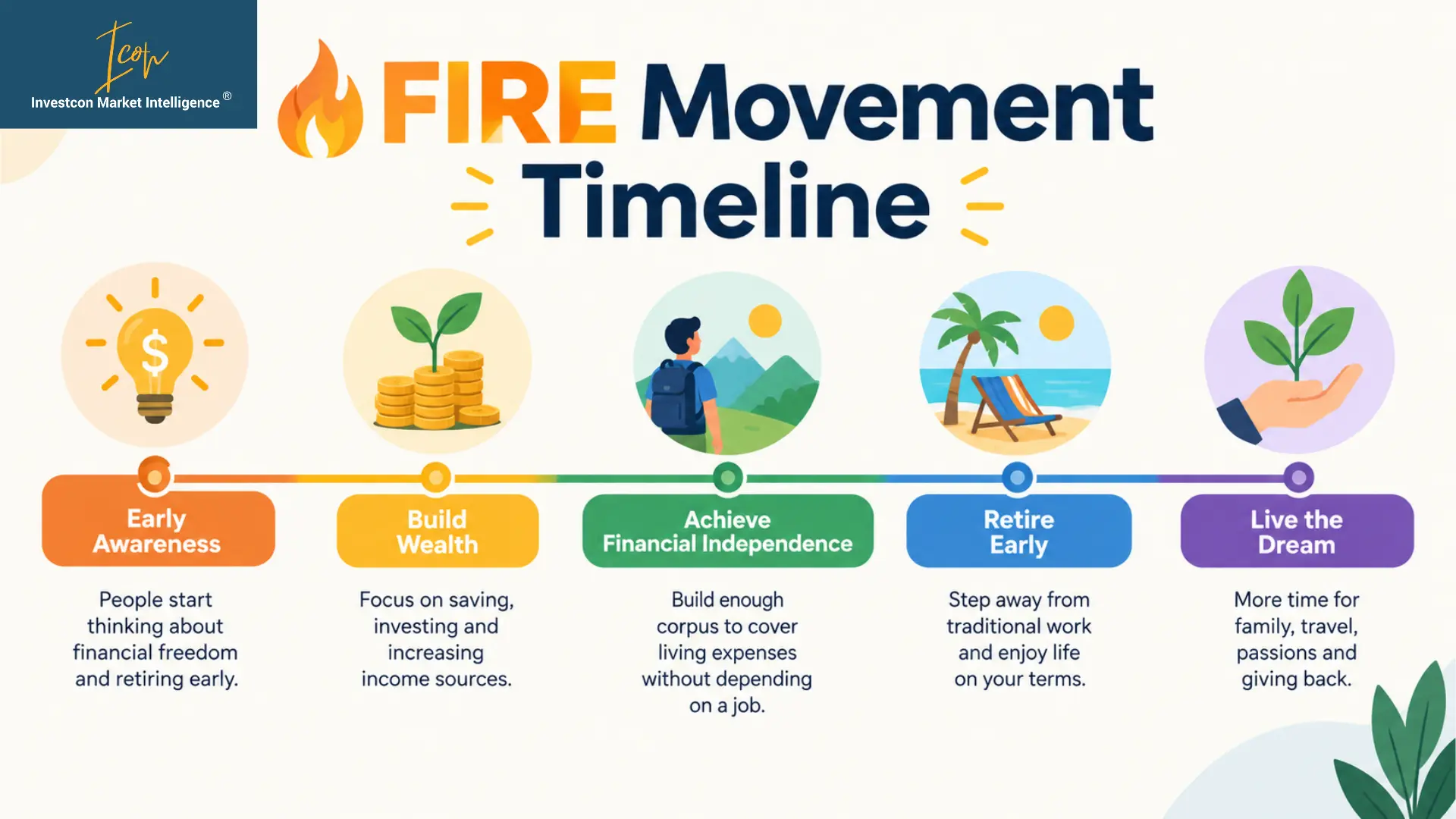
There cannot be a one-size-fits-all FIRE movement timeline, as everyone’s starting income, expenses, current investments, and financial goals differ.
The general path to FIRE can include the following steps:
Stage 1: Building the Foundation
At this stage, it is necessary to build an emergency fund, eliminate all debt, arrange proper insurance, and better understand monthly expenses.
It would be impossible to begin actively investing for early retirement without enough cash to cover any extra expenses without selling long-term investments during a market downturn.
Stage 2: Raising the Saving Rate
After creating the necessary foundation, the goal becomes increasing the savings rate. In simple terms, a person who saves 10% of their income will have a completely different timetable for becoming financially independent than a person who saves 40% or 50%.
Stage 3: Building the Investment Portfolio
This stage marks the transition towards regular investment, which will become the main driver of wealth building.
The portfolio may consist of a mixture of equity as well as debt investments based on the requirements of the individual investor. The goal here is not just to earn the highest possible returns, but to create an investment portfolio that can meet future expenses.
Stage 4: Attaining Financial Independence
Financial independence is when the portfolio, along with other sources of income, is enough to sustain the individual’s expenses.
It is important to remember that becoming a crorepati is not the same as attaining financial independence. While a ₹1 crore portfolio is adequate for some people, it may not be enough for others based on their expenses and retirement period.
Stage 5: Early Retirement
It should be noted that early retirement does not always mean quitting work completely.
An individual following the FIRE movement to retire early may leave behind his/her stressful job in the corporate world, work part-time, start a business, freelance, travel, and take up low-paying jobs.
Early Retirement Cost in India
There is no universal FIRE cost for India.
The first thing to do is to estimate annual expenses. Suppose a family spends ₹60,000 per month now.
In such a case, annual expenses equal:
₹60,000 × 12 = ₹7.2 lakh
The first practical way to calculate the cost of early retirement is to use the withdrawal rate method, which bases the annual withdrawals from the retirement corpus on a percentage of the corpus. The 4% rule came from studies dedicated to 30-year retirements and US stock market history. Therefore, it is better not to consider the rule India-specific.
For the ₹7.2 lakh annual expense:
With a 4% withdrawal rate:
₹7.2 lakh ÷ 0.04 = ₹1.8 crore
With a 3.5% withdrawal rate:
₹7.2 lakh ÷ 0.035 = about ₹2.06 crore
With a 3% withdrawal rate:
₹7.2 lakh ÷ 0.03 = ₹2.4 crore
These examples illustrate the idea but are not the exact costs of early retirement in India. If you want to retire at a younger age, you need to be more cautious.
A study conducted in 2026 specifically for India reveals that, for a 45-year retirement horizon, a withdrawal rate between 3% and 3.5% is appropriate.
Investment Instruments Available for FIRE in India
An ideal investment portfolio is one that is created with consideration of the investor’s time horizon, risk tolerance, and future spending needs.
Some of the commonly used financial instruments are:
- Equity Mutual Funds: These mutual funds provide long-term growth opportunities and help generate wealth. However, equity markets usually experience short-term downturns.
- Direct Equity: Stocks provide an opportunity to invest in companies shares, and the risk involved is both company- and market-related. Note that the higher the return, the higher the volatility.
- EPF and PPF: These are the provident fund schemes that can form a steady part of the investment portfolio. As per the government’s recommendations, the EPF rate can be 8.25% for FY2025-26.
- NPS: The National Pension Scheme can be part of a retirement plan, especially for investors who wish to create one through the dedicated retirement instrument. It is essential to consider the withdrawal and annuity features of NPS while creating an early-retirement portfolio.
How to build a FIRE Plan on Indian Income
It is possible to create a viable FIRE strategy in a number of steps. First, it is necessary to calculate the true financial situation before making any investments. The calculations must be based on real-life expenses.
- Calculate annual expenses: housing costs, food, transport, insurance, health care, utilities, vacations, family expenses, and entertainment.
- Calculate the savings rate: annual investments divided by annual net income. It will be easier to track this percentage than just track your investment portfolio.
- Define a target corpus: Forecast your future annual costs and make a conservative withdrawal assumption that will suit your retirement period. Check your target regularly rather than considering it a fixed figure.
- Create an emergency fund: Early retirees do not have salaries to help cover unexpected expenses. Maintaining sufficient liquidity will ensure you do not have to liquidate your long-term assets in a falling market.
- Insure against risks: This includes health insurance, adequate life insurance where necessary, and proper contingency plans, since a single risk can destroy the efforts made over several years to achieve FIRE goals.
- Evaluate your portfolio: Asset allocation needs to be adjusted as you approach financial independence. A growth-focused portfolio may be inappropriate for a retiree.
Risk Factors That Indian Investors Must Consider
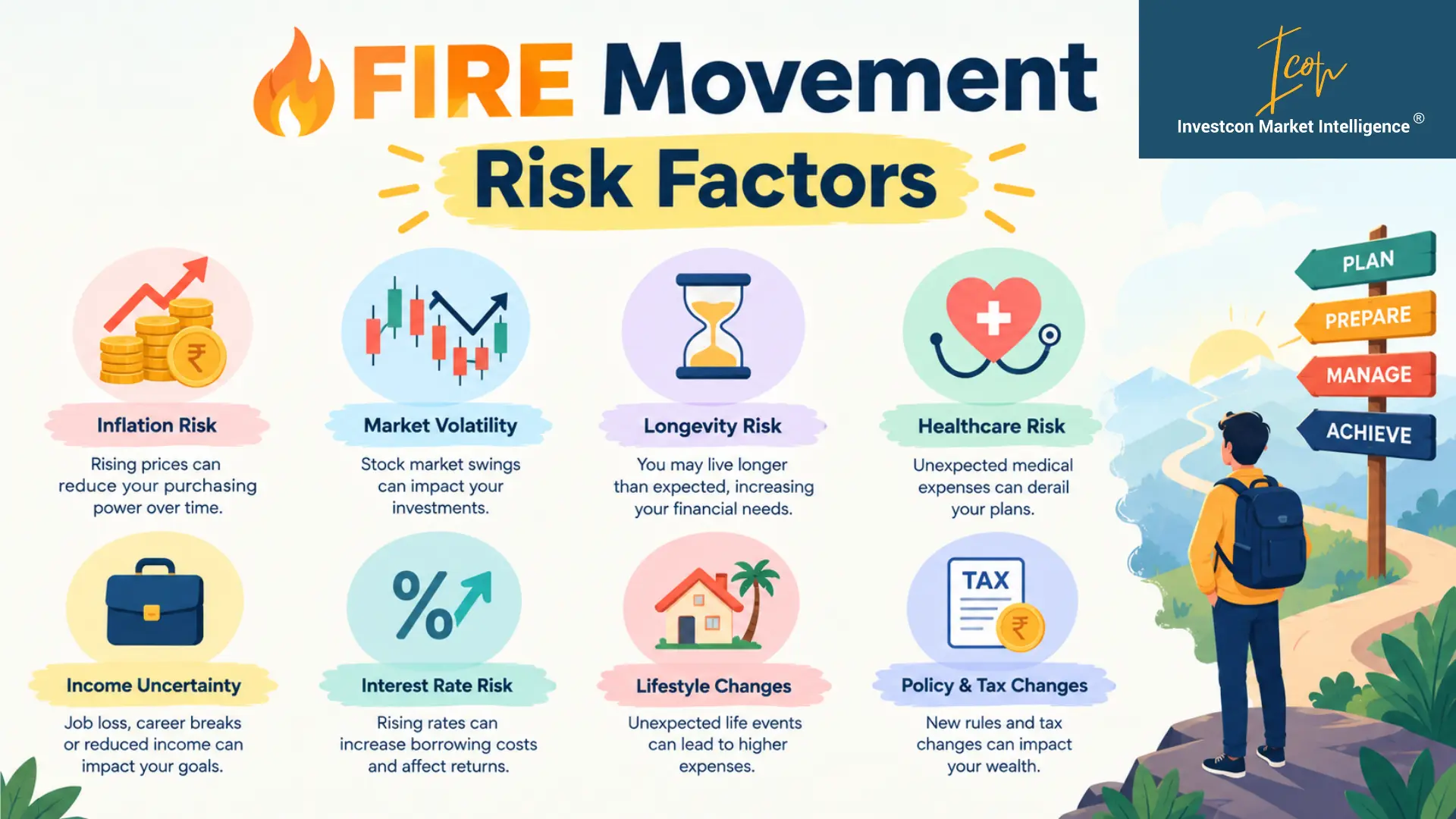
Even early retirement comes with its own risk factors, which are usually not faced by traditional retirement planning. Some of the important risks to note are:
- Sequence of returns risk: An early market downturn can have a more significant impact due to withdrawals from an already-falling portfolio.
- Longevity risk: A person retiring at age 40 could need to withdraw money for up to 50 years. Portfolio strategies suitable for 20 years of retirement may not suit 50 years.
- Medical expenses: Over time, the cost of medical care is bound to increase. Hence, health insurance along with a healthcare savings strategy becomes a critical part of FIRE planning.
- Inflation in lifestyle: A growing income doesn’t mean one has achieved financial independence if lifestyle expenses have increased alongside it. Savings rate might be more important than reaching certain salary levels.
- Tax implications: There could be various taxation methods applicable for investment gains, withdrawals, capital gains, interest income, etc. FIRE needs to calculate after-tax returns.
Conclusion:
FIRE movement in India to retire early is about building a sustainable link among one’s income, expenditure, savings, and investments. The Indian professional can certainly plan an early retirement, although the corpus would depend on his expenses, inflation rate, investment strategy, taxation, health needs, family obligations, and years of portfolio sustenance.
Hence, it would be more practical and helpful to have a FIRE movement timeline personalised to oneself. Rather than thinking about when one can actually retire, one should think about what one spends, what and how much one invests, how expenditure may change, and how many years one will have to manage the corpus.

Lakshmi Sundari is a finance content writer and editor with over four years of experience across financial content and content strategy. She holds an MBA in Finance and writes on investing, personal finance and fixed-income markets. Her work spans long-form articles, PR, thought leadership, newsletters and social media, along with editorial planning and content strategy. She focuses on explaining financial developments and investment concepts through research-backed, practical writing.