The anatomy of an equity research report is defined by how its components function together to present a company’s business, financial performance, valuation, risks, and investment view. These elements form the equity research report structure, where each section adds context to the next. An equity analysis report, however, does not simply present financial data. It builds a case study that leads the reader from the investment thesis to an actionable recommendation. That is what makes high-converting equity research content.
Key Takeaways
- An equity research report connects company analysis, financial performance, valuation and risks into one investment case.
- Charts, tables and credible sources make financial information easier to assess and support major claims.
- Presenting the risks alongside growth drivers provides the readers with a complete basis for assessing the equity.
What Makes an Equity Research Report Effective?
The core elements of effectiveness include:
- Clear Investment Thesis: An equity research report states whether the analyst recommends a Buy, Hold or Sell, along with the target price and the key reasons supporting that view.
- Transparent Valuation: The report explains how the target price is calculated using methods such as Discounted Cash Flow (DCF) or comparable-company multiples with stated assumptions used in the valuation.
- Balanced Risk Analysis: An effective report considers both bullish growth drivers and bearish downside risks. This includes industry headwinds, competition, financial risks and other potential downside factors.
- Differentiated Insights: It provides a distinct perspective or identifies relevant industry data beyond information already available through company announcements and public sources.
- Intellectual Honesty: The report further explains how changes in key assumptions can affect the analysis and does not use excessive jargon to conceal weak fundamentals.
Key Sections of an Equity Research Report
The components of high-converting equity research content bring together the information and analysis needed to support a clear investment view. Let us briefly discuss each component and its role in an equity research report.
Basic Information
The equity analysis report begins with essential stock and company details. This includes the ticker symbol, stock exchange, sector, industry, current share price, market capitalisation, target price and investment recommendation. It may also include information on the stock’s liquidity, public float and major shareholders.
Business Description
This section explains the company, its products and services and how its business generates revenue and incurs expenses. The focus is on understanding the key economic drivers of the business.
Industry Overview and Competitive Positioning
This section should explain the industry dynamics and competitive environment. It can include peer companies, market share, production capacity, pricing, distribution and the factors that give a company an advantage over competitors.
Investment Summary
The investment summary brings together the company overview, recent developments, earnings forecast, valuation and recommended investment action. If the report recommends buying or selling the stock, it should explain why the stock is mispriced. This means identifying what the market is currently overlooking and what could cause the stock to be re-priced.
Valuation
The valuation analysis of the company uses established valuation metrics and formulas to determine its estimated value. It can include absolute valuation methods such as discounted cash flow and relative valuation metrics such as price-to-earnings, price-to-sales, price-to-cash-flow and price-to-book ratios. Using more than one valuation model can help compare different valuation outcomes.
Financial Analysis
This section analyses historical financial performance of the company and forecasts its future results. It should assess earnings quality by reviewing financial statement footnotes, non-recurring items, off-balance-sheet financing and accounting policies. Financial modelling, business cycles and industry-specific financial ratios should also be considered when evaluating future performance.
Investment Risks
This section identifies industry and company developments that could threaten the investment thesis, including operational, financial, regulatory and legal risks. It should also consider subjective risks, auditor qualifications and material weaknesses in internal financial controls.
Environmental, Social and Governance (ESG)
ESG factors assess how a company manages environmental, social and governance matters that can affect its short- and long-term prospects. These include climate impact, employee relations, customer satisfaction, board structure, executive compensation, succession planning and anti-corruption practices.
How to Build a Research Report That Converts
Here is how you can build an equity analysis report to present a clear investment case, support key conclusions with data and help the readers to assess both potential opportunities and risks.
Start With the Investment Case:
The report should present the main investment case early. This should include the investment recommendation, target price and key reasons supporting the analyst’s view. The executive summary or thesis statement at the beginning helps the readers to understand the key argument before reviewing the detailed analysis.
Turn Data Into Insights:
The report should interpret financial and industry data rather than presenting financial figures. Each analysis should answer “So what?” by explaining what the data indicates about company performance, future prospects and the investment case. This helps turn raw information into high-converting equity research content.
Use Charts and Tables:
Charts and tables can present financial and market data to increase visual data retention and scannability. They should have descriptive titles and clear source labels, as this would allow readers to understand the key comparisons and trends without relying only on lengthy written analysis.
Support Every Major Claim:
Important claims in the report should be supported by primary sources or verified third-party data. This can include financial disclosures, company filings and reliable industry information. Supporting major claims with credible evidence strengthens the equity research report structure and gives readers a basis to assess the analysis and investment view.
Keep Risks Visible:
The report should clearly present the risks that could affect the investment case, as it is crucial for legal compliance and building trust. These can include operational, financial, regulatory, legal and industry risks, allowing potential downside to remain visible alongside the investment opportunity.
Equity Research Report Example
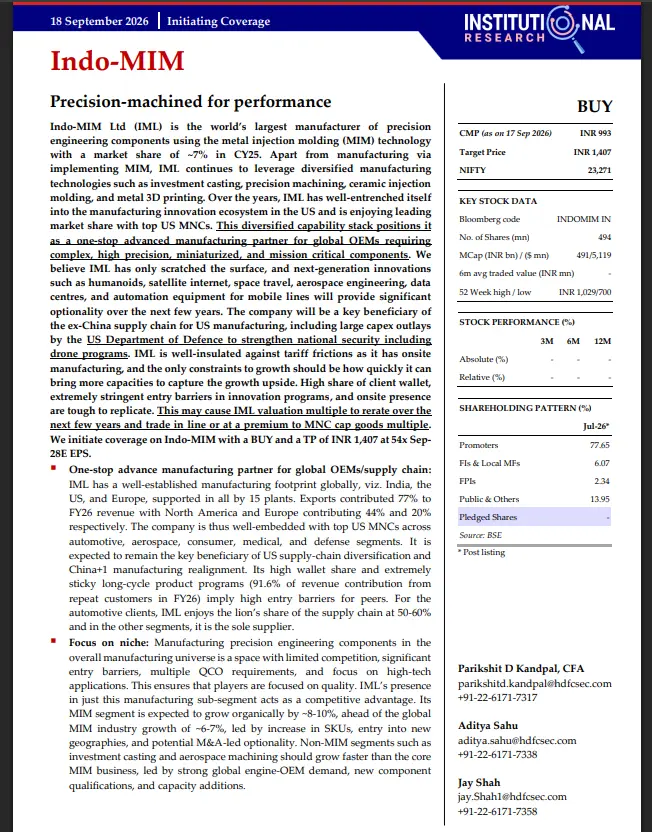
Below is an example of an equity research report on Indo-MIM, published by HDFC Securities on 18 September 2026. As shown in the report, the analyst presents the recommendation, target price, company overview, key stock data and investment rationale on the opening page. This demonstrates how the key elements of an equity research report structure can be brought together in a concise format.
Bottomline
A well-written equity analysis report should help readers move from information to informed judgement without making the analysis difficult to follow. The strongest reports combine analytical depth with concise writing, relevant evidence and a clear line of reasoning. When every section serves a purpose and the analysis remains balanced, the report becomes a practical resource for evaluating an investment rather than simply presenting financial data.
This is also where specialised financial research and communication expertise can make a difference. Investcon Market Intelligence works across equity research and financial content, helping businesses turn complex market and company information into structured, clear and credible research-led content.
FAQs
Q:What is an equity research report?
Ans: An equity research report is an analyst document that evaluates a company, its financial performance, industry position, valuation and risks. It usually includes an investment recommendation and target price based on the analysis.
Q: What valuation methods are used in an equity research report?
Ans: The common equity research report valuation methods include discounted cash flow (DCF), comparable-company valuation using P/E and EV/EBITDA, and sum-of-the-parts (SOTP) valuation. Analysts may use multiple methods to cross-check the estimated value of a company.
Q: What are the main sections of an equity research report?
Ans: The main equity research report sections include company information, business description, industry analysis, investment summary, financial analysis, valuation, investment risks and ESG factors. The exact format can vary by report type and purpose.
Q: What should a good equity research report include?
Ans: A good report should present a clear investment thesis, supporting financial analysis, transparent valuation assumptions, relevant industry information and key risks. It should also explain the evidence behind the target price and recommendation.

- The Anatomy of a High-Converting Equity Research Report - October 7, 2026
- 2 Bar Reversal Indicator - August 31, 2026
- Insurance Content Writing: How to Explain Policies Without Losing Readers - August 17, 2026