The NBFC market has become much more competitive in 2026. Several lenders pursue the same borrower market via search, social media, and app stores. Customers nowadays seldom visit a branch to explore their offerings. Instead, they spend weeks researching loan options, comparing interest rates, and reading reviews on the internet before submitting an application. While conventional advertising can introduce a product, it is unable to allay a borrower’s concerns. For this reason, the role of financial content marketing has evolved from generating leads to fostering trust. This blog explains the content marketing playbook every NBFC must have in 2026.
What Makes Content Marketing Different for NBFCs
Financial content is categorised as Your Money Your Life (YMYL), and Google applies greater scrutiny when ranking it. This is because misleading financial content risks individual lives severely. Therefore, financial content marketing must understand what makes NBFC content different and how unique curation can be made:
- Financial choices include high-trust purchases: Before clicking on apply for any NBFC credit product, borrowers need assurance because they would be giving out sensitive information and making repayment commitments.
- Clients evaluate lenders: The content of an NBFC is evaluated against several other lenders in the same browser tab via rate aggregators, forums, and review websites.
- Accuracy and openness are required by regulations: Every claim about rates, fees, or eligibility must be verified and up to date to comply with regulatory disclosure standards. Ambiguous or misleading promises are not acceptable in this category.
- Content should educate before it sells: Compared to a consumer who is only given a banner ad, a borrower who is aware of foreclosure costs or the impact on their credit score converts more quickly.
- Extended customer journey: Consistent financial content marketing keeps a brand visible during the lengthy process of loan approvals. It can address different customer queries and problems at distinct touchpoints of the journey.
- The value of expertise: Content that demonstrates topic expertise is rewarded by higher search engine rankings and greater reader trust, rather than generic, rehashed advice.
- The main factor driving conversion is trust: When it comes to lending, trust converts better than discounts. A well-explained procedure can deliver greater convertibility than just an eye-catching offer.
The Content Marketing Playbook for NBFCs in 2026
Content marketing for fintech requires a systematic approach rather than sporadic bursts of creativity. Discussed here is a detailed playbook that might aid the investor journey:
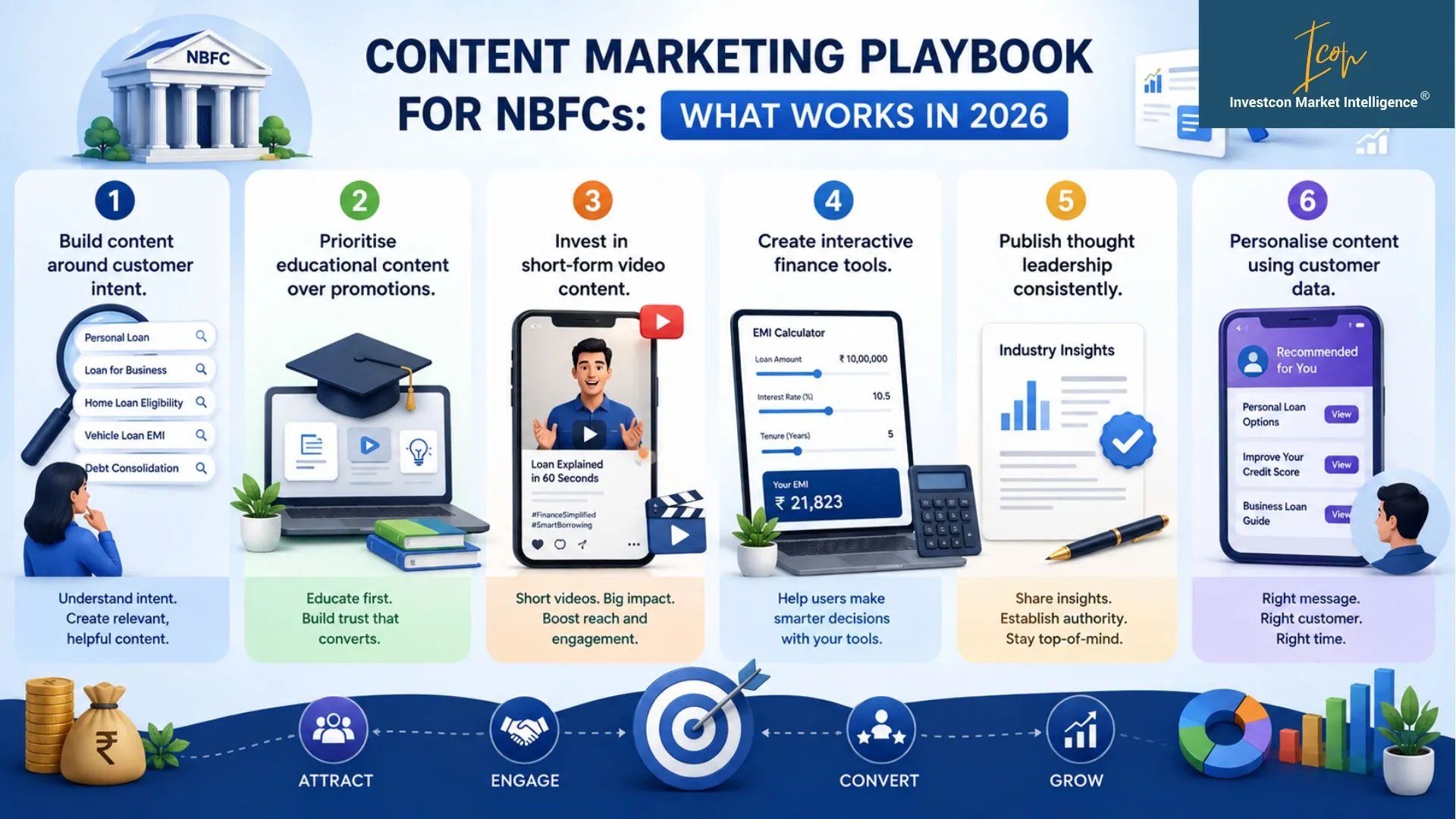
1. Build content around customer intent.
Instead of always delivering the same basic message, content information should adapt to the distinct stages that borrowers go through in their financial journey. Discussed below are some of these stages:
- Knowledge: The customer in this stage wants to know about a product. Therefore, rather than any call to action (CTA), the focus of content should be to inform and explain. Topics like “what is a personal loan”, “how does a gold loan work”, etc., are some content ideas in this stage.
- Consideration: Customers in this stage are evaluating the different options available. The objective of the content here is to make their evaluation easy. CTAs are a crucial aspect of content in this stage. Lender comparison pages, loan eligibility information, and EMI calculators are some content pillars at this stage.
- Decision: Here, the customer has made a choice, and the role of content is to make navigation easy. Remove any hindrance that can deter the customer from following through. Content topics are processing-fee breakdowns, document checklists, and application walkthroughs exists in this stage.
- Post-loan engagement: A quality finance brand should not leave its customer after the purchase is made. Post-purchase content helps stay in touch and make the user journey seamless. Topics around top-up loan guidelines, credit score enhancement advice, and payback reminders can be useful.
What really converts organic traffic into applications is mapping content to purpose instead of releasing one-size-fits-all pieces.
2. Prioritise educational content over promotions.
Educational information builds trust, which encourages a borrower to apply, whereas promotional content sells and attracts scrutiny or suspicion. Since educational content addresses a query the reader already has, it often performs better than direct advertising postings. Educational formats, like explainer blogs, FAQs, infographics, comparative pieces, and brief videos, benefit ranking and help foster trust. It suits the Google guidelines, which favour informative, expert material over misleading promotions.
3. Invest in short-form video content.
Borrowers, particularly first-time and Tier 2/3 audiences, increasingly find lenders through reels, YouTube Shorts, LinkedIn videos, and regional-language films. Quick finance strategy recommendations, 60-second loan explainers, RBI update summaries, myth-versus-fact explainers, and customer success stories are examples of high-performing formats. Since it shows knowledge in a format that people actually watch, well-produced NBFC material in this domain increases recall more quickly than static posts.
4. Create interactive finance tools.
Through EMI calculators, eligibility calculators, loan comparison tools, interest calculators, and budget planners, borrowers can do more than just read. Interactive tools hold visitors’ attention longer, generate first-party data through form fills, and often become a site’s highest-converting pages since the visitor has effectively self-qualified by the time they reach the “Apply Now” button.
5. Publish thought leadership consistently.
An NBFC is positioned as a source of expertise rather than merely a lender through industry studies, market insights, economic commentary, RBI policy effect analysis, and consumer borrowing trend articles. Thought leadership builds credibility over time and provides sales, PR, and social teams with content they can utilise across channels when it is published regularly rather than as a one-time report.
6. Personalise content using customer data.
Location-based information, product suggestions, renewal reminders, email journeys, and behaviour-triggered messaging transform generic content into something that feels pertinent to each borrower. For example, if a customer has left an application process midway, send a friendly reminder to complete. AI-driven personalisation can eliminate the need for manual effort.
Content Formats Every NBFC Use in 2026
Although NBFCs are not fintech startups, there is a lot of commonality in what works when it comes to content marketing. Both NBFCs and fintech brands rely on the same key formats, such as blogs for SEO, calculators for lead capture, and case studies for social proof. It is not the channels themselves that change, but rather the tone and level of cooperation.
| Content Type | Best Use |
| Blogs | SEO & education |
| Short videos | Awareness |
| Webinars | Trust building |
| Case studies | Social proof |
| Email newsletters | Retention |
| Infographics | Simplifying finance |
| Calculators | Lead generation |
| FAQs | Conversion support |
Common content marketing mistakes NBFCs should avoid
Here are some common mistakes NBFC creative content must avoid.
- Product-heavy content: Sites that are only focused on the “Apply Now” message turn off users who are still in the research stage and aren’t ready to convert.
- Ignoring compliance: Ambiguous information about fees or interest rates encourages regulatory investigation and undermines reader confidence.
- Poor SEO: Without SEO, well-written material won’t be seen because it isn’t organised for search purposes.
- Excessive use of financial jargon: When words like “amortisation” or “moratorium” are used without a clear explanation, readers who require a basic understanding are turned off.
- No content distribution plan: Good material must be promoted via email, social media, and other sources to enable sales
- Inconsistent publishing: Irregular material undermines audience habit and search momentum.
- Ignoring engagement metrics: Leads are important, but neglecting engagement metrics obscures which material is genuinely fostering trust.
Measuring the Success of an NBFC Content Strategy
An incomplete image results from concentrating just on clicks. A blog that receives traffic it cannot convert may not be as beneficial as one that consistently helps conversions but ranks lower. Discussed below are different key metrics you should not ignore:
- Organic traffic: Indicates whether or not content is accessed without the need for paid advertising.
- Time on page: This indicates if the content is being read rather than merely clicked.
- Qualified leads: It refers to those visitors who meet qualifying requirements rather than merely filling out a form. It helps understand if the content is reaching the target audience or not.
- Video completion rate: This measures how well short-form material retains viewers’ interest.
- Search rankings: Monitors visibility for the content’s target intent-based keywords.
- Returning visits: They are a sign of trust. Borrowers who return are more likely to submit an application.
Bottomline
Lenders who appear earlier in the research process of the customer with more lucid and helpful responses will continue to divert borrowers from NBFCs that consider content as an afterthought. The 2026 content marketing strategy calls for creating material that is aligned to intent, supported by knowledge, and assessed in ways other than leads. When an NBFC understands the foundations of financial content marketing, content ceases to be a cost centre and instead becomes the most economical means of fostering trust. Expert finance writers at Investcon bridge the gap between credible financial knowledge and interesting content that people enjoy. Visit Investcon today!
Key Takeaways
- Finance content is uniquely categorised by Google as YMYL and attracts greater scrutiny.
- NBFCs should align their content to different touchpoints in the user journey for better results.
- Prioritising quality content over exaggerated promotions is crucial for a quality customer experience.
FAQs
1. How much should an NBFC budget for content marketing in 2026?
Budgets vary by scale. NBFCs investing seriously in content typically allocate a meaningful share of overall marketing spend to it rather than treating it as a one-time project cost. Such an expenditure is usually split across content production, SEO/tools, and video equipment.
2. How long does it take for NBFC content to start generating leads?
Educational and SEO content usually takes a few months to build ranking momentum, though calculators and comparison tools can start driving leads faster since they capture bottom-of-funnel intent from day one.
3. Should NBFCs create content in regional languages?
Yes, a large share of loan applicants outside metro cities research in their regional language before applying. Therefore, translated or natively created regional content often converts better than English-only assets for that audience.

- 2 Bar Reversal Indicator - August 31, 2026
- Insurance Content Writing: How to Explain Policies Without Losing Readers - August 17, 2026
- Why Every Wealth Management Firm Needs an Industry Report (Not Just a Blog) - August 12, 2026