Summary
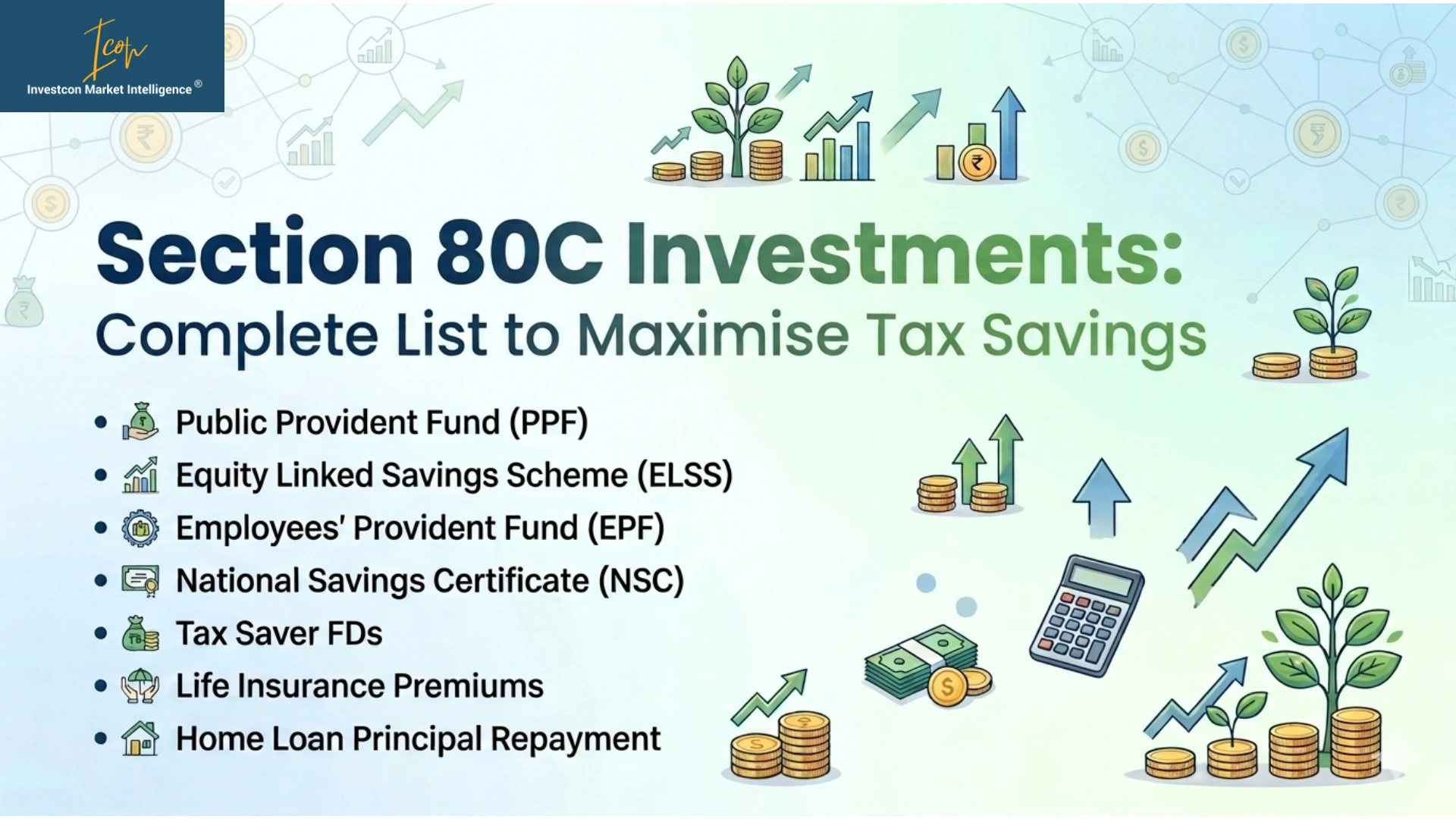
- A complete list of eligible tax-saving investments, such as PPF, EPF, insurance premiums, and many government schemes, covered under Section 80C of the Income Tax Act.
- The key conditions for availing of Section 80C benefits include fulfilling eligibility requirements, observing mandatory lock-in periods, and staying within the deduction limit of ₹1.5 lakh.
What is the Section 80C Investments deduction in the Income Tax Act?
Section 80C is a tax-saving provision under the Income Tax Act, that was introduced by the Government of India. This provision allows taxpayers to claim benefits on specific investments, savings schemes, and expenses.The purpose of this provision is to provide tax benefits to taxpayers and encourage investments and savings. However, under the old tax regime, taxpayers can claim benefits under this provision.
Who can claim?
The taxpayers eligible to avail of deductions under Section 80C are listed below.
1. Individuals: Individuals who are employed and earn a salary or are self-employed are eligible to claim tax benefits under Section 80C.
2. Hindu Undivided Family (HUF): the Hindu Undivided Families (HUFs) can claim a deduction for investments and expenses under this section.
How much can be claimed?
Taxpayers can avail deductions of up to ₹1,50,000 under Section 80C for specified investments and qualifying expenses, thereby reducing their taxable income. If the payment or expense exceeds the limit, tax benefits will be applied only to ₹1,50,000 of the total payments or expenses. Contributions made to tax-saving investments, including fixed deposits, provident funds, and government-backed savings schemes, are eligible for deduction under the provision. It also allows a tax benefit on payments made in a financial year, irrespective of which year the payment belongs to.
List of investments for deduction under Section 80C
The tax-saving benefits under Section 80C are applied to the following investments.
Insurance Premium
Payment of life insurance premium for self and family, including spouse and children, is eligible for tax-saving benefits. The Hindu Undivided Families (HUFs) can also claim a deduction for eligible investments made for its members. However, if an annuity plan is purchased for a family or member, no tax deduction is allowed. Taxpayers often use life insurance for protection against unforeseen events as well as part of tax planning.
Employee Provident Fund
Employee provident funds are the retirement schemes generally applicable to salaried employees. Employees make monthly contributions from their salary to the provident fund, helping them accumulate savings for retirement. This contribution is eligible for tax-savings benefits under section 80C. However, no deduction is allowed for any contribution made by the employer to their employee’s provident fund.
Public Provident Fund
Any contributions made to a public provident fund, which is a government-backed savings scheme, are eligible for deduction under section 80C. Individuals who have maintained PPFs for themselves as well as their spouse and children can claim tax-savings benefits. HUFs can also claim tax benefits for contributions made by their members.
Superannuation Fund
Superannuation funds are retirement plans that help employees build a corpus which provides financial security over retirement. This provision allows employees to claim a deduction on the contribution made. If the combined annual employer contribution to PF, NPS, and superannuation funds exceeds ₹7,50,000, the excess amount is taxable as salary income in the hands of the employee.
Equity-Linked Savings Scheme (ELSS)
ELSS is an equity-oriented mutual fund that offers tax-saving benefits while helping investors build long-term wealth. Under section 80C, these investments qualify for deductions. The scheme imposes a lock-in period of 3 years, during which the invested amount cannot be withdrawn. Any activities related to these funds, such as the transfer or repurchase of the units, can be done after the lock-in period ends.
Securities of Infrastructure Companies
Any investment made in equities or bond securities of infrastructure-related companies such as transport, telecom, or energy is eligible to claim tax-saving benefits under section 80C. The mandatory holding of these investments should be at least 3 years. In case of transfer made before the end of the holding period, the deductions will be treated as income.
Pension Scheme Contributions
Any investments made to the pension schemes established by mutual funds and approved NPS Tier-II accounts qualify to claim tax benefit under this provision. Tax benefits on NPS Tier-II account investments are restricted to employees working under the Central Government. The holding period of the Tier-II scheme should be at least 3 years.
NABARD Bonds
Any investments made in bond securities issued by the National Bank for Agriculture and Rural Development (NABARD) under section 80C. These bonds are issued to increase the development of the rural and agricultural sectors while providing tax-saving benefits to investors.
National Savings Contribution (NSC)
These are government-backed fixed-income securities designed to provide small investors with a stable and predictable annual return. Investment in these programs qualifies for a deduction under this provision. The returns earned on these securities are required to be reinvested. However, the amount reinvested is treated as “income from other sources”.
Senior Citizen Savings Scheme
These schemes are government programs for senior citizens to enhance their savings plans. Any deposits made under this scheme are eligible to claim a deduction under section 80C. In case of closing the account before the end of 5 years, the deductions claimed will be treated as income and shall be taxable only on the claimed amount. However, in case of transfer due to the death of the account holder, no tax will be charged.
Time Deposit with Post Office
Any time deposits made in the post office are eligible to claim a deduction under this provision. These are government-backed investments that provide assured returns. If the account holder closes their account, the deduction claims will be considered income and shall be taxed.
Sukankya Samriddhi Scheme
These are government-backed schemes, especially for the girl child, to encourage savings for supporting higher education and marriage expenses. These investments support 2 girl children under a single account while providing tax-saving benefits to the account holders.
Fixed Deposits
Any deposits made as fixed deposits with a maturity period of at least 5 years are allowed to claim tax-saving benefits under section 80C. These term deposits cannot be used as collateral or security to borrow loans.
Conditions and restrictions under section 80C
The following eligibility criteria and conditions apply for claiming deductions under Section 80C.
1. Eligible Taxpayers: Only individuals and Hindu Undivided Families (HUFs) are allowed to claim the deduction. However, companies, partnerships, and LLPs are not allowed to claim tax-saving benefits.
2. Maximum Limit: The deduction on eligible accumulated investments and deposits is strictly limited to ₹1,50,000 for each financial year. Any additional investments above the limit will not qualify for tax-saving benefits.
3. Tax regime constraint: The tax saving benefits under section 80C are only available under the old tax regime. To claim deductions under Section 80C, taxpayers must opt for the old tax regime, as the new regime does not allow these benefits.
4. Lock-in periods and penalties: Many investments and deposits have specific mandatory lock-in periods. Withdrawing these funds prematurely will result in penalties, and previously exempted amounts will become chargeable for tax.
How to maximise section 80C tax benefits?
The tax-saving benefits can be maximised through the following.
1. Account for mandatory expenses first: Taxpayers can consider and select the investments or expenses that are already eligible for exemptions from tax. Many mandatory and common expenses are allowed to claim a deduction, such as life insurance premiums, tuition fees, provident funds, etc. Accumulation of these common expenses can fill their limit of ₹1,50,000 without having to make extraordinary investments.
2. Choose the right investment mix: Section 80C of the Income Tax Act offers multiple options to choose from with different risk profiles, return potentials, and lock-in periods. Choose the options and create a mix of these funds, rather than entirely concentrating on a single instrument. This will help to get benefits from different investments and create a balance of funds based on their investment objective and risk tolerance.
3. Claim the bonus NPS benefit: Taxpayers can also claim from the National Pension System (NPS) introduced by the government to enhance the limit of ₹1,50,000 with an additional ₹50,000. They can add the investments under section 80C alongside NPS under section 80CCD(1B) and create an overall deduction limit of ₹2,00,000.
Common mistakes while claiming section 80C tax benefits
The following are the common mistakes that many taxpayers make while claiming deductions under section 80C.
1. Forgetting to switch tax regimes: The tax-saving benefits under 80C are only available under the old tax regime. Many individuals invest in tax-saving instruments but fail to opt for the old tax regime, which is necessary to claim these deductions. Failing to select the appropriate regime may lead to losing the expected tax benefits.
2. Exceeding the limit: The provision of deduction has a limit on its deductions, i.e., the maximum amount of the accumulated investments and expenses is ₹1,50,000. If taxpayers claim a deduction on an investment amount exceeding the limit, the additional amount will be taxed.
3. Missing eligible expenses: Section 80C not only provides tax benefits on investments and deposits, but it also provides a deduction on common expenses such as house loans, stamp fees, registration fees, tuition fees, etc. Many taxpayers usually overlook these expenses and forget to claim deductions for the same.
4. Incorrect life insurance claims: The deduction on life insurance cannot be claimed entirely on the policy. To qualify for deductions, insurance policies must satisfy the conditions regarding the total sum assured and the premium. Claiming without verifying the conditions will result in the failure of tax benefits.
5. Not considering lock-in periods: Taxpayers must consider the lock-in periods applicable to the investments. Making investments without understanding the lock-in period may affect the liquidity and financial goals of the investment. They should evaluate and select investments carefully, because making a premature withdrawal will lead to treating the deductions as taxable income.
Final Thoughts
Section 80C of the Income Tax Act allows individuals and Hindu Undivided Families (HUFs) to claim a tax deduction of up to ₹1.5 lakh in a financial year on eligible investments. Qualifying options include life insurance premiums, EPF, PPF, ELSS, and certain government-backed savings schemes.
To avail of the deduction, taxpayers must invest in eligible instruments and comply with the applicable conditions, such as investment limits and lock-in periods. Combining Section 80C with other tax-saving provisions, such as Section 80CCD(1B), can further enhance overall tax savings.
FAQs
1. What is Section 80C in simple words?
Section 80C is a provision under the Income Tax Act that allows taxpayers to reduce their taxable income by investing in specified savings schemes or incurring eligible expenses. The maximum deduction available is ₹1.5 lakh per financial year under the old tax regime.
2. Can I claim deductions for investments made in my spouse’s name?
Yes, deductions can be claimed for certain investments made for your spouse, such as contributions to a Public Provident Fund (PPF) account. However, eligibility depends on the specific investment and the conditions prescribed under Section 80C.
3. What happens if I withdraw before the lock-in period?
Premature withdrawal may lead to the reversal of tax benefits claimed earlier. In many cases, the deducted amount becomes taxable in the year of withdrawal, and additional penalties may also apply depending on the investment.
4. Can I claim Section 80C under the new tax regime?
No, most deductions available under Section 80C cannot be claimed under the new tax regime. These benefits are generally available only to taxpayers who opt for the old tax regime.

- The Anatomy of a High-Converting Equity Research Report - October 7, 2026
- 2 Bar Reversal Indicator - August 31, 2026
- Insurance Content Writing: How to Explain Policies Without Losing Readers - August 17, 2026