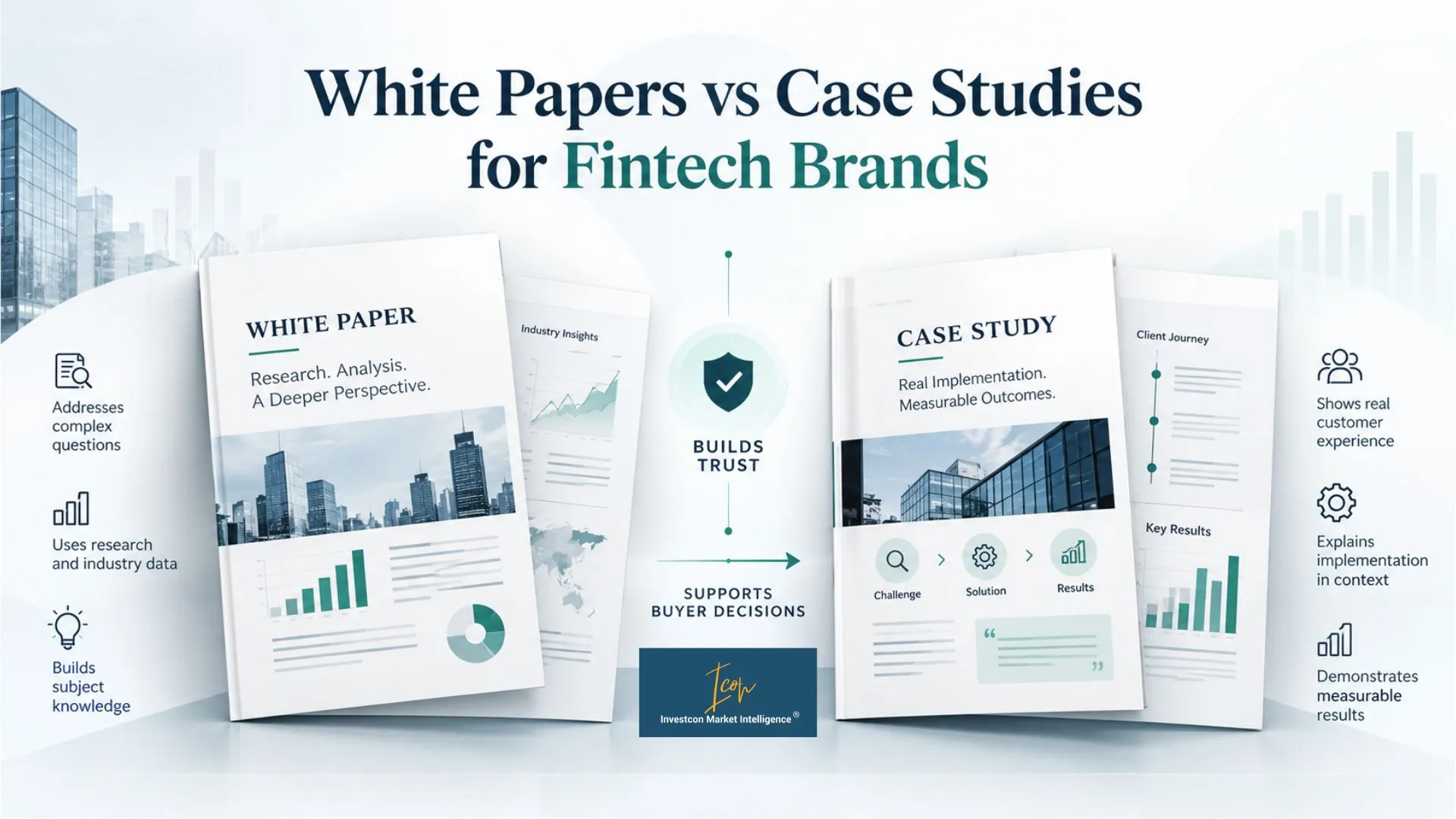
Case studies provide practical evidence when prospective clients want to understand how a fintech solution has worked in practice. White papers are useful when buyers need to understand a complex problem or assess a proposed approach. In the white papers vs case studies comparison, the deciding factor is which one of these supports the buying decision. Both formats can build trust when supported by relevant evidence. For finance and fintech brands, the priority is to choose the format that addresses the buyer’s concern and presents the available information accurately.
A fintech company may have a capable product team, detailed research and positive customer outcomes, yet struggle to explain its value to prospective clients. A product brochure can introduce features, but buyers may need a fuller explanation before taking the next step.
The 2024 Edelman–LinkedIn B2B Thought Leadership Impact Report found that 73% of decision-makers considered thought leadership a more trustworthy basis for assessing an organisation’s capabilities than marketing materials and product sheets. The research covers B2B thought leadership broadly; it does not establish a winning format for fintech.
Choosing the right document starts with understanding what your prospective client still needs to know.
Key Takeaways
- White papers build confidence in a fintech brand’s expertise and approach.
- Case studies help prospective clients assess implementation and customer outcomes.
- Choose the first format around recurring buyer questions and available evidence.
- Investcon focuses on content writing for finance and fintech brands.
White Papers vs Case Studies at a Glance
A white paper explores a problem and evaluates an approach through research and analysis. A case study documents a particular customer’s challenge, implementation and results.
| Comparison point | White papers | Case studies |
| Main buyer question | Does this approach make sense? | Has this worked for a business like ours? |
| Basis for trust | Subject knowledge, research and clear reasoning | Documented experience and customer outcomes |
| Supporting material | Industry data, expert inputs and technical explanations | Customer interviews, project details and measured results |
| Fintech example | Analysis of challenges in payment reconciliation | A customer’s experience of automating reconciliation |
| Useful next step | A discussion about the approach or requirements | A discussion about implementation and suitability |
These roles can overlap. A white paper may include customer examples, while a case study may explain technical details. The difference lies in the document’s main purpose.
How Fintech White Papers Establish Expertise
Fintech white papers help brands explain subjects that need more depth than a product page allows. They are particularly useful when buyers must understand a process, compare alternatives or build an internal case for change.
For example, a lending technology provider could examine why applications require repeated manual checks. A useful white paper would explain the causes, assess possible improvements and discuss the information needed to implement them.
Address a Specific Financial Problem:
Start with a defined question. “The future of digital lending” offers a broad theme. “Reducing delays caused by incomplete loan applications” gives the research a clearer purpose.
A focused topic also helps marketing teams decide which product specialists, research sources and operational details the document needs.
Make the Analysis Traceable:
Identify the sources behind the argument and explain what the data represents. Findings from a limited pilot should remain clearly labelled as pilot findings.
Discuss relevant conditions, including data quality, integration requirements and tasks that still need human review. These details help buyers assess whether the approach fits their operations.
Explain Complex Processes Clearly:
Specialist writing should preserve distinctions that matter to a financial audience. Faster application processing, for instance, does not automatically establish better lending decisions.
Fintech white paper writing services are useful when a brand has the technical knowledge but needs help turning it into a coherent argument for prospective clients.
How Case Study Content Writing Demonstrates Results
Case studies help buyers assess practical delivery. They show what a customer needed, how the provider responded and what happened after implementation.
Effective case study content writing gives readers enough context to judge whether the experience resembles their own requirements.
Describe the Customer’s Starting Point:
Explain the original process and the problem it created. A payments case study might describe a finance team manually matching records across several payment channels and investigating unresolved transactions.
This is more informative than saying the customer needed greater efficiency. It establishes the issue against which the result should be assessed.
Show What Implementation Involved:
Describe the work behind the outcome. Include relevant system connections, changes to the customer’s workflow and any phased rollout.
These details help prospective clients understand their likely responsibilities. They also make the account more useful during sales discussions about implementation.
Put Every Result in Context:
Consider a hypothetical customer that reduces average reconciliation time from five hours to two hours per day. That represents a 60% reduction, but the calculation alone is insufficient for a credible case study.
The published account should identify the measurement period, whether transaction volumes were comparable and whether other changes contributed. Time saved should also remain distinct from outcomes such as cost savings or improved accuracy.
Financial case study writing builds confidence when the reader can understand both the achievement and the circumstances behind it.
Which Format Should Your Fintech Brand Choose First?
Review the questions that recur in sales calls, product demonstrations and follow-up emails. They can reveal whether the immediate need is explanation or evidence of delivery.
| What prospects are asking | Recommended starting point | Why it fits |
| How does this approach address our problem? | White paper | Explains the reasoning and relevant evidence |
| What should we consider before adopting it? | White paper | Outlines alternatives, requirements and limitations |
| Have you handled requirements like ours? | Case study | Presents a relevant implementation |
| What changed for the customer? | Case study | Connects the solution to documented outcomes |
Available evidence should influence the decision too. A young fintech company with research and subject expertise can develop a white paper before it has completed customer deployments. A provider with approved customer results can prioritise a case study when prospects repeatedly request implementation evidence.
As the content library grows, connect the formats. A payments white paper can explain reconciliation challenges and link to a customer story showing one implementation. This creates a useful path from understanding an approach to examining its application.
The same principle supports a wider content strategy for fintech brands: each piece should answer a recognisable buyer question and offer a relevant next step.
How Investcon Helps Finance and Fintech Brands
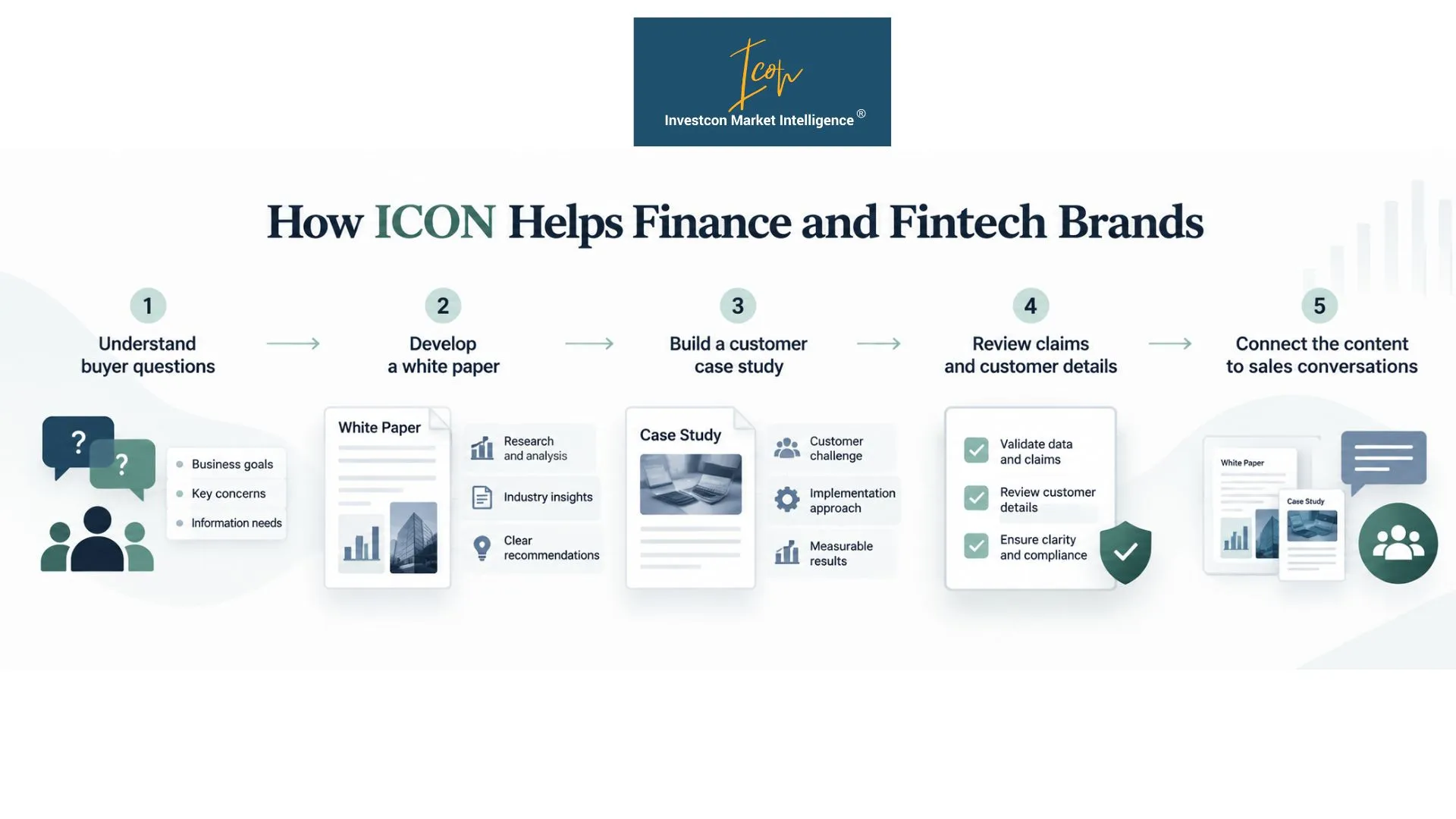
Consider a hypothetical payments company, XYZ, approaching Investcon to explain its payment processing and reconciliation capabilities to prospective business clients. The following illustrative workflow shows how finance white papers and finance case studies could support that brief. It does not describe an actual client engagement.
Step 1: Identify What Prospective Clients Need to Know
We would begin by reviewing XYZ’s product information and recurring sales questions. Buyers might want to understand how its platform matches payment records, handles settlement differences and flags transactions for investigation. These questions would define the content brief.
Step 2: Explain the Approach Through a White Paper
For XYZ, we could develop a white paper examining reconciliation challenges and the role of automation. Drawing on relevant research and inputs from its product team, the document would explain matching processes, integration requirements and exceptions requiring manual review.
As with other finance white papers, the aim would be to help readers evaluate the approach and understand its limitations.
Step 3: Build a Customer Story From Approved Evidence
If XYZ could provide a completed customer implementation, we would use approved project details to develop a case study. It would describe the customer’s original workflow, the implementation and the documented results.
Credible finance case studies need evidence behind their claims. Any reported improvement would therefore include its measurement period and relevant operating conditions.
Step 4: Review the Claims and Customer Details
XYZ’s product team would review technical explanations, while the featured customer would approve references and quotations. We would check that the wording distinguished demonstrated capabilities from expected benefits and that hypothetical examples were clearly identified.
Step 5: Connect the Content to Sales Conversations
XYZ could share the white paper with buyers seeking an explanation and the case study with those requesting implementation evidence. This would give its sales team material suited to each conversation.
For brands planning similar content, finance case studies can document customer experience, while finance white papers can explain the approach behind the offering.
Summary
The white papers vs case studies decision should follow the buyer’s uncertainty. Choose a white paper when prospects need to understand your approach; choose a case study when they need evidence of delivery. Together, the formats can support trust-building content for fintech by connecting expertise with documented experience. Investcon helps finance and fintech brands communicate both through specialist content writing. If your team has research, product knowledge or approved customer results that need a clearer presentation, discuss your white paper or case study requirements with Investcon.
FAQs
What is the difference between a white paper and a case study?
A white paper examines a problem and evaluates an approach through research and analysis. A case study documents a specific customer’s challenge, implementation and results. For fintech brands, white papers demonstrate subject expertise, while case studies provide evidence of practical delivery.
What is the purpose of a white paper?
A white paper helps readers understand a complex issue and evaluate possible solutions. Fintech white papers can explain financial processes, compare approaches and present supporting research. Their purpose is to give prospective clients enough information to assess an argument and ask informed questions.
When should you use a case study instead of a white paper?
Use a case study when prospective clients understand your solution but want evidence that it has worked in a relevant setting. A fintech case study should explain the customer’s circumstances, implementation and measured outcomes. Choose a white paper when the reader first needs a fuller explanation of the approach.
Can a white paper include a case study?
Yes. A white paper can include a case study to illustrate how an approach worked in practice. The customer example should support the wider analysis, with its circumstances and limitations clearly explained. One customer’s result should not be presented as an outcome every buyer can expect.
How long should a white paper or case study be?
There is no fixed length. White papers generally need more space for research, analysis and supporting explanations. Case studies usually provide a shorter account of a customer’s problem, implementation and results. For finance and fintech content, include the detail readers need to assess the evidence, then remove repetition.

- White Papers vs Case Studies: Fintech Trust Explained - October 8, 2026
- The Anatomy of a High-Converting Equity Research Report - October 7, 2026
- 2 Bar Reversal Indicator - August 31, 2026