The RBI monetary policy December 2026 meeting is scheduled for 2-4 December. The RBI is expected to announce its decision on 4 December. Most economists expect the RBI to increase the repo rate by 25 basis points (bps) from 5.50% to 5.75%.
The Monetary Policy Committee-MPC, meets every two months to review inflation, economic growth and other economic conditions before deciding on the repo rate. The repo rate is the interest rate at which the RBI lends money to banks. Changes in this rate can affect loan interest rates and deposit rates.
In this article, we look at what economists expect from this December meeting, the factors that could influence the RBI’s decision and how a rate hike could affect home loans and other borrowings.
Quick Answer:
The RBI Monetary Policy Committee will meet from 2–4 December 2026, with its decision expected on 4 December. Most economists expect a 25 bps repo rate hike, taking it from 5.50% to 5.75%, mainly due to rising inflation. Such a hike could increase borrowing costs for home loans and other floating-rate loans, while the final decision will depend on inflation, GDP growth and global economic conditions.
Key Takeaways
- The RBI monetary policy December 2026 meeting is scheduled for 2 to 4 December. Most economists expect a 25 bps repo rate hike from 5.50% to 5.75%.
- While major financial institutions expect a 25 bps hike in December, their repo rate forecasts for 2027 range from 5.75% to 6.25%.
- Retail inflation exceeding 6%, rising food prices and strong GDP growth of 7.8% in Q1 FY27 support expectations of another rate hike.
- A 25 bps hike increases the monthly EMI on an illustrative ₹50 lakh home loan by ₹780, assuming full transmission and an unchanged tenure.
RBI Policy Meeting December 2026: Date and Schedule
The six-member MPC, chaired by Governor Sanjay Malhotra, will convene for its 64th meeting. The following are the meeting details:
| Particulars | Details |
| MPC meeting dates | 2- 4 December 2026 |
| Expected policy announcement | 4 December 2026 |
| Previous MPC meeting | 5-7 October 2026 |
| Next scheduled MPC meeting | 3- 5 February 2027 |
While the repo rate remains the main focus, there are other announcements to watch during the RBI policy meeting. These include:
- Standing Deposit Facility (SDF) rate: Banks can park their surplus funds with the RBI & earn interest at this rate.
- Marginal Standing Facility (MSF) rate: When banks need funds overnight, they can borrow from the RBI under this facility.
- Bank rate: The RBI uses this rate to calculate certain penalties payable by banks.
- Cash Reserve Ratio (CRR): Banks must keep a certain portion of their deposits and other eligible liabilities with the RBI. Any reduction in CRR gives banks more funds to lend.
- Monetary policy stance: It gives a signal of the RBI’s future view on rate direction, liquidity and economic management.
- GDP growth and inflation projections: The RBI reviews its earlier estimates based on the latest economic data.
- Voting pattern: The announcement also includes the MPC panel’s voting decision.
The RBI may also announce measures to manage liquidity in the banking system or introduce new banking regulations.
Before the December meeting, here is where the key policy parameters stand as of 25 November 2026:
| Policy parameter | Current rate/status |
| Repo rate | 5.50% |
| SDF rate | 5.25% |
| MSF rate | 5.75% |
| Bank rate | 5.75% |
| CRR | 3.00% |
| Monetary policy stance | Calibrated tightening |
RBI Repo Rate History: 2025 and 2026
The RBI began its previous rate-cutting cycle in February 2025 as domestic inflation moderated. Four rate cuts during the calendar year brought the repo rate down to 5.25%.
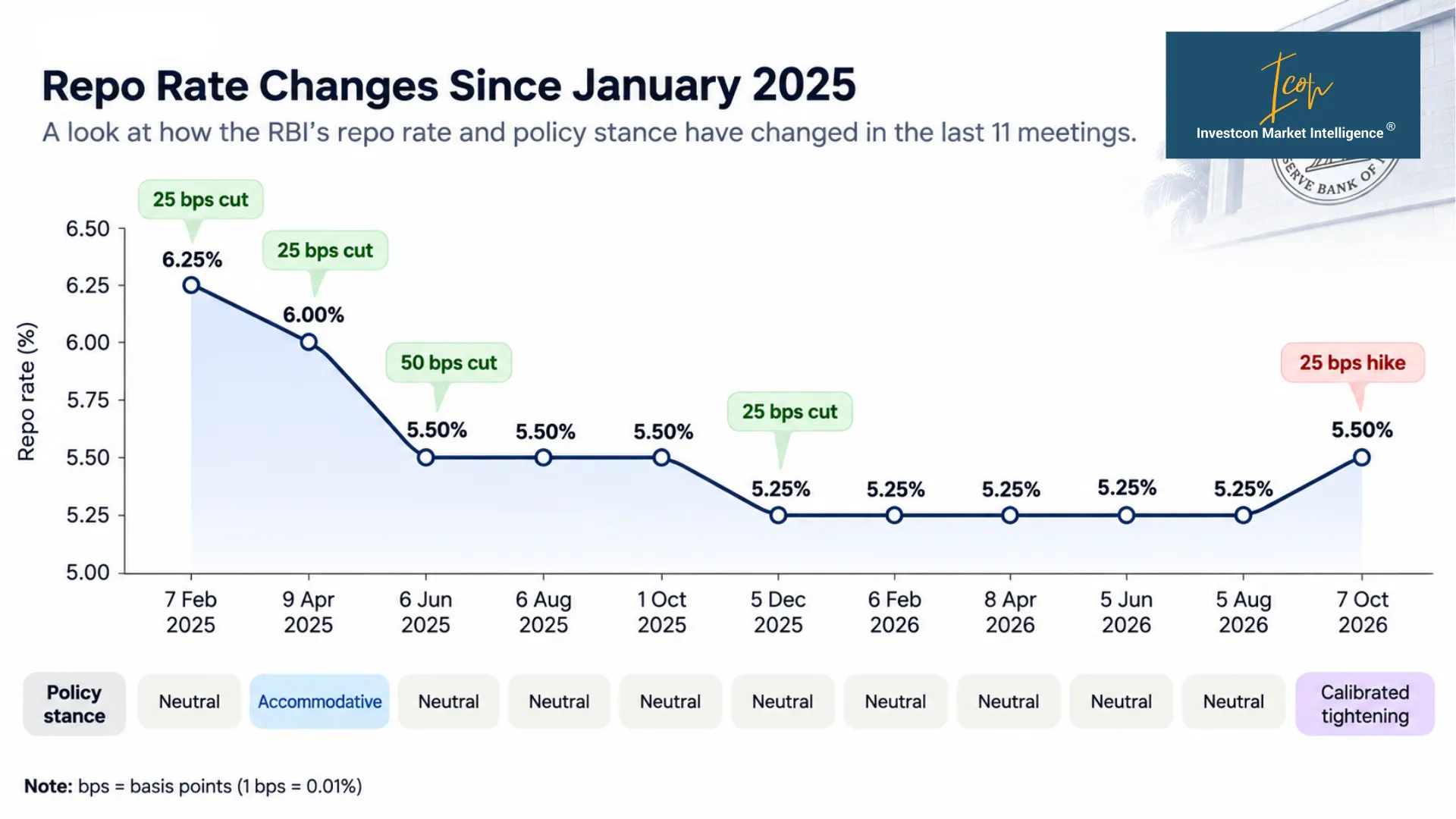
The RBI cut the repo rate by a total of 125 bps in 2025, making loans cheaper. If the RBI raises the repo rate by another 25 bps in December 2026, it will have reversed 40% of the 2025 rate cuts.
The key developments from the last MPC (Oct 2026) are:
- The MPC raised the repo rate from 5.25% to 5.5%. This was the first rate hike in over three years.
- All six MPC members voted for the rate hike. However, two wanted to keep the policy stance neutral.
- The RBI was concerned about rising inflation and the risk of higher production costs making goods & services more expensive.
- The MPC changed its stance from ‘neutral’ to ‘calibrated tightening’. Meaning rate cuts are unlikely for now. The MPC may raise rates further or keep them unchanged based on economic conditions.
RBI Repo Rate December 2026: What Do Economists Expect?
Most Indian and global financial institutions expect the RBI to raise the repo rate by 25 bps in December 2026. However, they have different views on how many more rate hikes could follow.
| Financial institution | Expected December hike | Expected December repo rate | Subsequent rate outlook |
| Goldman Sachs | 25 bps | 5.75% | 6.25% by mid-2027 |
| Morgan Stanley | 25 bps | 5.75% | 6.25% by April 2027 |
| J.P. Morgan | 25 bps | 5.75% | 6.25% under its baseline forecast |
| Barclays | 25 bps | 5.75% | 6.00% by February 2027 |
| Nomura | 25 bps | 5.75% | Potential prolonged pause at 5.75% |
| HSBC | 25 bps | 5.75% | Limited scope for further hikes under its baseline forecast |
| DBS Bank | 25 bps | 5.75% | 6.25% by mid-2027 |
| SBI Research | 25 bps | 5.75% | 5.75%–6.00% |
| Canara Bank | 25 bps | 5.75% | 6.25% during FY2027–28 |
| YES Bank | 25 bps | 5.75% | 6.00% by February 2027 |
| S&P Global Ratings | 25 bps | 5.75% | Another hike likely in early 2027 |
| Crisil Intelligence | 25 bps | 5.75% | Further hike if inflation persists |
| ICRA | 25 bps | 5.75% | Dependent on economic data |
| JM Financial | 25 bps | 5.75% | Not specified |
The difference in forecasts is largely due to how long these institutions expect inflation to remain high. Some expect the RBI to stop raising rates after December, while others expect more hikes in 2027.
Factors Influencing the RBI Monetary Policy December 2026 Decision
While rising inflation supports the need for another rate hike, the RBI also needs to consider how higher interest rates could affect economic growth. Here are the key factors that could influence the December decision.
Rising Retail and Food Inflation
India’s retail inflation crossed the RBI’s upper limit of 6% in October 2026. Poor monsoon rainfall, rising food prices and higher production costs have contributed to this rise.
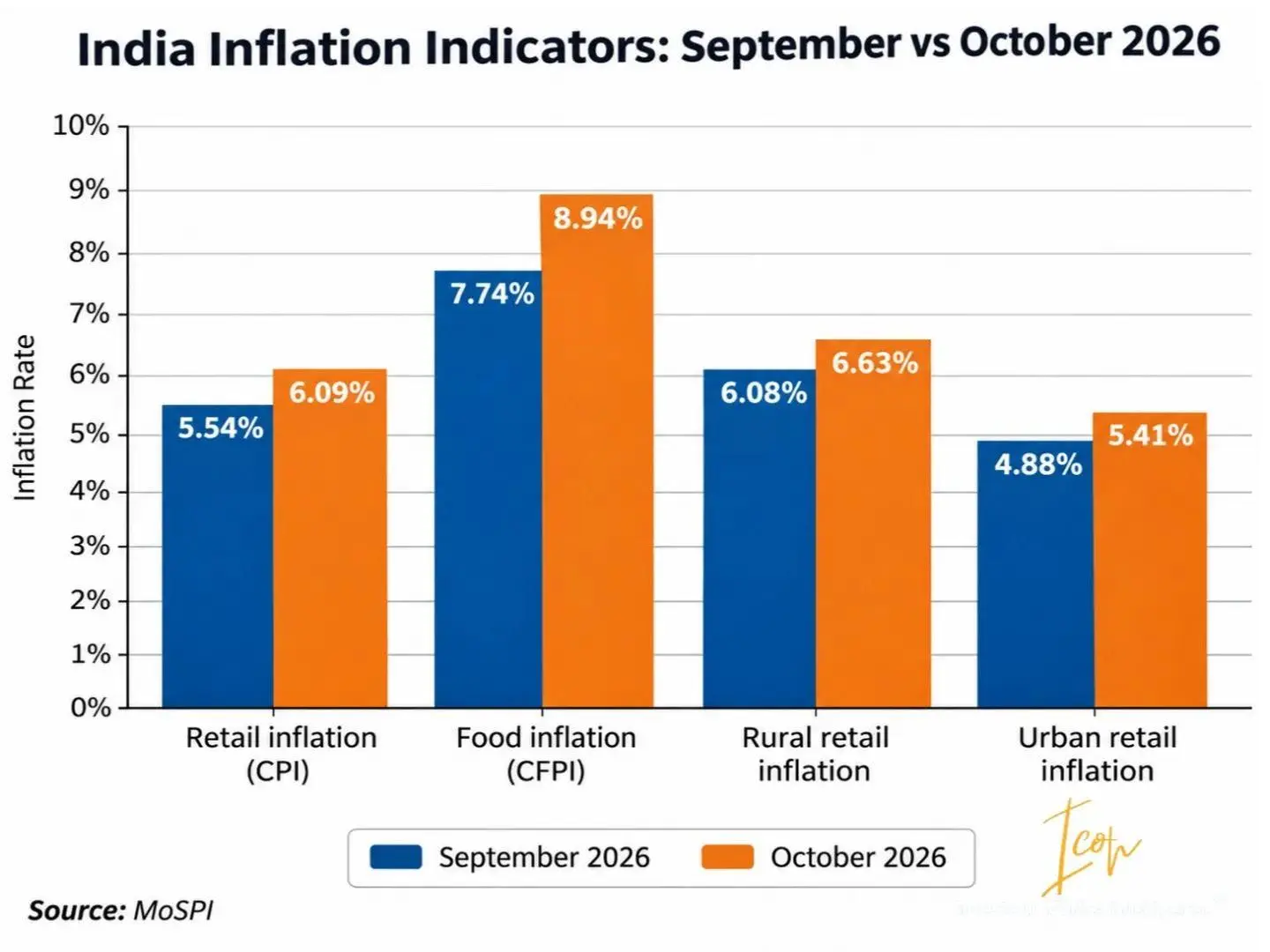
When repo increases, loans become more expensive. This can reduce borrowing & spending, helping control inflation.
However, a rate hike cannot solve problems such as food shortages or poor rainfall. The RBI needs to check whether rising food & production costs are also pushing up the prices of other goods and services.
India’s Economic Growth Outlook
India’s real GDP grew by 7.8% in the first quarter of FY2026–27. As the economy grew faster than expected, the RBI revised its growth estimates in October.
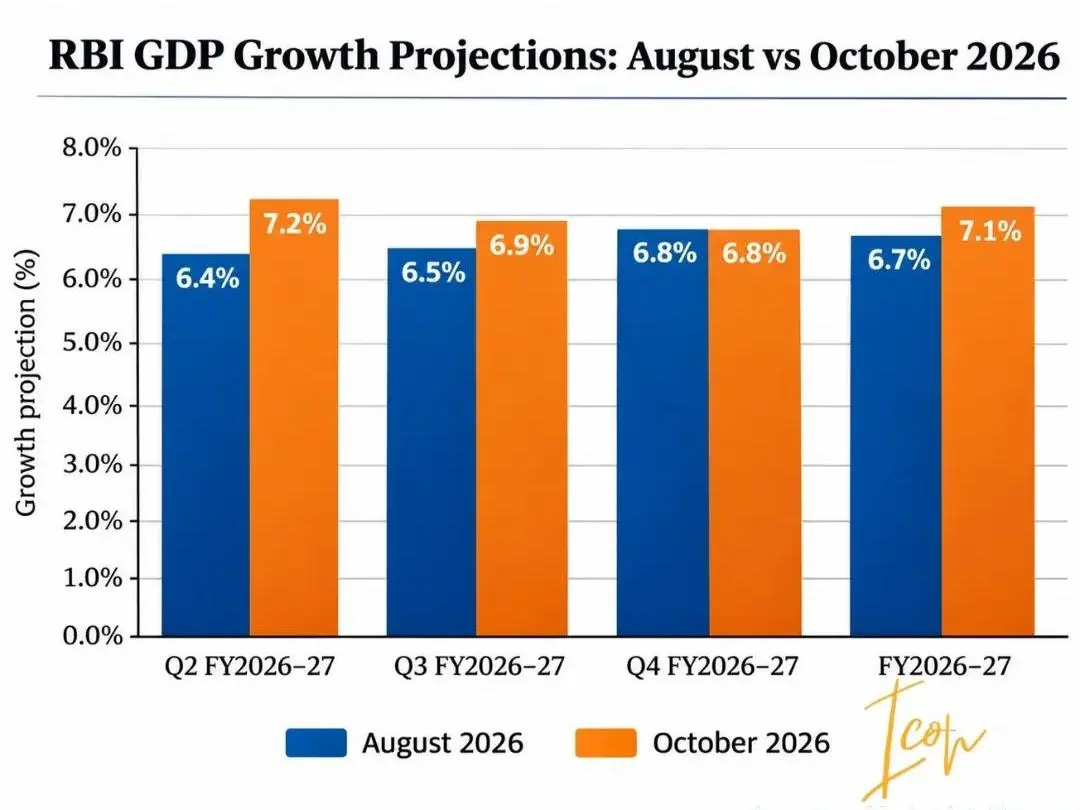
When the economy is growing in a healthy direction, the RBI has more room to raise interest rates to curb inflation. But raising rates too much can reduce consumer spending & business investment, slowing economic growth.
The Q2 GDP data will be released on 30 November 2026. If growth is higher than expected, it could support the case for a larger rate hike. If growth is weaker than expected, the RBI may be more careful about raising rates.
Crude Oil Prices, Rupee and Global Economic Conditions
India imports a large share of its crude oil. When oil prices rise or the rupee weakens against the US dollar, imports become more expensive. This can lead to higher inflation in India.
However, SBI Research noted the following changes in its November assessment:
- Foreign portfolio inflows of around USD 7.68 billion after 4 November.
- A 0.7% rise in the value of the rupee against the US dollar.
- An 11.1% fall in Brent crude oil prices.
These changes could reduce inflation caused by rising import costs. If import costs continue to fall, some inflationary pressure could ease without a large repo rate hike.
Repo Rate Impact on Home Loans and Other Borrowings
An increase in the repo rate can make loans more expensive. However, not all borrowers will be affected in the same way. It depends on the type of loan they have.
| Home loan type | Impact of a repo rate hike |
| Repo-linked floating-rate loan | Interest rate generally increases in line with the repo rate. |
| Marginal Cost of Funds Based Lending Rate (MCLR) linked loan | Interest rate may increase depending on the bank’s cost of funds. |
| Fixed-rate loan | Interest rate remains the same during the fixed-rate period. |
As per RBI rules, banks must revise interest rates on external benchmark-linked loans at least once every three months. So, borrowers may not see an increase in their EMIs immediately after the policy announcement.
How Much Could Your Home Loan EMI Increase?
Suppose you have a home loan with an outstanding balance of ₹50 lakh, a remaining tenure of 20 years and an interest rate of 7.94%.
Here is how a repo rate hike in December could affect your loan repayments:
| Particulars | No rate change | 25 bps hike | 50 bps hike |
| Repo rate | 5.50% | 5.75% | 6.00% |
| Home loan interest rate | 7.94% | 8.19% | 8.44% |
| Monthly EMI | ₹41,635 | ₹42,415 | ₹43,201 |
| Increase in monthly EMI | Nil | ₹780 | ₹1,566 |
| Additional interest over 20 years | Nil | ₹1,87,123 | ₹3,75,836 |
You may also choose to keep your EMI the same and repay the loan over a longer period. In the above example, a 25 bps hike could extend your loan tenure by 12 months, while a 50 bps hike could extend it by 26 months.
Impact on Other Loans
Interest rates on floating-rate personal, vehicle, education and business loans may also increase after a repo rate hike.
While existing fixed-rate loans remain unaffected during their fixed-rate period, banks may charge higher interest rates on new loans.
Conclusion
The December policy announcement could provide greater clarity on how far the RBI intends to reverse its previous rate cuts. While economists broadly anticipate an increase of 25 bps, their forecasts for subsequent meetings remain divided.
The revised inflation projections, GDP growth estimates and monetary policy stance will be equally important in assessing future borrowing costs.
Investcon Market Intelligence will continue to track these developments as the monetary policy cycle evolves. Meanwhile, existing borrowers can review their outstanding loan balance, applicable interest rate benchmark and reset date to understand how further monetary tightening could affect their repayment obligations.
FAQs on RBI monetary policy December 2026
Q: Will RBI cut repo rate again in 2026?
Ans: A repo rate cut is unlikely in December 2026. Most economists expect the RBI to raise the repo rate by 25 bps to 5.75% due to rising inflation.
Q: Will interest rates go down in 2026?
Ans: Interest rates on repo-linked loans are unlikely to fall in December 2026, as economists expect another repo rate hike. However, existing fixed-rate loans will remain unaffected during their fixed-rate period.
Q: When is the next RBI policy meeting in 2026?
Ans: The next RBI policy meeting is scheduled for 2 to 4 December 2026. The RBI is expected to announce its decision on 4 December.
Q: What is the current RBI repo rate in India?
Ans: The current RBI repo rate is 5.50% as of 27 November 2026. The MPC raised it by 25 bps at its October 2026 meeting.
Q: Will home loan EMIs increase in December 2026?
Ans: If the RBI raises the repo rate in December, borrowers with repo-linked home loans may see an increase in their EMIs or loan tenure. The timing depends on when the lender resets the interest rate.

Raksha is a BBA LL.B. graduate specialising in Corporate Law from Delhi, with over six years of experience in financial writing. She specialises in financial markets, investments, mutual funds, taxation and personal finance. With a strong foundation in legal research and a keen eye for detail, she focuses on translating complex financial concepts into accurate, accessible and engaging content.